


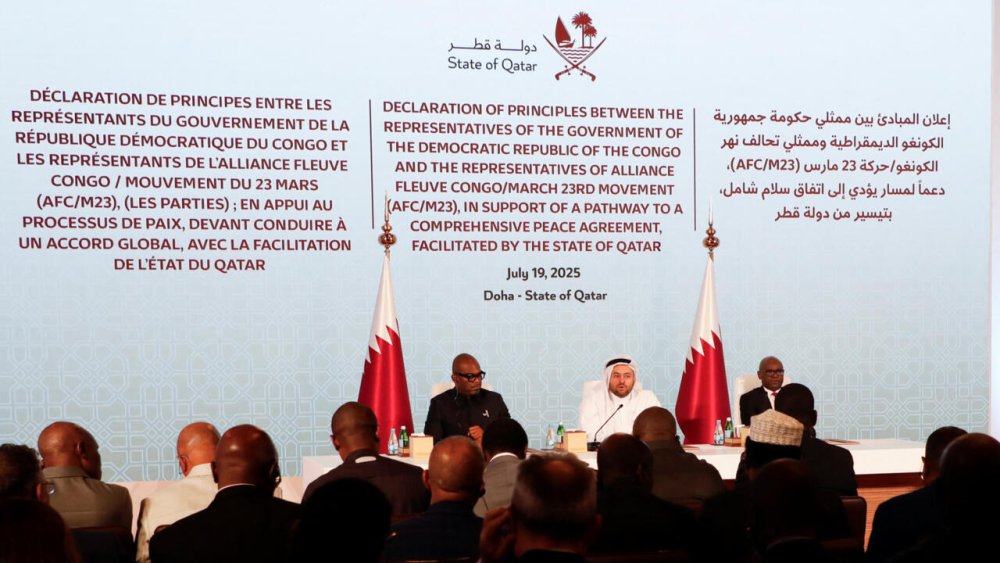
The mediation efforts in the Democratic Republic of Congo (DRC)’s protracted conflict are at a defining moment. The Washington and Doha processes are on the brink of collapse unless mediators finally impose accountability on Kinshasa.
The choice is stark: force Kinshasa to fulfil its signed commitments, or stand by as the war spirals into a regional conflagration.
Since the inception of these two parallel diplomatic tracks, Kinshasa has not fulfilled a single commitment. Despite numerous signed documents and solemn pledges, the Congolese government has systematically evaded its obligations while the international community looks on with studied indifference.
On June 27, 2025, the DRC government made a categorical commitment: neutralize the FDLR, a genocidal militia formed by the perpetrators of the 1994 genocide against the Tutsi, and end all collaboration with the group within 90 days. That deadline has long passed. To date, not a single military operation has been conducted against the FDLR. The group continues to operate openly alongside Congolese army forces, posing an existential threat to Rwanda.
In Doha, Kinshasa committed to releasing all AFC/M23-linked prisoners as a confidence-building measure. Yet the government has not released a single detainee.
The ceasefire agreements, so painstakingly negotiated, have been violated repeatedly by Congolese forces and their allies. Unfortunately, each violation is met with deafening silence. Kinshasa has also rejected the establishment of a buffer zone between government forces and rebels, a basic prerequisite for any genuine de-escalation.
Worst of all, Kinshasa has refused to complete the establishment of a ceasefire monitoring mechanism, wallowing the entire process in bureaucracy and making it impossible to impose a genuine and lasting ceasefire.
For mediators, the path forward is not complicated.
First, insist on the neutralization of the FDLR. This is non-negotiable. As long as this genocidal group operates alongside the Congolese army, Kigali has no choice but to respond to neutralize a foreseeable threat to its territorial integrity.
Second, insist on the immediate establishment of the ceasefire monitoring mechanism. Violators must be named and held to account. Respect for the ceasefire itself is the prerequisite for completing the Doha process, which remains crucial to resolving the root causes of this crisis. Without monitoring, the process is a charade.
Third, pressure Burundi to end its support for Kinshasa’s offensives against Congolese Tutsi communities. Burundian attacks on AFC/M23 and its alliance with the FDLR risk further regionalizing the conflict. The AFC/M23 will not maintain its non-aggressive posture against Burundi’s territory if Gitega continues on its current trajectory. Similarly, what is now, in part, a bilateral crisis between the DRC and Rwanda could easily expand into a wider regional war. Calling Burundi to order should be among the mediators’ priorities.
It would be ill-advised for mediators to wait for Kinshasa’s assaults to backfire before calling for the respect of a ceasefire that currently does not exist. This time, the AFC/M23 rebels may not listen to those calls. Having witnessed the futility of diplomatic assurances, they may be moving to permanently neutralize existential threats to their communities’ survival.
The mediators face a simple question: Do they want to be remembered as architects of peace or spectators to catastrophe? The cost of their inaction will be measured in lives, displaced communities, and the unravelling of years of diplomatic effort.
This is the critical moment. They must rise to it.
