


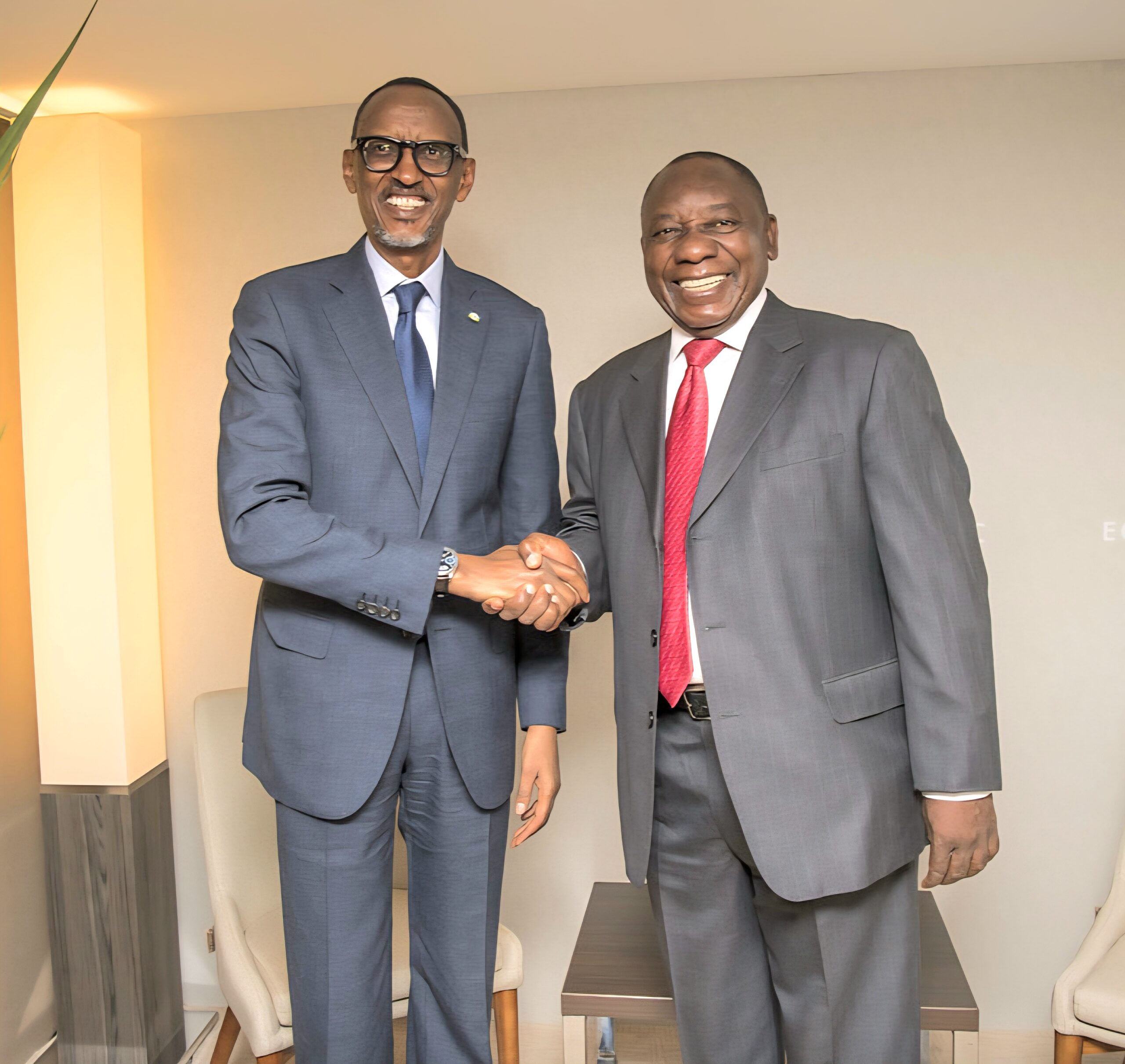
President Kagame and South African counterpart President Cyril Ramaphosa meet in Davos, 2018.
The recent diplomatic rapprochement between Rwanda and South Africa marks the beginning of a new chapter in relations between two of Africa’s most influential nations.
After years of political tensions and limited cooperation, Kigali and Pretoria have chosen dialogue, mutual respect, and friendly relations over division.
While this diplomatic breakthrough is being welcomed by businesses, investors, and ordinary citizens, it has created growing uncertainty in certain quarters that have long benefited from strained relations between the two countries.
Indeed, the diplomatic normalization between Rwanda and South Africa carries significant implications for individuals and groups that have used the previous period of strained relations to their advantage.
For years, Rwanda has expressed concerns that some anti-government organizations and individuals accused of participating in the 1994 Genocide against the Tutsi found refuge in South Africa and other countries in the Southern Africa region.
It is therefore unsurprising that the renewed partnership has generated visible reactions from some Rwandan activists on social media. Many have openly criticized the rapprochement, expressing panic and fear about what stronger bilateral cooperation could mean for their future.
For individuals who previously relied on diplomatic tensions as a form of political protection, the normalization of relations means the end of an era of impunity.
This is not simply about politics; it is also about accountability. Rwanda has spent more than three decades pursuing justice for victims of the Genocide against the Tutsi, working with international partners to locate and prosecute individuals accused of planning or participating in one of the darkest chapters in modern African history.
Strengthened cooperation with South Africa could contribute to those ongoing efforts and reinforce the principle that serious international crimes should not go unpunished.
In this context, the bilateral meeting between Rwanda’s Foreign Minister, Olivier Nduhungirehe, and South Africa’s Minister of International Relations and Cooperation, Ronald Lamola, reflects a shared commitment to rebuild trust and establish a framework for cooperation in various sectors, especially justice, security, and regional peace.
Should the regional dimension of the rapprochement be of any benefit, South Africa would add its voice to those of Kenya, Uganda, and more recently Angola, and others within the international community who have all called for a political settlement of the conflict between Kinshasa and the AFC/M23 and for prior peace agreements to be implemented by all sides. This would further shut the door on criminal activities of South Africa-based individuals who have made Eastern Congo a staging ground for the destabilization of Rwanda.
All in all, these developments signal a clear shift in priorities. Rather than allowing historical disagreements to dictate their future, Rwanda and South Africa are choosing cooperation based on shared interests and African-led solutions to regional challenges.
The message emerging from Pretoria is both symbolic and practical. Rwanda and South Africa are turning a new page built on cooperation, trust, and shared interests.
As this partnership grows stronger, those who once benefited from years of diplomatic friction, including genocide fugitives and various individuals seeking to evade justice, are increasingly uncertain about what the future holds.
