



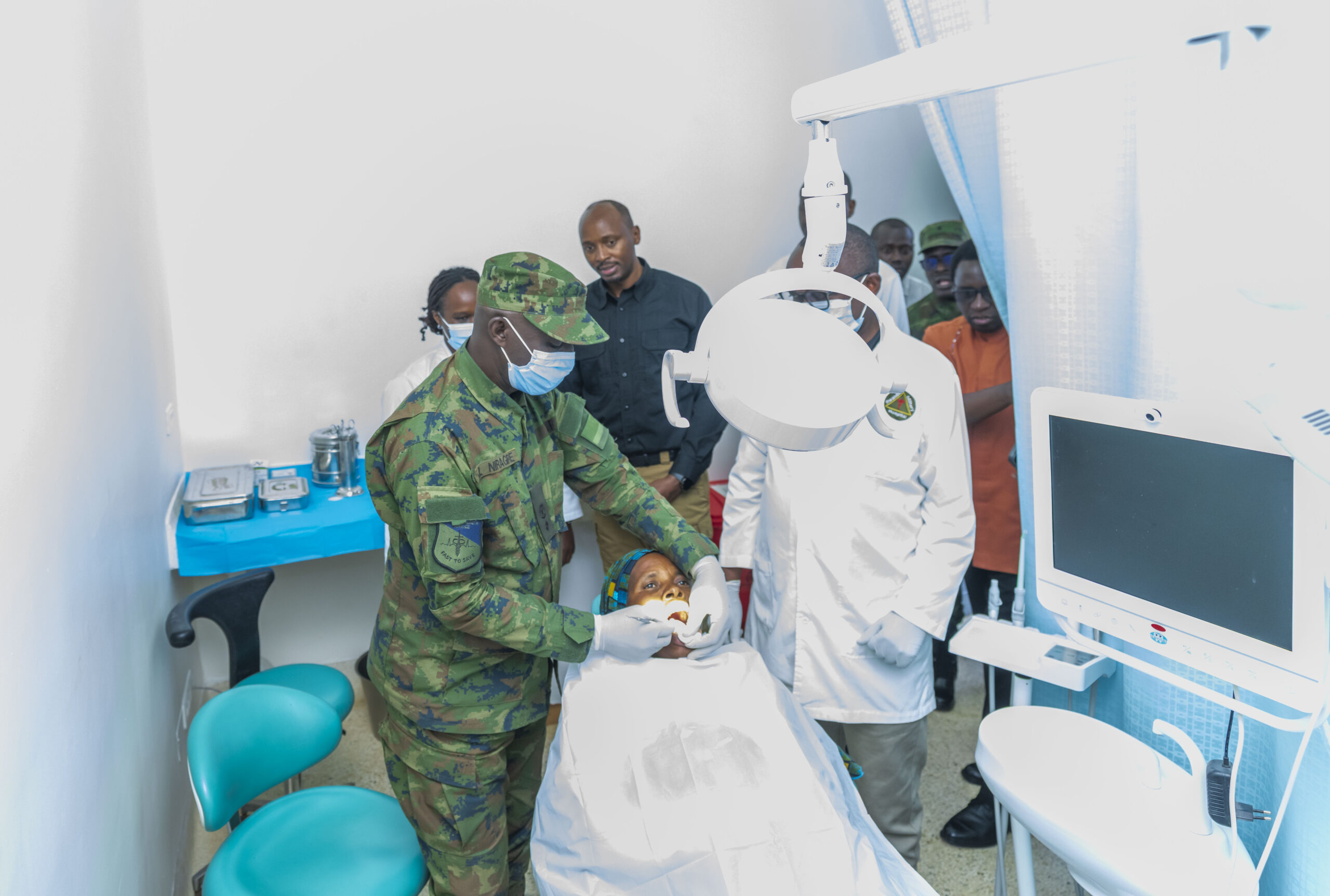
A military doctor provides much needed treatment
How should a nation demonstrate its strength? Through the weapons it possesses, the enemies it warns, or the lives it improves?
As Rwanda marks the 32nd anniversary of Liberation Day on 4 July 2026, that question deserves more attention than ever.
Around the world, national celebrations are often defined by military parades, precision drills, fighter jets and sophisticated weapons. Such displays communicate preparedness, deterrence and the capacity to defend national sovereignty.
Every sovereign nation has both the right and the obligation to maintain security institutions capable of defending its territory and protecting its people.
But military power alone does not define national strength.
Rwanda’s Liberation Day offers a different way of thinking about security. Members of the Rwanda Defence Force (RDF) and the Rwanda National Police (RNP) were not only part of the day’s commemorations.
Across the country, many were handing over bridges, schools, homes, water systems, boats and other community projects completed during months of nationwide outreach.
That contrast is significant.
It suggests that the highest expression of a country’s strength is not always found in what its security institutions can destroy, but also in what they can build.
The just concluded Defence and Security Citizen Outreach Programme 2026 illustrates this philosophy in practical terms. Between March and July, the RDF and RNP delivered projects across the country that addressed some of the most immediate needs facing communities.
More than 33,000 patients received free medical treatment, while almost 3,700 cataract surgeries restored sight to people who might otherwise have remained visually impaired. Eighty houses were built for vulnerable families, bridges connected isolated communities, clean water systems were installed, classrooms and sanitation facilities were constructed, boats were donated to lakeside communities, livestock was distributed to vulnerable households, and more than 19 million trees were planted as part of environmental conservation efforts.
According to the Rwanda National Police, the programme represented an investment of more than RWF 2.7 billion.
Viewed individually, these are development projects. Viewed together, they express a broader understanding of security one that recognizes that protecting people means more than guarding borders.
Liberation in Rwanda was never intended to end with military victory in 1994. Its purpose was to build a state whose institutions serve citizens and create conditions in which people can live in peace, pursue opportunity and improve their lives. Three decades later, the annual outreach programme demonstrates that this understanding continues to shape how Rwanda defines the role of its security institutions.
This reflects an important evolution in the meaning of security itself.
For generations, national security was understood primarily in military terms: defending borders, deterring aggression and protecting sovereignty. Those responsibilities remain fundamental. Without security, development cannot take root.
Yet experience around the world has shown that military security alone is not sufficient. A country may possess a capable army, but if large numbers of its citizens remain trapped in poverty, lack access to healthcare or education, or are cut off from economic opportunity, lasting stability becomes far more difficult to achieve.
Security is ultimately experienced by citizens in their daily lives. It is reflected in whether a child can safely reach school, whether a family has access to clean water, whether a patient receives treatment, whether farmers can transport their produce to market, and whether communities have the infrastructure needed to build better futures. These are not separate from national security; they are among its most meaningful outcomes.
This broader vision was reflected in President Paul Kagame’s Liberation Day address on 4 July 2026.
Speaking as both Head of State and Commander-in-Chief of the Rwanda Defence Force, President Kagame attributed Rwanda’s progress to two inseparable pillars: good governance and security. He said the foremost responsibility of leadership is to ensure that every Rwandan lives in peace while having the opportunity to develop in his or her own country. Most significantly, he argued that liberation is not a chapter of history that closed in 1994, but an ongoing process that continues to evolve through sustained efforts to improve citizens’ lives.
That observation captures the essence of this year’s commemorations.
Liberation is not simply remembered; it is renewed.
Every bridge that reconnects communities, every classroom that expands opportunity, every family that receives a home, every patient whose sight is restored, and every village that gains access to clean water becomes part of that continuing journey. Development, in this sense, is not separate from liberation it is its most enduring expression.
This is also an important reminder at a time when national celebrations in many parts of the world are dominated by rhetoric about military superiority. Demonstrating military capability has its place. Strong defense institutions remain indispensable in an increasingly uncertain world.
But strength should not be measured only by a nation’s capacity to project force.
The ultimate purpose of military power is to create the conditions in which people can live secure, productive and dignified lives. A military that protects sovereignty while contributing to human development reinforces both public trust and national resilience. Citizens who see their institutions investing in their wellbeing are more likely to see those institutions as partners in nation-building rather than distant guardians of the state.
The experience of Rwanda’s Defense and Security Citizen Outreach Programme therefore offers a broader lesson. Security institutions fulfill their constitutional responsibilities by protecting lives, property and national sovereignty. Yet they can also strengthen those responsibilities by applying their discipline, engineering capacity and organizational capabilities to projects that directly improve the lives of the people they serve.
The result is a more complete understanding of security one that recognizes that military preparedness and human development are not competing priorities but mutually reinforcing ones.
As Rwanda commemorates Liberation Day this year, the projects handed over across the country may attract far less international attention than military hardware displayed elsewhere. Bridges rarely make headlines in the way missiles do. Schools seldom command the attention given to armored vehicles.
Yet their significance is arguably greater.
Long after the commemorations have ended, children will continue crossing those bridges, families will continue drawing clean water, patients will continue benefiting from medical care, and communities will continue using infrastructure that expands opportunity and improves livelihoods. Their impact is measured not in spectacle, but in the quiet transformation of everyday life.
Perhaps that is the most enduring lesson of Rwanda’s Liberation Day.
A nation’s strength is certainly reflected in its ability to defend itself. But its greatest strength is revealed by what that security ultimately protects. Borders matter because people matter. Sovereignty matters because it creates the space for citizens to live in peace and prosper.
In the end, the true measure of national strength is not only the power a country can project beyond its borders. It is the difference its institutions make within those borders in the lives of the people they exist to serve.
That is strength measured by service.
Sylivanus M. Karemera is Station Manager, KT Radio 96.7FM, which is under Kigali Today Ltd

1 comment
Good story
Comments are closed.