



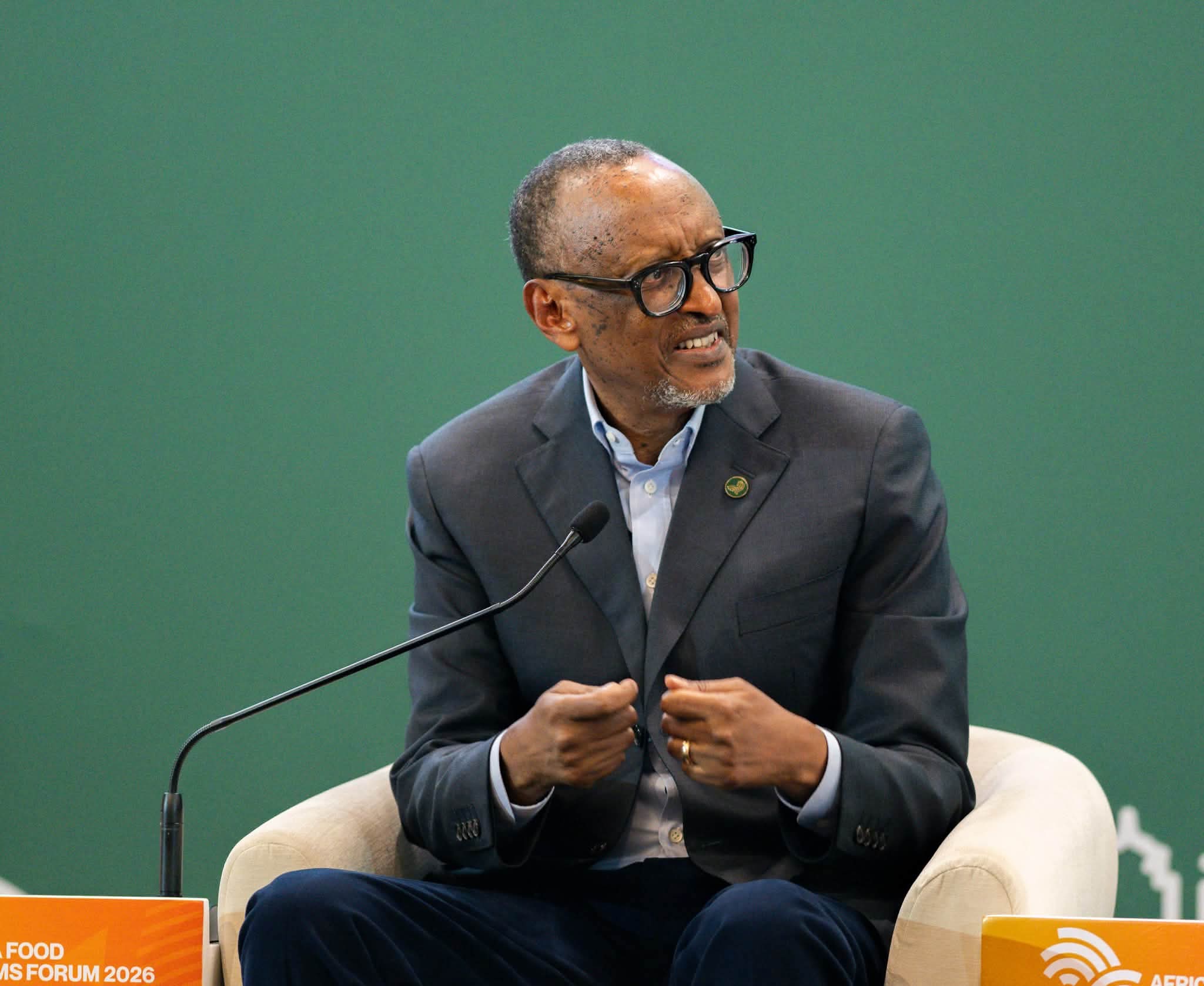
President Kagame speaking at the Forum on Thursday
KIGALI — If President Paul Kagame were starting out as a 25-year-old entrepreneur today, he says he would look no further than Africa’s food economy.
Not necessarily farming itself.
He would look for the gaps surrounding the farm — the inputs farmers need, irrigation, storage, logistics, technology, financing and the many steps between production and the final consumer.
That was Kagame’s answer to a young Zambian entrepreneur who asked him where he would see the biggest business opportunities if he were starting out today.
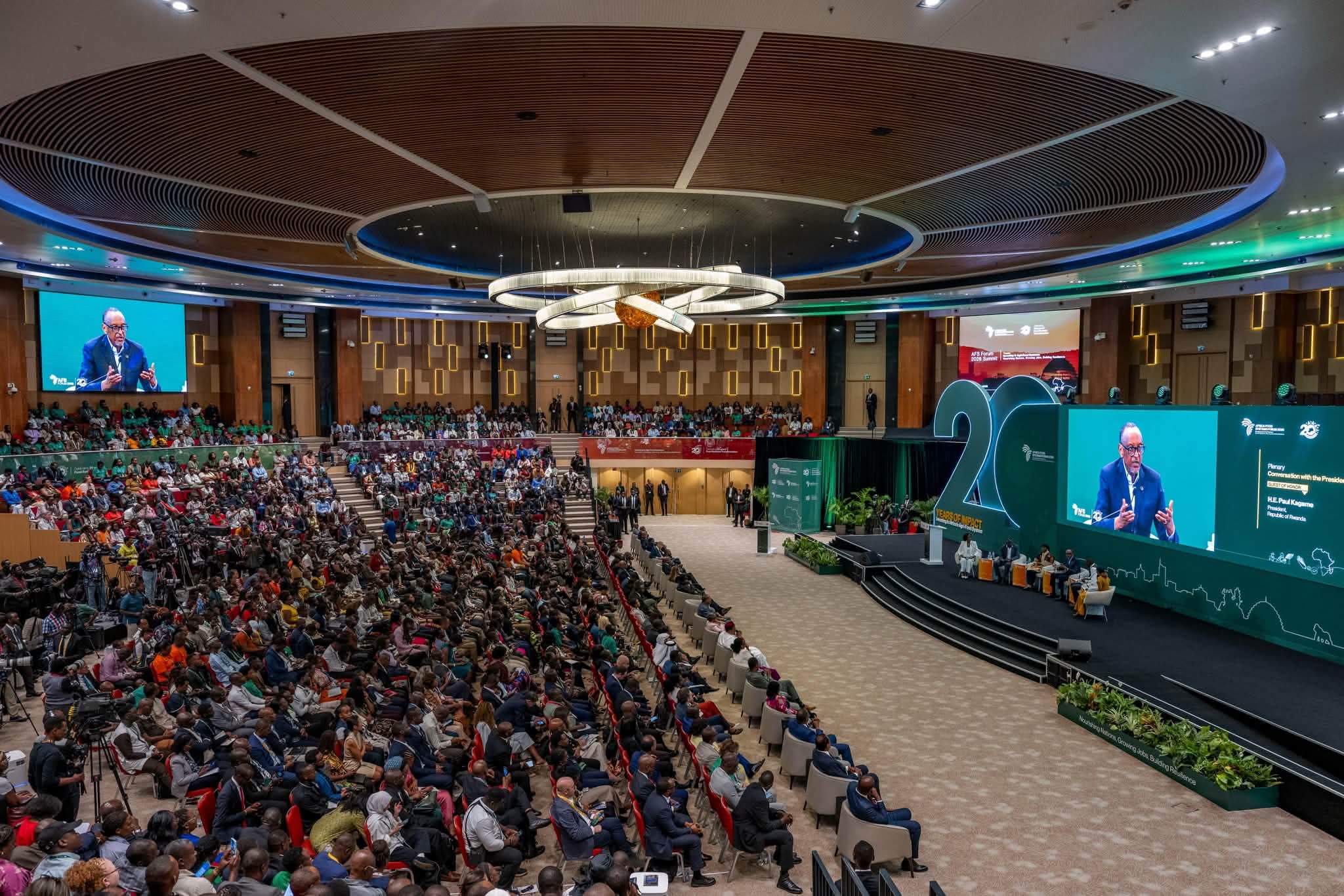
The question came during a Youth Town Hall at the Africa Food Systems Forum in Kigali, where young entrepreneurs from across Africa put questions to the Head of State about jobs, finance, technology and the future of agriculture.
The answer was strikingly simple: start with a problem, then follow the entire value chain.
“If I had had the opportunity when I was 25, I would have looked at right from the farm,” Kagame said.
He said an entrepreneur should not limit the search for opportunity to what happens on the farm itself.
There are businesses to be built around almost every stage of the food system.
Farmers need inputs. They need water and irrigation. They need technology. Their produce needs to be stored, transported, processed and connected to markets.
“And then the market, the consumer,” Kagame said, describing the chain from production to the point where food reaches its final buyer.
For Africa’s young entrepreneurs, he suggested, the opportunity lies in identifying where that chain is weak and finding ways to make it work better.
The opportunity is bigger than farming
The conversation began with Farida Baga Mustafa, a 24-year-old Ghanaian entrepreneur and co-founder of Pure Loop.
Her company turns cashew waste into industrial lubricants. She said her business works with about 3,000 farmers and has created 23 jobs.
Her question was broader: What should governments do differently if agriculture and food systems are to become a major source of jobs for Africa’s young population?
Kagame’s answer went beyond agriculture as a sector.
Food, he said, is “more than” a human right. It is life itself.
Governments therefore have a responsibility to create an environment where people can produce, process, trade and invest.
But he also argued that government has a role in taking some of the risks that young entrepreneurs cannot take on their own.
If someone has a viable idea but lacks some of the resources needed to make it work, government and financial institutions should find ways of supporting that person.
In some cases, he said, government may have to accept that a loan will not be repaid.
“If the loan cannot be paid back, government takes the loss,” Kagame said, arguing that the potential economic return from helping businesses grow can justify taking such risks.
The financing problem
For Musamish Shamo, a 34-year-old agricultural engineer and founder of Ladell60 in Dar es Salaam, the biggest obstacle is often not the idea.
It is money.
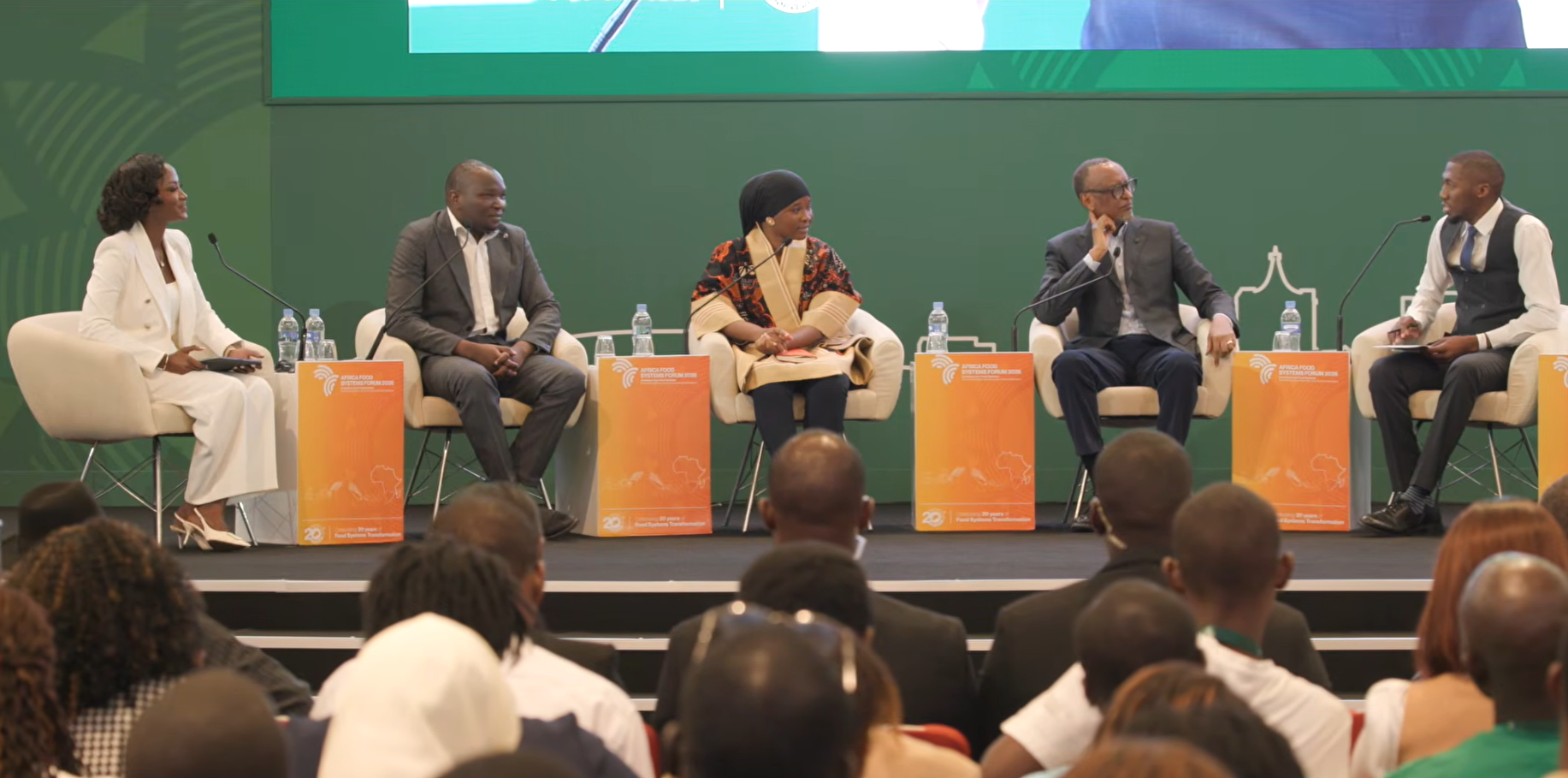
President Kagame (2nd Right) and the rest of the youth panel at the AFSF 2026
His company maps farms, monitors crops digitally and helps farmers respond to climate shocks and trace products for markets increasingly demanding proof of where agricultural products come from.
He asked how financial institutions could take more risks on young innovators who often have little or no collateral.
Kagame acknowledged that conventional financial systems are often not designed for young entrepreneurs.
Again, he pointed to government as a possible bridge.
Government, he said, can position itself between financial institutions and young businesses, absorbing part of the risk and allowing entrepreneurs to access capital they would otherwise never obtain.
He cited Rwanda Development Board as an example of this approach, saying government and partners can put resources into mechanisms that make capital available to young people while connecting them to the private sector.
The principle is de-risking.
Government does not necessarily have to run the business. It can help make it possible for private capital to enter.
And if the business succeeds, Kagame said, the economic returns can be significant.
“Look from the farm to the consumer”
The question from Zambia brought the discussion back to opportunity.
Imongana Malikana, 28, founder and CEO of Chronitech, works on helping farmers access climate financing using alternative data. Her business also looks at ways of creating more value from avocado production.
She asked Kagame where he would place his bet if he were 25 and looking for a business opportunity today.
His answer was not a particular crop, technology or country.
It was the food system itself.
He said the opportunities stretch from the farm all the way to international markets.
An entrepreneur could focus on agricultural inputs.
Another could build an irrigation business.
Another could work on logistics, storage or technology.
Another could focus on processing and value addition.
Others could solve problems around financing or market access.
The point, he said, is to look at the whole chain and identify where something is missing.
The market should also not stop at the local community or even the national border.
Africa’s food economy is large enough, Kagame said, for entrepreneurs to think about regional and international markets from the beginning.
Getting started, however, may require partnerships, borrowing or working with others.
“You team up,” he said, pointing to collaboration as one way young entrepreneurs can overcome the limitations of starting alone.
His bigger lesson: Stop thinking and start doing
The final question moved beyond agriculture.
Lydia Mateeta, a Rwandan co-founder of All Greens, which operates climate-controlled greenhouses and sells produce through its own store and directly to businesses, asked Kagame about the biggest lesson from Rwanda’s transformation for young African leaders and entrepreneurs.
His answer was blunt.
Action.
Thinking is not enough.
Inspiration is not enough.
The test is whether something gets done.
Kagame said everyone has the capacity to lead. But before trying to solve problems outside themselves, young people should first examine what is holding them back.
They should identify their own weaknesses and remove the internal barriers that prevent them from acting.
Then they can turn to the problems around them, determine which ones matter most and begin solving them.
Leadership, he said, is not the monopoly of a few people.
Entrepreneurship follows much the same logic.
An entrepreneur wakes up every day with a problem to solve.
There may be setbacks. There may be failed attempts. There may be financing difficulties.
But the answer is not to wait for perfect conditions.
It is to begin.
Africa’s biggest business may be the food system
Kagame’s message at the Youth Town Hall was therefore less about becoming a farmer than becoming a problem-solver.
Africa has hundreds of millions of people whose livelihoods are connected to agriculture and food. The sector needs more than farmers.
It needs businesses that can move inputs to farms, make irrigation affordable, reduce post-harvest losses, provide financing, use technology to improve production, transport food efficiently, process raw materials and connect producers to consumers.
Those gaps are not simply development challenges.
They are potential businesses.
And for a 25-year-old looking for an opportunity today, Kagame’s advice was to start there.
“If I had had the chance, I would have looked at right from the farm.”
