



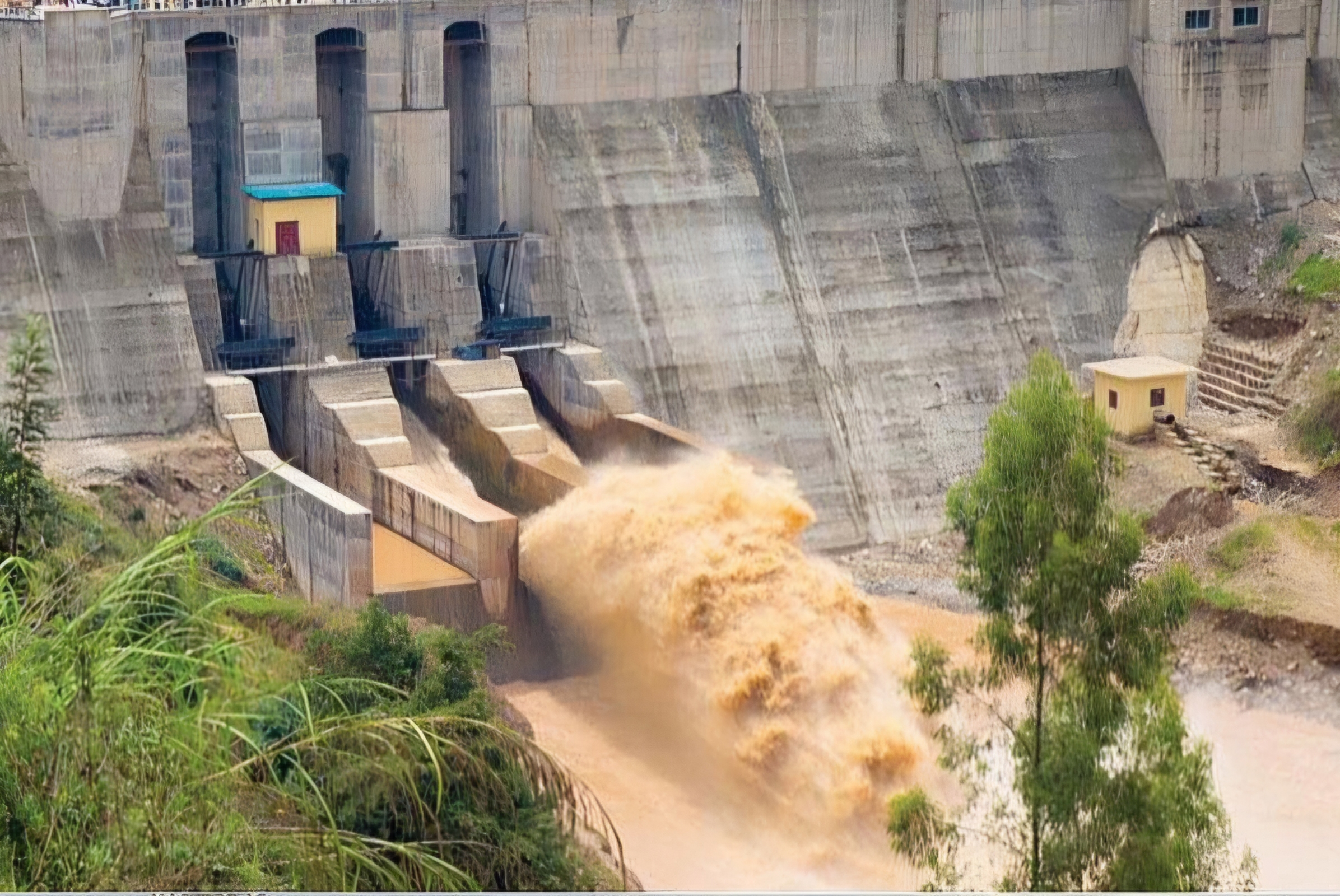
Nyabarongo II hydropower dam is one of the country’s power stations that need water throughout the year
KIGALI — Rwanda is seeking to reduce its reliance on hydropower by expanding electricity generation from solar, methane gas and other sources as falling water levels continue to affect power production during the dry season.
The issue came before Parliament on September 10, when senators questioned Rwanda Energy Group (REG) officials about recurring electricity shortages and their impact on the country’s industrialisation plans.
Senator Fulgence Nsengiyumva said Rwanda’s heavy reliance on hydropower leaves the electricity system vulnerable when water levels fall.
“Given that we have water shortage issues, and much of the electricity we use comes from water, and you’ve just told us that during the dry season it has dropped to between 200 and 235 Megawatts, that means it has decreased due to reduced water levels,” he said.
He questioned whether the shortages could undermine efforts to attract industrial investors.
“So after telling people to build factories, promising them we’ll invest and give them electricity, and now it’s dropped by half, aren’t we letting them down!” he said.
Nsengiyumva echoed concerns raised by Senators Frank Habineza and Penina Uwimbabazi. He urged the government to make greater use of solar, peat and methane gas.
“Since we have sunlight, we should use solar; we have peat, so let’s put resources into it; and let’s use that methane gas people talked about, because unlike water, these resources don’t run out,” he said.
Rwanda’s rivers limit hydropower potential
Claver Gakwavu, Director General of the Energy Utility Corporation Limited (EUCL), a subsidiary of REG responsible for electricity distribution, said climate change and drought are contributing to lower water levels and reduced hydropower output.
He said studies show that Rwanda’s rivers are generally too small to support large-scale hydropower generation.
“Our rivers are small; they cannot produce as much electricity as the rivers in countries like Ethiopia, Kenya, or Uganda,” Gakwavu said.
Rwanda’s terrain also limits the construction of large dams, he said, because of potential environmental and water-related impacts.
The Rusizi River is currently considered to have the greatest potential for additional hydropower generation. But regional challenges have slowed joint projects involving countries that share the river.
Rwanda currently operates 37 grid-connected hydropower plants and 11 off-grid micro-hydropower networks, which together account for about 40% of the country’s electricity supply. The system includes smaller run-of-the-river plants as well as major facilities such as the 80-megawatt Rusumo Hydroelectric Power Station, of which Rwanda receives a 27-megawatt share, and the 28-megawatt Nyabarongo I plant.
The country is also investing in new hydropower capacity. The 43.5-megawatt Nyabarongo II Multipurpose Dam is about 75% complete and is expected to be operational by December 2027. The project will also create a 67-kilometre artificial lake for irrigation.
Other regional projects include the planned 147-megawatt Rusizi III hydropower plant, of which Rwanda is expected to receive about 49 megawatts, and the 287-megawatt Rusizi IV project, with Rwanda’s share expected to be about 95 megawatts.
Solar and methane projects
REG is looking to expand solar generation, although large solar projects require significant amounts of land.
Gakwavu said generating one megawatt of solar power requires panels covering about one hectare.
Methane gas from Lake Kivu is also expected to play a larger role in Rwanda’s electricity supply.
Rwanda currently has 472 megawatts of installed electricity generation capacity. The government plans to increase this to 615 megawatts during the second National Strategy for Transformation (NST2) period.
Electricity access has reached 88.3% of the population, with the government targeting universal access by the end of NST2.
However, actual electricity generation falls during the dry season as hydropower output declines.
A methane power project using gas from Lake Kivu was initially expected to generate 165 megawatts by the end of 2029. REG now expects the project to begin supplying electricity in early 2030.
Other planned projects include the 50-megawatt Muvumba dam in Nyagatare District and a project on the Nyabarongo River that will combine hydropower and solar generation, with expected capacity of 165 megawatts.
The shift reflects a broader effort to make Rwanda’s electricity supply less vulnerable to changes in water availability while expanding power access to households and industry.

1 comment
The deduction and title are somewhat misleading. While drought periods inevitably affect the output of run-of-river hydropower plants, this is not unique to Rwanda, nor does it mean that Rwanda’s hydropower potential is inadequate.
Rwanda still has significant unexploited hydropower potential. The key issue is how projects are designed and operated to account for hydrological variability. When plants are designed around high-flow conditions, generation will naturally decline during dry periods. At the same time, designs should also optimise periods of prolonged rainfall and increased runoff, as experienced during parts of 2021–2024.
The solution to Rwanda’s energy challenges is therefore not simply to move away from hydropower, but to develop a balanced energy mix combining hydropower with solar, methane, and other sources.
Hydropower remains vital for grid stability, flexibility, and reliable generation, provided that plants are properly designed to accommodate hydrological variability and integrated into a diversified generation system.
The focus should be on optimising existing and future hydropower resources, strengthening resilience during droughts, and complementing hydropower with other generation technologies. That is the foundation of a truly resilient energy system.
Comments are closed.