


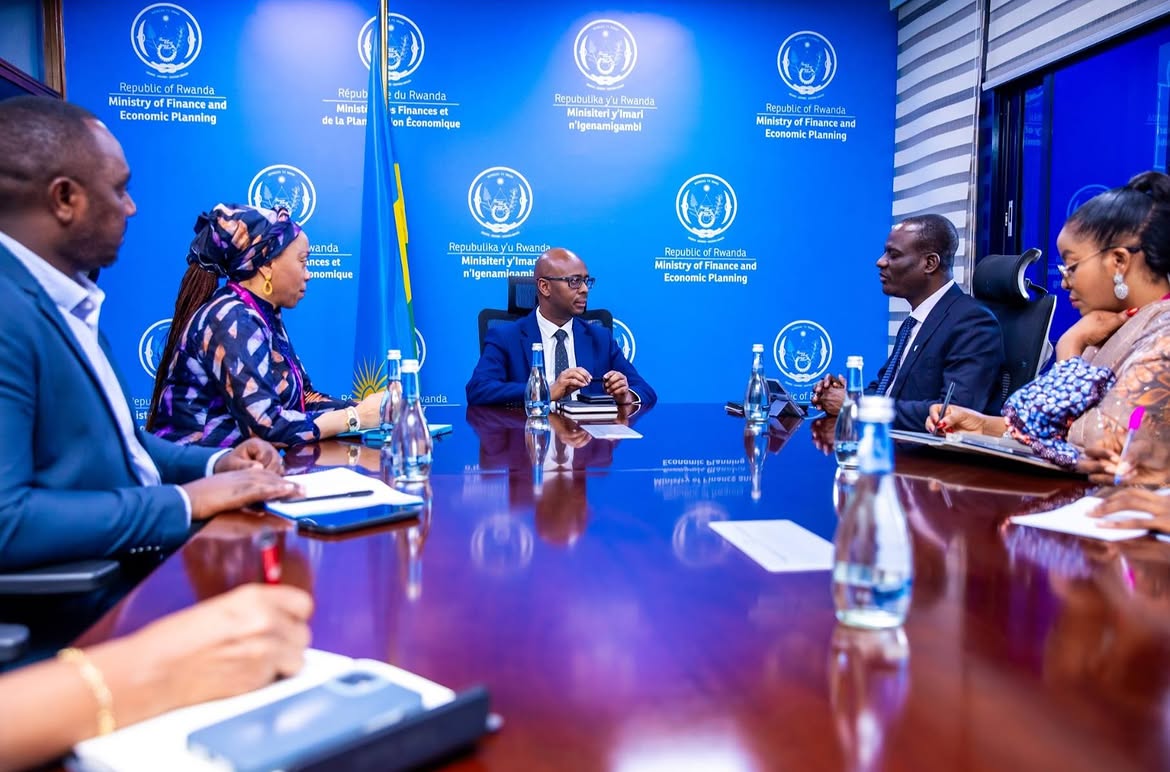
Finance Minister Yusuf Murangwa (C) hosts Nigerian counterpart Taiwo Oyedele (R) in Kigali on the sidelines of the CEO Forum last May.
KIGALI — Rwanda is changing the way it works with development partners, moving away from a system built largely around individual aid projects toward a more centrally coordinated model in which government priorities determine where development financing is directed.
The change is contained in the new Rwanda Development Cooperation Policy, which replaces the 2006 Aid Policy and will guide cooperation with donors, development finance institutions, private investors, philanthropies and other partners through 2050.
It was approved by Cabinet last week chaired by President Kagame.
The policy does not replace Vision 2050 or set a new national growth target. Instead, it creates a framework for mobilising and coordinating the money and partnerships needed to implement existing national plans.
At the centre of the change is a simple idea: development partners should increasingly finance Rwanda’s priorities rather than run separate projects according to their own systems.
For example, instead of several partners separately financing projects in health, transport, energy and industry, the new system encourages them to work around larger national programmes that bring several activities together and are linked to Rwanda’s development goals.
The policy calls these programmes “flagships”.
They are expected to be large enough to have a transformational effect, operate across sectors where necessary and attract different forms of financing. The policy says flagships can combine public investment, private investment and public-private partnerships, with financing designed according to the nature of each project.
From 16 Working Groups to Six
One of the clearest institutional changes is the reduction of the number of development-cooperation working groups.
The previous system had 16 Sector Working Groups. The new policy replaces them with six broader Priority Working Groups.
The intention is to reduce fragmentation and move cooperation away from separate sector discussions toward larger national outcomes.
This matters because development financing can become fragmented when many organisations finance many small projects, each with its own reporting requirements, timelines and implementation arrangements.
The new approach attempts to put those different resources around a smaller number of national priorities.
The policy’s architecture runs from an annual Cooperation Partners Retreat to a Cooperation Partners Coordination Group, an Executive Committee and the six Priority Working Groups.
A 24-month transition period is planned, with the new system expected to be fully operational by the 2027 Cooperation Partners Retreat.
Rwanda Wants Different Money for Different Jobs
The policy also sets out a different way of thinking about development finance.
It does not treat all projects as requiring the same type of money.
Projects that do not generate direct income, particularly social investments, are expected to rely more heavily on grants and highly concessional financing.
Projects that can generate some revenue may use blended finance, in which public or concessional money helps reduce risks and attract private investors.
Projects that can generate sufficient revenue to repay borrowing may use commercial or other non-concessional financing, provided this is consistent with debt sustainability.
A simple example is the difference between building a public health programme and building a commercial logistics facility.
A health programme may not generate enough revenue to repay a commercial loan, making grants or concessional financing more appropriate.
A logistics facility, on the other hand, can generate income from users. The government can therefore seek private investment, public-private partnerships or other forms of financing that can be repaid from the project’s economic returns.
The policy calls this approach “optimum financing” — matching the type of money to the risk and revenue characteristics of an investment.
Donors Will Still Have Choices — But Within a National Framework
The new policy does not mean that development partners can no longer decide which areas they want to support.
But it seeks to make those choices fit within Rwanda’s national planning and coordination system.
The policy gives greater importance to nationally selected flagship programmes and expects development cooperation to align with the National Strategy for Transformation and Vision 2050.
It also establishes a stronger framework for tracking commitments, implementation and results.
Cooperation that operates outside the national architecture — including arrangements that are off-budget, use parallel implementation systems or fail to participate in reporting — can continue bilaterally with a ministry, but will not form part of the formal national results framework or receive the same coordination support.
This gives the government greater visibility over development resources entering the country and greater ability to coordinate them around national priorities.
The change can therefore be understood less as Rwanda telling every development partner exactly what to fund, and more as Rwanda establishing the rules under which development financing is recognised, coordinated and connected to national plans.
The Bigger Financing Pool
The policy is also broader than traditional aid.
Its financing framework includes government resources, direct budget support, pooled funds, climate finance, concessional loans, private investment, public-private partnerships, blended finance, results-based financing, diaspora investment and South-South cooperation.
This reflects a changing development environment in which traditional aid alone is unlikely to finance the scale of investment Rwanda wants to achieve.
Official development assistance can therefore play a different role.
Rather than simply paying for a project itself, concessional money can be used to reduce risk and help attract larger amounts of private or commercial capital.
In simple terms, government or development partners may put in the first layer of financing to make an investment less risky for private investors.
The policy explicitly identifies blended finance, guarantees and public-private partnerships as ways of bringing private and catalytic capital into flagship investments.
The policy says flagship investments are expected to mobilise substantial financing, with the size determined partly by their scale and ability to produce transformational results, but it does not provide a universal financial threshold.
That makes the policy more about the machinery for raising and managing money than about a fixed financial target.
The next question, therefore, is how much money Rwanda expects that machinery to mobilise.
That information will be important because the country’s ambitions under Vision 2050 require large investments in infrastructure, industry, human capital, technology, energy and other areas.
What Does It Mean for Ordinary Rwandans?
The policy does not directly fix personal income, wages, taxes or household benefits.
There is no provision promising that the average Rwandan will earn a particular amount by 2035 or 2050.
Its effect on individuals is expected to come indirectly through investment and economic activity.
The logic is straightforward: better coordinated financing should produce more productive infrastructure, businesses, jobs, exports and services, which in turn can support higher incomes and living standards.
But the policy itself does not quantify those individual gains.
That distinction matters.
What Has Changed From Vision 2050?
Rwanda already has Vision 2050, which sets its long-term economic and social ambitions, as well as the National Strategy for Transformation, which translates those ambitions into shorter-term priorities.
The new development cooperation policy does not change those destinations.
Instead, it changes the road Rwanda wants development partners to use to help get there.
Vision 2050 can be viewed as the destination.
The National Strategy for Transformation is part of the roadmap.
The new development cooperation policy is the system for organising the vehicles, fuel and financing that are expected to move the country along that road.
This distinction is important because the new policy should not be read as Rwanda creating a second Vision 2050.
It is creating a new coordination and financing layer around the existing vision.
A More Centralised Development Partnership Model
The most significant change may therefore be institutional rather than financial.
Rwanda is seeking to move from a model where many development partners can operate through separate projects and systems toward one where government has a stronger role in defining priorities, coordinating resources and measuring results.
The policy describes the broader shift as moving beyond aid effectiveness toward development effectiveness.
That means the focus is not only on how much aid is received, but on whether the combined resources produce measurable development outcomes.
The flagship model reflects this approach. A successful flagship is expected to show results such as jobs created, additional electricity generated, higher export value or improved health outcomes rather than simply reporting how much money was spent.
For Rwanda, that could change the relationship with development partners in a fundamental way.
The government is not simply asking partners to provide more resources. It is trying to determine how those resources fit together, what type of financing should be used, who should provide it and what measurable result should come from it.
The success of the new policy, however, will ultimately depend on what happens after the framework is approved.
The key questions will be how many flagship programmes are developed, how much financing they attract, how much private capital is mobilised, whether development partners align with the new system and whether the new coordination structure produces better results than the fragmented project-based model it replaces.
For now, Rwanda has established the rules and architecture.
