




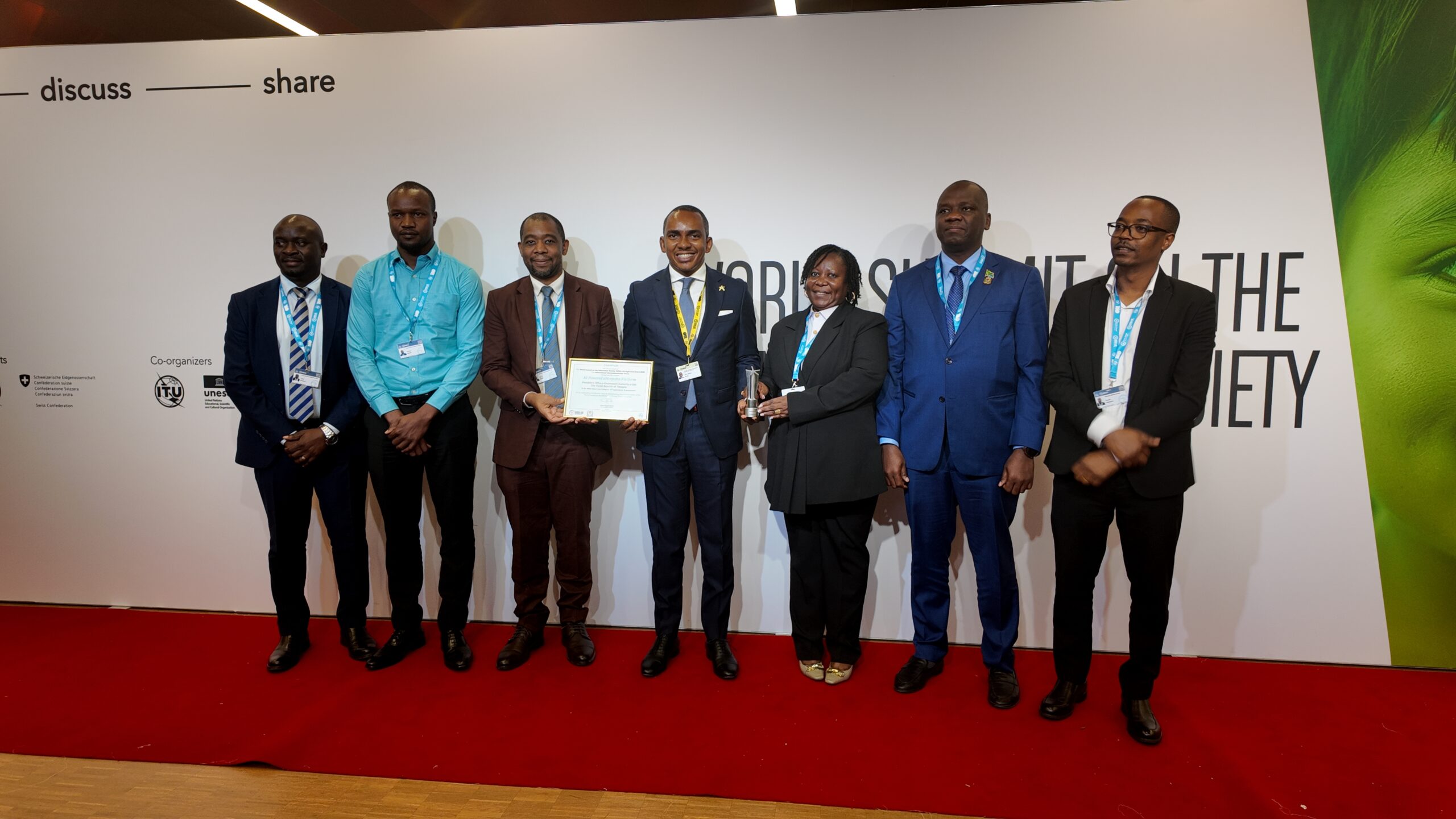
The Minister for Communication and Information Technology, Jerry Silaa (center), in a group photo with leaders from the Ministry and officials from the e-Government Authority (e-GA), shortly after receiving the eMrejesho award following the platform’s victory in the WSIS 2025 Awards under the e-Government category in Switzerland.
Tanzania quietly earned international praise at the WSIS+20 Forum in Geneva this year, where its e-Mrejesho feedback system was named a WSIS 2025 Champion in the eGovernment category. This recognition reflects more than technical innovation—it highlights a national strategy based on real-world public impact and institutional integration.
The e-Mrejesho platform was developed by Tanzania’s e-Government Authority (e-GA). Designed to capture citizen feedback—from complaints to compliments—it uses artificial intelligence to direct messages straight to the responsible department, tracks responses, and improves accountability. It doesn’t just collect data; it connects citizen voices to government action in real time. That trusted, operational design earned its accolades.
This innovation fits within e-GA’s broader mission: transforming public service delivery into an integrated, secure digital framework. Over 200 government systems now exchange information through a central backbone, cutting redundancy and improving operational efficiency. Cybersecurity audits, constant data centre monitoring, and institutional training are foundational—not optional—to this transformation.
By contrast, Rwanda’s well known IremboGov portal is deeply integrated into national strategy and Vision 2050, giving citizens access to over 100 services from birth certificates to land titles. Yet, studies highlight that Rwanda’s digital model is unevenly implemented, with gaps in infrastructure, social inclusion, legal frameworks, trust, language, and institutional coordination. Rwanda also faces interoperability issues, constrained by legal and technical silos.
Tanzania’s achievement lies in coherence. Its institutions operate within a shared digital spine, public servants are trained across ministries, and new tools pass through security and usability gates before deployment. Rwanda has strong frameworks and high ambition—evident in its emerging data governance unit and the 2025–2029 data-sharing platform—but it faces implementation complexities across agencies.
For Rwanda, Tanzania’s experience offers clear lessons: digital maturity is a blend of institutional discipline and user-centred services. It’s not just about technology. It’s about embedding new systems into the workflows, oversight bodies, and digital habits of government.
Moving forward in the region, the winning model appears to be one where innovation and system readiness go hand in hand. For Rwanda, continuing to invest in legal alignment, staff training, infrastructural coverage, and interoperability can bridge the gap between capability and delivery.
Tanzania’s WSIS award doesn’t celebrate a single tool—it celebrates a shift in government posture.
For Rwanda and East Africa as a whole, the real opportunity lies not in competition, but in shared progress: leveraging digital platforms not just for prestige, but for accountable, effective, and people-centred governance.
