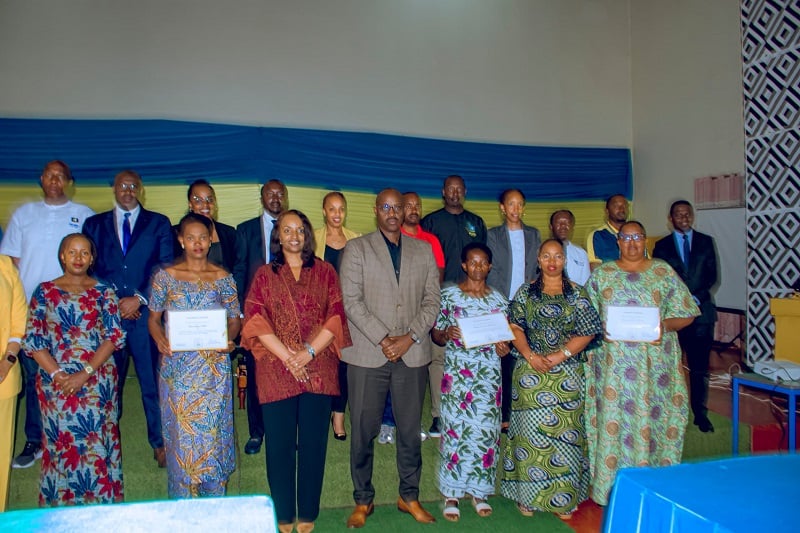
Central Bank Governor Soraya Hakuziyaremye delivers certificate to one of the beneficiaries of the program
In Rwanda’s remote villages, where cash once changed hands informally and financial decisions were often outsourced, a quiet transformation is underway.
Women who once relied on borrowed SIM cards to receive money are now confidently sending, saving, and investing through mobile phones—on their own terms.
At the heart of this shift is the Gendana Konte initiative, a campaign led by the National Bank of Rwanda (BNR), aimed at closing the financial inclusion gap between men and women.
From SIM cards to savings, Rwanda’s central bank is banking on rural women—literally and figuratively—to drive the next wave of grassroots economic transformation.
In Ngoma District alone, more than 16,000 women have been trained to use mobile phone-based financial services. Over 4,000 new accounts have been opened, and many more dormant ones reactivated.
The aim is simple but powerful: empower women to access, manage, and grow their money independently.
Claudine Kayitaramirwa, one of the newly trained participants, recalls how limited their options were before.
“There were many of us who had to borrow SIM cards just to receive money,” she said. “Some people ended up in tears after losing their money. If they gave someone else access to receive money on their behalf, they might only get part of it back—or nothing at all. It was common for someone to hand over 100,000 francs and only get 50,000 in return.”
Thanks to the training, Kayitaramirwa says even the elderly now go to mobile money agents with confidence.
“Now, whether you are old or young, you can deposit or withdraw money without needing help. That’s a big change.”
Another woman, Esther Uwariboye, said the program has given her real financial literacy.
“I learned how to manage my money. Before this, I didn’t know anything about budgeting or planning. Now I can track my income, avoid wasteful spending, and make informed decisions about how to use my money.”
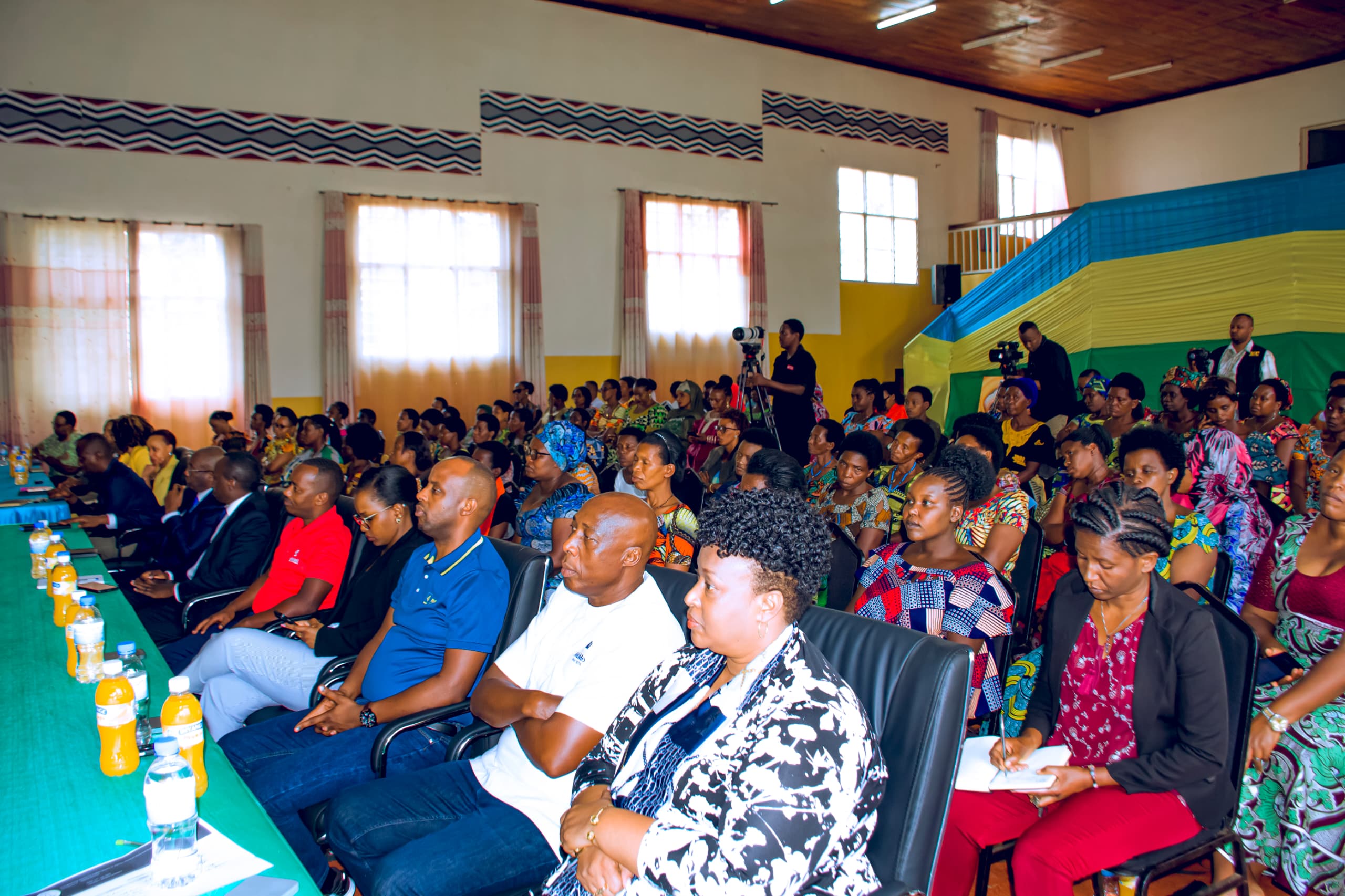
A cross section of women who are leading the movement in that region
But the program is about more than just digital tools. Women are also trained in saving, investing, insurance, and retirement planning—all through platforms accessible on their phones.
According to Soraya Hakuziyaremye, Governor of the National Bank of Rwanda, this is only the beginning.
“Once someone is trained and has a Mobile Money account, our hope is that they move forward—start a small business or create their own job. That’s how people build wealth,” she said.
“We would be proud if, years from now, a woman came back and told us she reached one hundred million francs, and it all started with this training.”
She emphasized that the initiative is ongoing and expanding.
“We’ve already begun this program in other districts as well. There are still many women, here in Ngoma and across the country, who haven’t been reached. But we will get to them. Every woman should be able to open an account and walk this journey toward financial independence.”
BNR data shows the gender gap remains a challenge. While 72 percent of women use mobile financial services, the figure is 81 percent among men. More than a million women in Rwanda still do not use digital finance tools.
That’s why Gendana Konte is scaling up. Already launched in Gakenke, Ngoma, Nyamasheke, Nyaruguru, and Rulindo, the campaign will eventually reach 127,000 women across 17 mostly rural districts, with a target of training 7,500 women per district.
In the Eastern Province, where Ngoma is located, there are over 3.5 million residents, of whom about 1.8 million are women.
The Governor of Eastern Province, Pudence Rubingisa, urged women who have received training to help extend the impact by teaching others.
“It’s now your responsibility to share this knowledge with women who haven’t had the chance to attend the training,” he said.
“We want to see this good news reach other places. This province holds so many opportunities for women to earn money—but they must embrace digital finance, saving, and development in all forms.”
With hundreds of stories like Claudine’s and Esther’s already emerging, and thousands more expected to follow, Rwanda’s campaign for digital financial inclusion is shaping not just individual lives—but the very structure of community economies.
As Governor Hakuziyaremye put it, the mission is clear:
“We are not just opening bank accounts. We are opening doors.”