



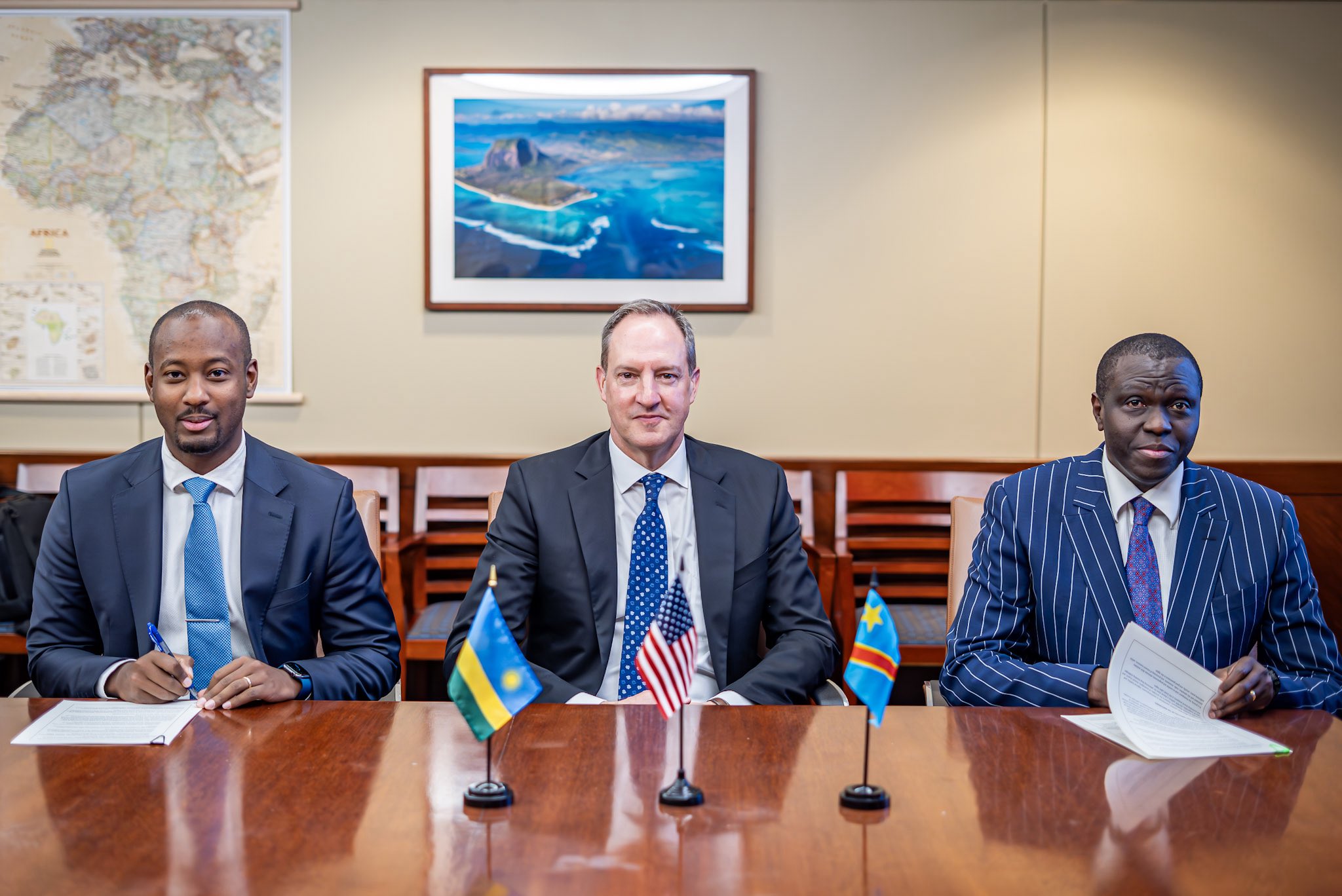
Tony Kajangwe, Rwanda’s Permanent Secretary in the Ministry of Trade and Industry, and his Congolese counterpart. The signing was overseen by the U.S.
Washington — Rwanda and the Democratic Republic of Congo (DRC) have agreed to jointly manage and share revenue from cross-border tourism, as part of a broader economic integration deal signed in Washington D.C. on Thursday.
The deal marks a major turning point in the long-fraught relationship between the two Great Lakes neighbors.
The commitment is one of several outlined under a new Regional Economic Integration Framework (REIF), a roadmap for shared growth across sectors such as tourism, energy, mining, infrastructure, and public health.
The agreement was formally signed by Tony Kajangwe, Rwanda’s Permanent Secretary in the Ministry of Trade and Industry, and his Congolese counterpart. The signing was overseen by U.S. Special Envoy Massad Boulos of the Bureau of African Affairs.
The REIF builds on the momentum of the Peace Agreement signed by the two countries on June 27, 2025, and aims to replace years of mistrust and cross-border conflict with shared development and mutual economic gains.
Tourism Becomes a Pillar of Peace
Among the most groundbreaking provisions is a joint commitment to share revenue from tourism in transboundary parks—notably in the Virunga–Volcanoes landscape, home to the region’s iconic mountain gorillas.
The two countries plan to harmonize revenue-sharing policies, support each other’s tourism operators, and link communities to tourism benefits through standardized livelihood policies and conservation funding models.
The deal also envisions a cross-border security strategy for protected areas, along with legal harmonization to fight poaching, trafficking, and illicit resource exploitation in national parks.
Rwanda and the Democratic Republic of Congo (DRC) share several vital tourism assets that straddle their common border, making the region uniquely positioned for cross-border ecotourism.
At the heart of this shared potential is the Virunga–Volcanoes massif, a chain of volcanic mountains home to the endangered mountain gorilla, which attracts thousands of high-end tourists each year.
Rwanda’s Volcanoes National Park and DRC’s Virunga National Park are both part of this ecosystem, offering complementary gorilla trekking experiences, rich biodiversity, and scenic volcanic landscapes.
Beyond gorillas, the two countries also share Lake Kivu, a major natural attraction ideal for water-based tourism, birdwatching, and cultural heritage exploration along its shores.
Additionally, both sides are connected by cross-border communities and trade hubs such as Rubavu (Gisenyi) and Goma, which offer vibrant local markets, hiking trails, historical sites, and gateway access to inland attractions.
Despite their security and logistical differences, Rwanda and DRC possess a shared ecological and cultural heritage that, if jointly developed and marketed, could transform the Great Lakes into a unified, world-class tourism destination.
A Broader Vision for Shared Growth
The REIF sets the stage for deeper regional integration by outlining cooperation across six pillars: energy, infrastructure, mineral supply chains, tourism and conservation, public health, and emerging sectors such as education, sports, and agribusiness.
It is intended to be a “living platform”, allowing both countries to adapt the agreement over time, add initiatives, and align with broader continental plans such as the African Continental Free Trade Area (AfCFTA) and the AU Continental Power Systems Masterplan.
In the energy sector, the REIF prioritizes the Ruzizi III hydropower project and methane gas exploitation from Lake Kivu, both seen as key to boosting electricity access and regional industrialization.
Cleaning Up Minerals and Attracting Investment
Another high-impact area of focus is the mining sector, where both DRC and Rwanda have pledged to clean up mineral supply chains, eliminate illicit trade, and boost local value retention through formalization and industrialization.
The agreement emphasizes the need to move from raw exports toward value-added processing, while protecting community rights and attracting responsible investors in minerals such as tin, tantalum, tungsten, niobium, and gold.
The two countries also committed to improve border infrastructure and coordination, facilitating smoother trade and better tracking of mineral flows to avoid financing armed groups.
Health and Infrastructure as Foundations for Integration
The deal includes a strong public health agenda, calling for joint efforts to prevent and control outbreaks in cross-border areas, share research, and promote regional health commerce.
On infrastructure, the REIF supports integrated development of cargo roads, market centers, warehouse systems, ports, and ICT connectivity.
These efforts are expected to link into broader U.S.-supported trade routes like the Lobito Corridor, positioning the Great Lakes region for greater access to global markets.
From Conflict to Complementarity
The deal represents a shift from seeing each other as rivals to partners. Officials on both sides described the agreement as complementary rather than competitive, recognizing Rwanda’s growing infrastructure and DRC’s immense resource potential as natural matches for joint industrialization.
Despite lingering distrust, particularly around rebel activity in eastern Congo, observers say the practical, sector-based nature of this agreement gives it a greater chance of survival than previous diplomatic overtures.
