




President Felix Tshisekedi and Parliament President Vital Kamerhe will need to turn to serious peace brokers, than playing to public appeasements
The conflict between the Democratic Republic of Congo (DRC) and Rwanda continues to be one of the most complex and volatile issues in the Great Lakes region. Despite high-level diplomatic efforts—including a Peace Agreement signed on June 27, 2025, with US support—some of the region’s political leaders seem more focused on public posturing than on implementing peace.
Consistent statements by leaders in the DRC, the latest being especially Vital Kamerhe, the Speaker of the National Assembly, cast doubt over the sincerity of Kinshasa’s commitment to peace. Kamerhe’s shifting language on Rwanda reveals more about internal political games than about real diplomatic progress.
The tensions between Rwanda and the DRC are caused in large part by longstanding security concerns, and mutual distrust. The DRC accuses Rwanda of supporting the M23 rebels in eastern Congo, a charge Rwanda firmly denies.
In recent weeks, Kamerhe has made headlines for his harsh words against Rwanda. While speaking at the 6th World Conference of Speakers of Parliaments in Geneva on July 30, he accused Rwanda and the M23 of occupying DRC territory and committing atrocities, including massacres of civilians and churchgoers. He called on the international community to condemn Rwanda and hold it accountable.
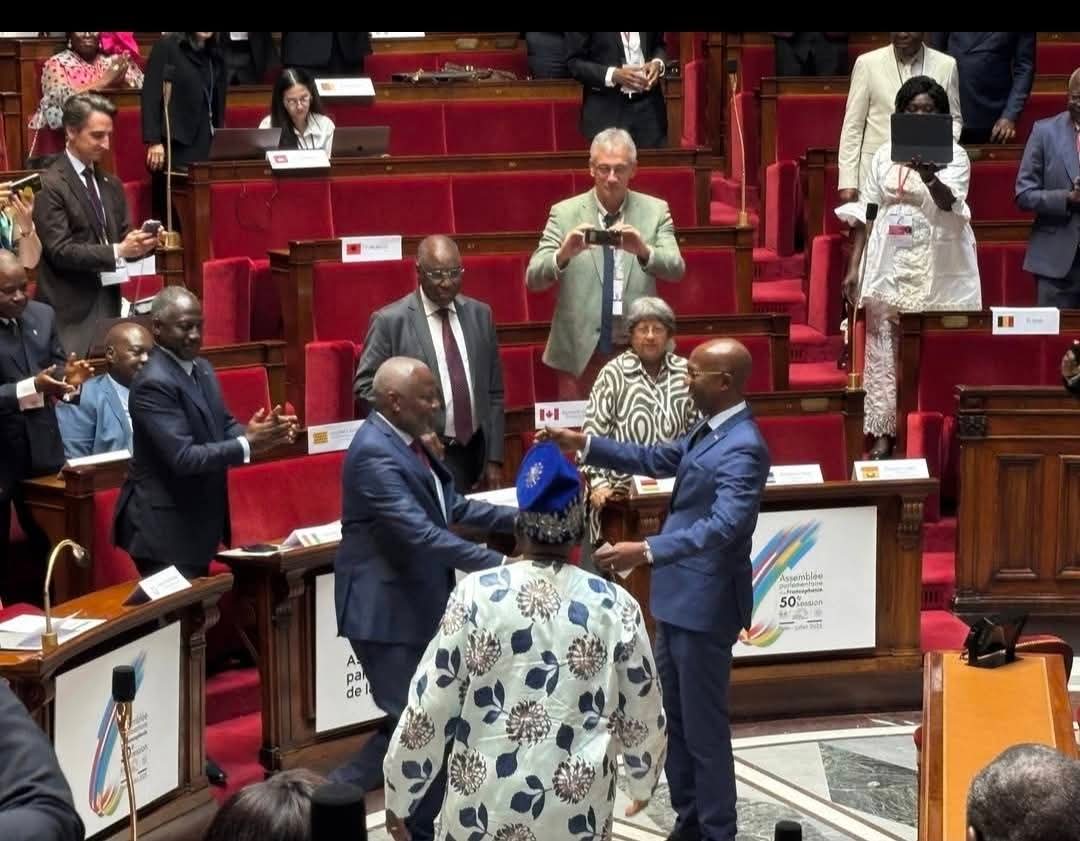
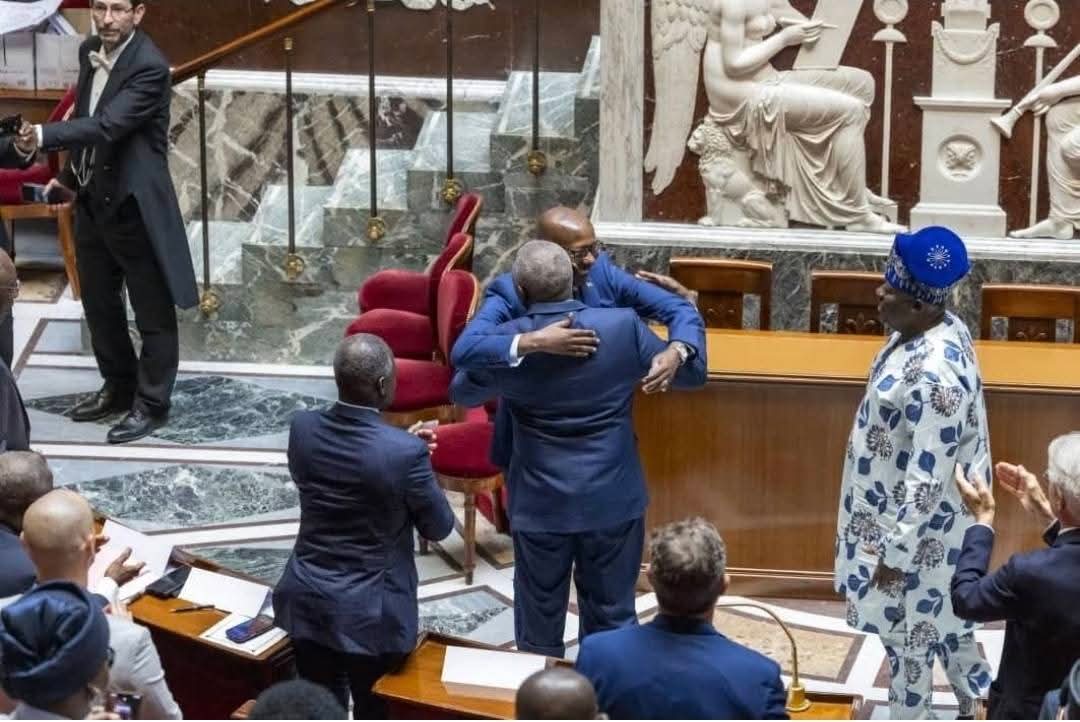
What makes these statements particularly striking is that just two weeks earlier, Kamerhe had taken a very different tone. At a meeting in Paris during the Parliamentary Assembly of La Francophonie, he publicly supported the Peace Agreement signed in Nairobi, praising it as an important step toward dialogue and cooperation. He even urged parliaments in both countries to move quickly to ratify the deal. The contrast between these two appearances is difficult to ignore.
Kamerhe’s Contradictions
Part of the explanation for Kamerhe’s turnaround lies in domestic Congolese politics. He has long faced accusations from some in Kinshasa of being a covert sympathizer or agent of Rwanda—allegations fueled by the fact that he has previously attended private events in Rwanda, including weddings. These suspicions exploded again after the Paris meeting, when a video circulated showing Kamerhe warmly hugging Rwanda’s Deputy Speaker of Parliament, Sheikh Fazil Harelimana. Back home, this embrace was interpreted by many as a symbolic move toward normalization of ties with Kigali, which caused a backlash among nationalist factions.
Kamerhe’s hardline rhetoric in Geneva, then, appears to be more about political survival than policy coherence. He is working to shake off the “double agent” label by taking a tough public stance against Rwanda, aiming to reassure skeptical segments of the Congolese public. Yet in doing so, Kamerhe adds to the dissonance coming from DRC’s leadership.
The problem is not just inconsistency—it’s that this kind of mixed messaging enflames regional tensions rather than easing them. By focusing on political optics at home, DRC leaders risk undermining the delicate efforts needed to build lasting peace in the region.
President Tshisekedi’s Escalatory Rhetoric
President Félix Tshisekedi himself has contributed to this pattern of contradiction. During his campaign for re-election in 2024, he warned that even the “slightest attack” (“Moindre escarmouche”) on the city of Goma by M23 would result in a military strike against Rwanda’s capital, Kigali. He claimed the Congolese army had drones capable of carrying out such attacks. These statements drew attention at the time and appeared to be aimed at rallying domestic support through nationalist sentiment.
Since winning the election, Tshisekedi’s tone has moderated somewhat, especially as peace efforts gained new momentum. Still, the strong words he used during the campaign have left a lingering effect and cast doubt on the sincerity of his commitment to reconciliation.
Rwanda’s Response: Calling for Consistency
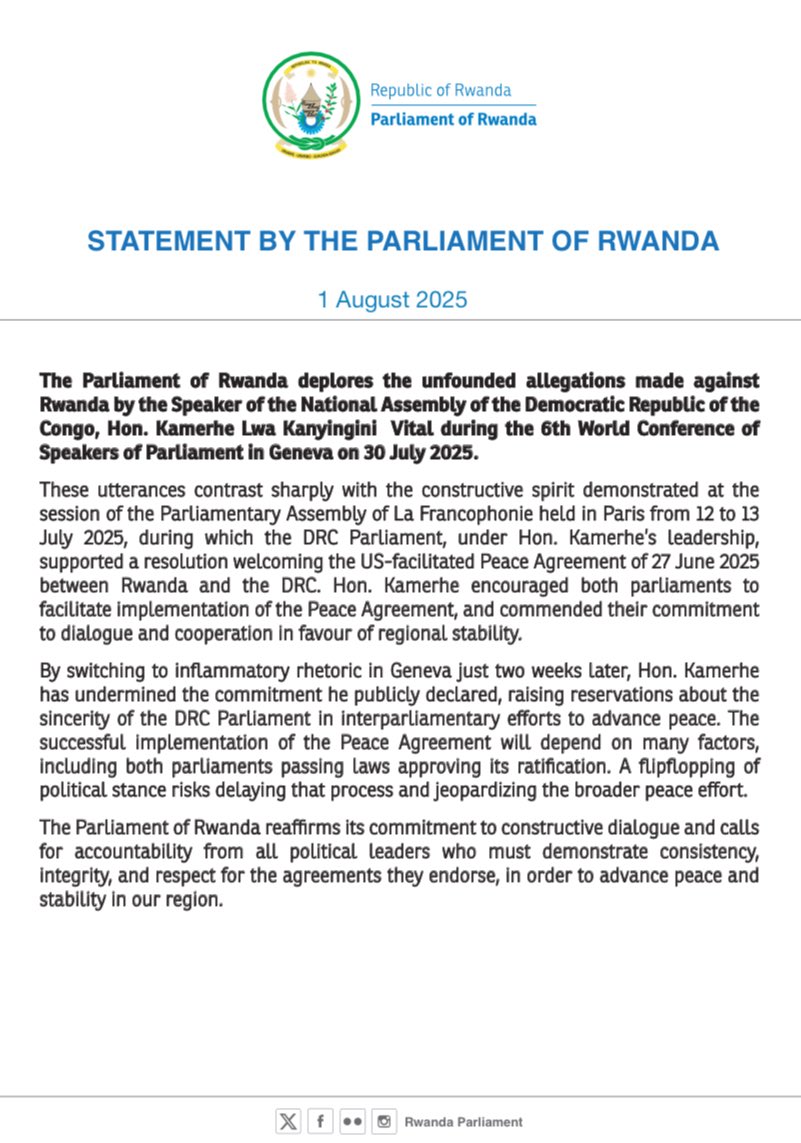
In response to Kamerhe’s remarks in Geneva, the Parliament of Rwanda issued a statement this Friday August 1, 2025. The Rwandan lawmakers rejected his allegations and pointed out the contradictions in his own public record. They reminded the DRC side that Kamerhe had, just weeks earlier, voiced support for the Peace Agreement and encouraged both parliaments to push it forward.
The statement expressed disappointment that Kamerhe would so quickly undermine the agreement by returning to accusations and inflammatory rhetoric. The Rwandan Parliament emphasized the need for maturity and seriousness in leadership, urging both sides to focus on implementation rather than politicization. Rwanda also reiterated its support for the Peace Agreement, noting that words must now be followed by real institutional actions.
Kamerhe’s contradictory messages and Tshisekedi’s earlier threats are not just political footnotes—they point to a deeper issue in how the DRC has approached the peace process. Instead of steady and honest diplomacy, leaders in Kinshasa have often relied on grandstanding. One moment they are calling for cooperation; the next, they are making serious accusations.
This lack of consistency weakens their credibility. It also distracts from the hard work needed to bring peace to eastern Congo. By placing blame entirely on Rwanda, the DRC leadership avoids confronting its own internal challenges: a weak and corrupt state, an army plagued by desertions, and an inability to dismantle dangerous armed groups.
Rather than putting forward concrete, long-term plans for peace and reform, these leaders appear more interested in scoring political points. Kamerhe’s change of tone between Paris and Geneva suggests he is speaking more for effect than for results.
A Fragile Peace Process Needs Serious Leadership
The Peace Agreement signed in June 2025 remains a workable path forward, but it cannot succeed if one party undermines it in public while claiming to support it in private. Effective peacebuilding requires trust, patience, and the kind of leadership that stays the course, even when it is politically inconvenient.
Leadership matters now more than ever. For the DRC, this means that both President Tshisekedi and Speaker Kamerhe must show discipline and speak with one voice. If their goal is truly peace, they must put aside slogans and focus on fulfilling the commitments they’ve already made.
Rwanda, for its part, has taken a more stable approach. By continuing to highlight the importance of implementation and avoiding emotional outbursts, Kigali has managed to keep the conversation grounded. It now falls to both sides to ensure the words spoken in peace agreements are matched by concrete, institutional action.
The Great Lakes region has suffered too much for peace to become another political performance. The DRC and Rwanda have an opportunity to chart a new path—but only if their leaders are willing to stop playing to the crowd and start doing the hard work of diplomacy.
There is still time to build lasting peace. But it will not come through loud speeches or threats. It will come through consistent, principled leadership—something the region urgently needs.
