



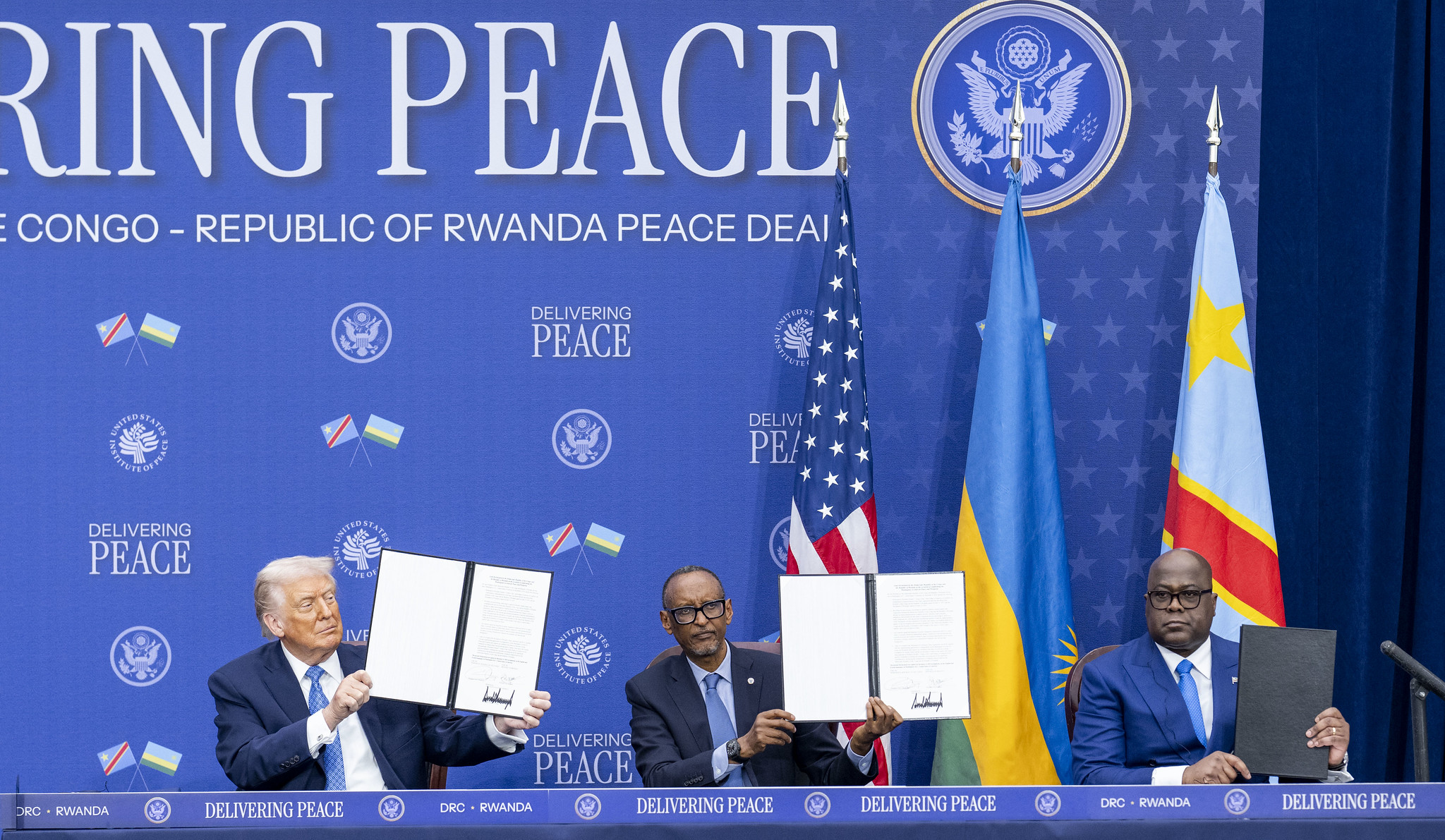
December 4, U.S. President Trump hosted President Paul Kagame and DR Congo’s Tshisekedi for signing of the Washington Accords. The barometer study looked the implementation of the initial accords signed at Ministerial level back in June, which covered a diversity of issues including security.
A new independent evaluation of the Washington Peace Accord reveals a growing implementation gap between the two signatory nations, with Rwanda pulling ahead of the Democratic Republic of the Congo (DRC) in fulfilling its commitments, according to a detailed study.
The report, compiled by the think tank Baromètre des Accords de Paix en Afrique for November 2025, assesses progress on the landmark agreement signed in June to end decades of conflict in the Great Lakes region.
While both countries are behind schedule, the data indicates Rwanda is demonstrating marginally greater compliance and institutional engagement.
According to the November 2025 evaluation report, the Washington Peace Accord outlines 30 specific tasks, distributed among the signatories and the international community.
Although the Washington Peace Accord was formally elevated and ratified by the Presidents of the DRC and Rwanda on December 4, 2025, its foundational text was initially negotiated and signed at the ministerial level earlier in the year.
This earlier ministerial signing represents the technical and operational groundwork of the agreement, detailing specific tasks and timelines—precisely the commitments tracked in this November 2025 evaluation report.
The Baromètre des Accords de Paix en Afrique focuses on assessing the implementation of these ministerial-level commitments because they form the actionable core of the accord; monitoring their progress reveals whether the technical follow-through is occurring on schedule, regardless of later presidential endorsement
Some tasks are the sole responsibility of one country. Many tasks are the shared responsibility of both countries.
DR Congo is responsible for 26 of these tasks, of which only 16 have seen partial implementation, resulting in an overall execution rate of 22.1%. Rwanda is assigned 22 tasks, with 13 partially implemented, achieving a nearly identical overall rate of 22.7%.
The report confirms that the most critical security task for DR Congo —neutralizing the FDLR militias, is at a complete standstill. This deadlock threatens to unravel the entire process.
The study includes sharp recommendations for both parties. It urges the DRC to “accelerate without delay” FDLR neutralization operations and to make the Doha ceasefire verification with AFC-M23 rebels mechanism operational.
