




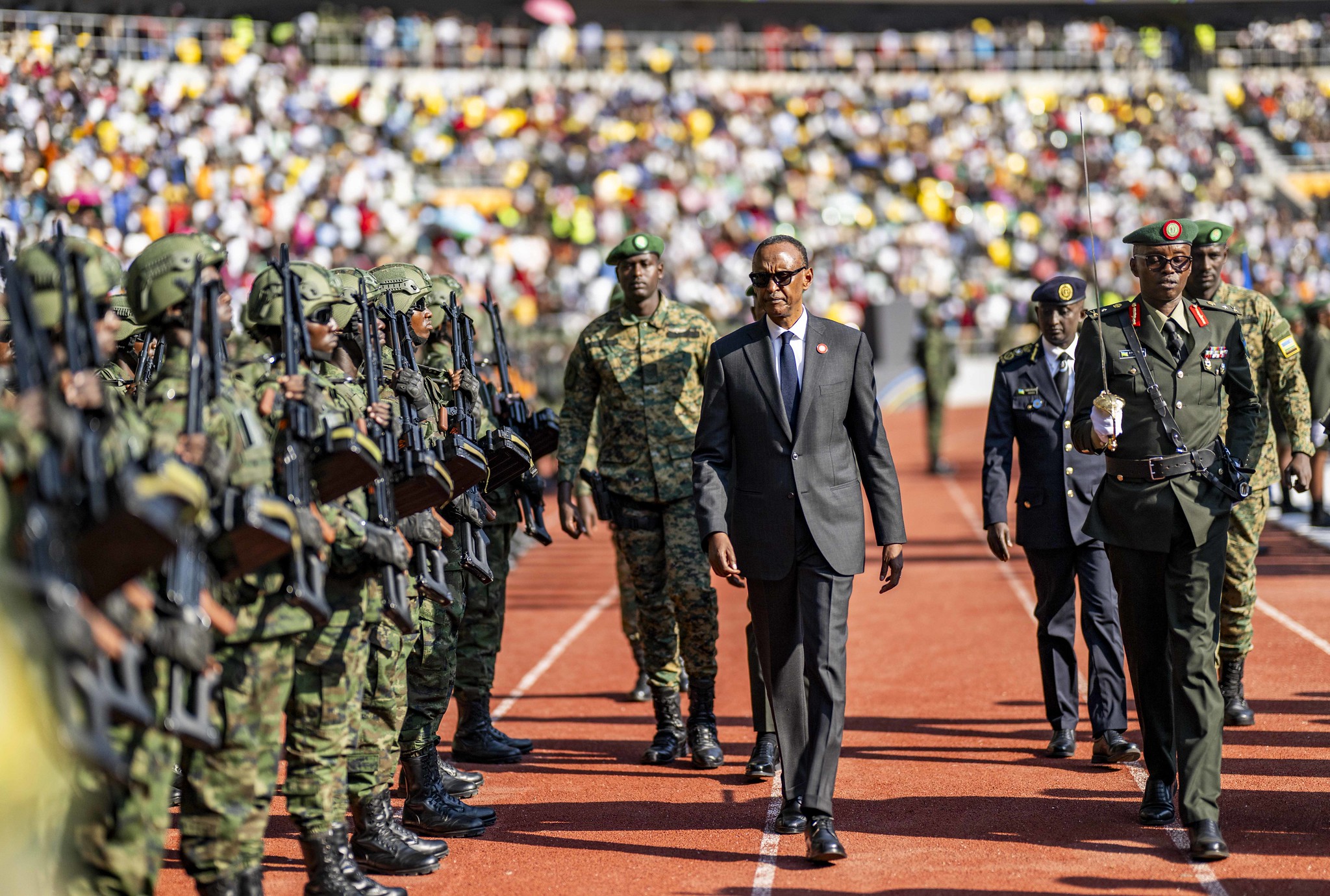
On August 11, 2024, President-elect Paul Kagame inspects Guard of Honor as part of the inauguration ceremony
Kigali, Rwanda – Rwanda has taken an important step to strengthen its military education and leadership.
Today, the Cabinet, chaired by President Paul Kagame, approved the draft law to establish the National Defence University (NDU). This marks a major milestone in a long-term plan to create a dedicated institution for advanced defence training within the Rwanda Defence Force (RDF).
The NDU will become Rwanda’s main military university. It builds on work started in 2024 and will bring together existing military training centers into one unified system.
The university will cover all levels of military education, including basic officer training, operational command courses, and advanced strategic studies.
A central part of the NDU will be the National Defence College (NDC), aimed at senior officers such as colonels and brigadier generals.
The NDC will fill a gap in Rwanda’s military education by offering advanced training in strategic defence policy, international security, leadership, command, and management—areas that were not available before at a national level.
The NDU will combine several existing RDF facilities. The Rwanda Military Academy (RMA) in Gako will provide undergraduate programs in military and social sciences, general medicine with a military focus, and long-course officer training.
The RDF Command and Staff College (RDFCSC) in Nyakinama, Musanze, will offer mid-to-senior level courses in command, staff management, and defence policy.
The NDC will serve as the highest level for senior leadership development. Other supporting institutions, such as the RDF Combat Training Centre in Gabiro, the Non-Commissioned Officers Academy, the School of Infantry, the Cadet Training Academy, the Special Forces Training School, and the Peace Support Operations Training School, will all contribute to the university’s programs.
The NDU will provide a clear pathway for military education. New officers will gain tactical skills, mid-career officers will build operational expertise, and senior officers will develop strategic knowledge.
The university may also develop research facilities and partnerships with other agencies and international institutions.
Unlike civilian universities such as the University of Rwanda, the NDU will focus specifically on military and security studies for RDF personnel and selected security-related civilians.
Programs will include bachelor’s degrees in military fields, mid-level command courses, and postgraduate studies in defence policy, international relations, security, and leadership.
Practical training will prepare students for complex security challenges, peacekeeping missions, and contributions to national development goals.
At this point, there are few details about the university beyond what has been shared at previous forums. The draft law will soon be presented to Parliament by the Ministry of Defence.
From there, it is expected to pave the way for a launch in September, when the academic calendar in Rwanda begins.
The idea for the NDU began in 2018, when RDF leaders consulted international partners, including the United States National Defence University, to plan a modern institution.
By 2024, the Ministry of Defence had presented the project to Parliament, emphasizing the need for higher-level training to produce flexible and capable leaders.
A law passed in 2024 referenced the creation of a Defence University, paving the way for today’s Cabinet decision.
Curriculum development and partnerships with the University of Rwanda over the past year have prepared the university for launch.
Once the law is enacted, it will define the governance, funding, and organization of the NDU under the Ministry of Defence.
The university will reduce the need for RDF officers to study at civilian or foreign universities and will help build a professional, disciplined military that can protect Rwanda’s sovereignty and support regional stability.
This initiative shows Rwanda’s commitment to investing in human capital within the security sector and ensuring that the RDF remains modern and capable in a changing geopolitical environment.
More details about enrollment, program launches, and timelines will be announced after parliamentary review and presidential approval.
