




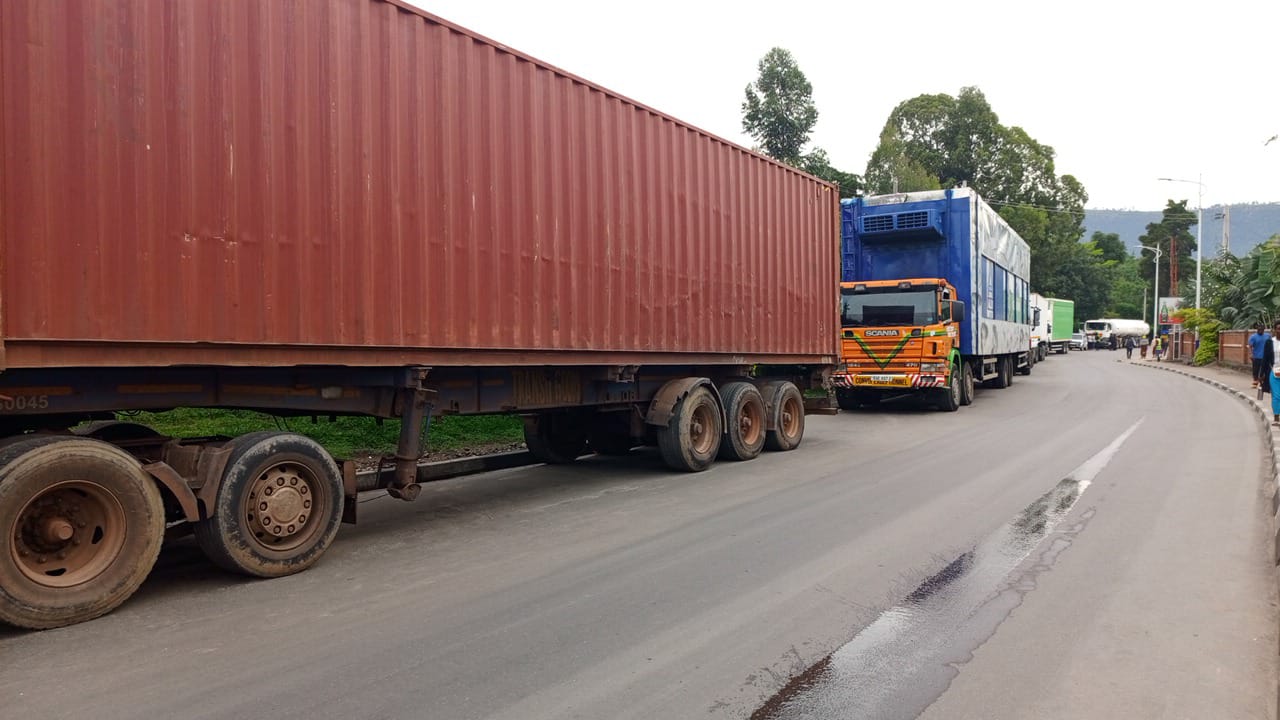
Truck parked on the Rwanda side of the Rubavu-Goma border, waiting to transport cargo. The border with Congo remains busiest in the region in terms of human and cargo traffic
The Democratic Republic of Congo (DRC) has reclaimed its position as Rwanda’s leading export destination, marking a major shift in the country’s external trade patterns after years of dominance by overseas markets, particularly the United Arab Emirates.
According to the latest Formal External Trade statistics released by the National Institute of Statistics of Rwanda (NISR), Rwanda exported goods worth USD 26.81 million to the DRC in December 2025, making Congo the country’s single largest destination for domestic exports during the month.
This placed the DRC ahead of China and the UAE, which ranked second and third respectively.
The return of the DRC to the top spot comes against the backdrop of a marked decline in Rwanda’s total domestic exports, which experienced a year-on-year drop in December 2025.
While many traditional export markets recorded steep drops, exports to the Congolese market remained relatively resilient, allowing the DRC to emerge as Rwanda’s most important export partner for the month.
The shift is particularly notable when viewed over a three-year period.
In December 2023, the UAE overwhelmingly dominated Rwanda’s exports, absorbing more than USD 91 million, while the DRC ranked a distant second with USD 14.32 million.
By December 2024, the UAE’s dominance intensified further, with exports exceeding USD 176 million, largely driven by high-value mineral shipments, while the DRC remained in second place.
However, in December 2025, exports to the UAE collapsed dramatically to just USD 9.05 million, reshaping Rwanda’s export map.
In contrast, exports to the DRC increased to their highest level in the three-year period, underscoring the growing importance of regional markets at a time of global volatility.
The resurgence of the Congolese market reflects Rwanda’s strong cross-border trade links, particularly in food products, manufactured goods, construction materials, and re-exports that flow through Rwanda into eastern Congo.
The DRC also absorbs the vast majority of Rwanda’s re-exports, reinforcing Rwanda’s role as a key regional trading and logistics hub.
The development aligns with recent government messaging on the need to strengthen regional trade and reduce over-reliance on a narrow set of distant, commodity-driven export markets.
Officials have repeatedly highlighted the DRC, East African Community, and COMESA markets as critical buffers during periods of global economic uncertainty.
While the return of the DRC to the top ranking has helped cushion Rwanda’s export performance, economists warn that the broader export slowdown remains a concern.
Sustained growth will depend on improving industrial productivity, increasing value addition, and ensuring factories operate closer to full capacity, as emphasized by the Prime Minister Dr. Justin Nsengiyumva, in his report to the Umushyikirano National Dialogue Council yesterday.
As regional demand holds firm and overseas markets fluctuate, Rwanda’s export trajectory appears increasingly anchored in its immediate neighbourhood—placing the DRC once again at the centre of the country’s external trade landscape.
Uganda is another major market destination, which in the past three years has remained in the top ten export destinations.
