




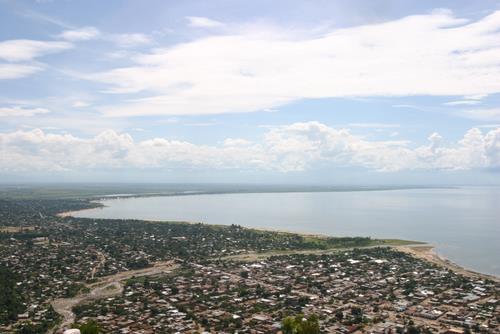
Uvira the lakeside town on Lake Tanganyika. It links to Burundi’s main city Bujumbura, about 30km away.
Doha, Qatar — The Government of the Democratic Republic of Congo and the Alliance Fleuve Congo/Mouvement du 23 Mars (AFC-M23) have agreed to allow the United Nations peacekeeping mission, MONUSCO, to deploy a field monitoring team to Uvira, South Kivu, following the signing of detailed ceasefire monitoring arrangements in Doha.
The agreement was signed on February 2, 2026, at the conclusion of latest follow up session of their ongoing peace talks, hosted by Qatari Government.
The new agreed mechanism sets out the terms of reference for a ceasefire monitoring and verification mechanism, reinforcing commitments made under the broader Doha Framework Agreement for Peace signed in November 2025.
Under the newly signed mandate, both parties reaffirmed their commitment to the ceasefire and pledged to implement all obligations in good faith.
The mechanism establishes procedures for joint oversight, reporting of violations, verification on the ground, and coordination channels aimed at preventing a return to hostilities in eastern DRC, particularly in North and South Kivu.
The signing was witnessed by key international and regional stakeholders, including the United Nations (MONUSCO), the African Union, the United States, the Republic of Togo—acting as African Union mediator—and the International Conference on the Great Lakes Region (ICGLR).
MONUSCO Deployment to Uvira
A key outcome of the latest agreement is the planned deployment of MONUSCO’s first field monitoring mission to Uvira in the coming days.
The team will be tasked with verifying compliance with the ceasefire, investigating alleged violations, and facilitating communication between the parties on the ground.
Uvira, a strategic city on the shores of Lake Tanganyika, was briefly taken by M23 fighters during a major offensive in December 2025 before rebel forces withdrew, allowing government control to be restored.
Before the rebels left, they demanded that the city be left to international community in letter to the UN Secretary General.
Qatari officials underscored the importance of translating political commitments into practical action, stressing the need for effective monitoring, information sharing, and regular coordination meetings to sustain the fragile truce amid persistent regional tensions.
The agreement builds on earlier progress in the Qatar-mediated talks, including an initial ceasefire oversight arrangement reached in October 2025.
Fragile Progress Amid Persistent Risks
While the Doha peace framework outlines broader pillars—covering security, governance, humanitarian access, return of displaced populations, economic recovery, and justice—many of these elements remain under negotiation.
Analysts view the MONUSCO mandate as incremental but meaningful progress in a conflict where past ceasefires have repeatedly collapsed due to mistrust and unresolved grievances.
The eastern DRC remains volatile, shaped by M23 territorial gains in 2025, and the presence of multiple armed groups.
Observers say successful deployment in Uvira, coupled with low levels of ceasefire violations, could help rebuild confidence and advance negotiations.
Conversely, non-cooperation or renewed fighting could undermine the Doha process.
The agreement comes amid sustained international pressure to de-escalate one of Africa’s longest-running humanitarian crises, which has displaced millions and continues to threaten regional stability.
