


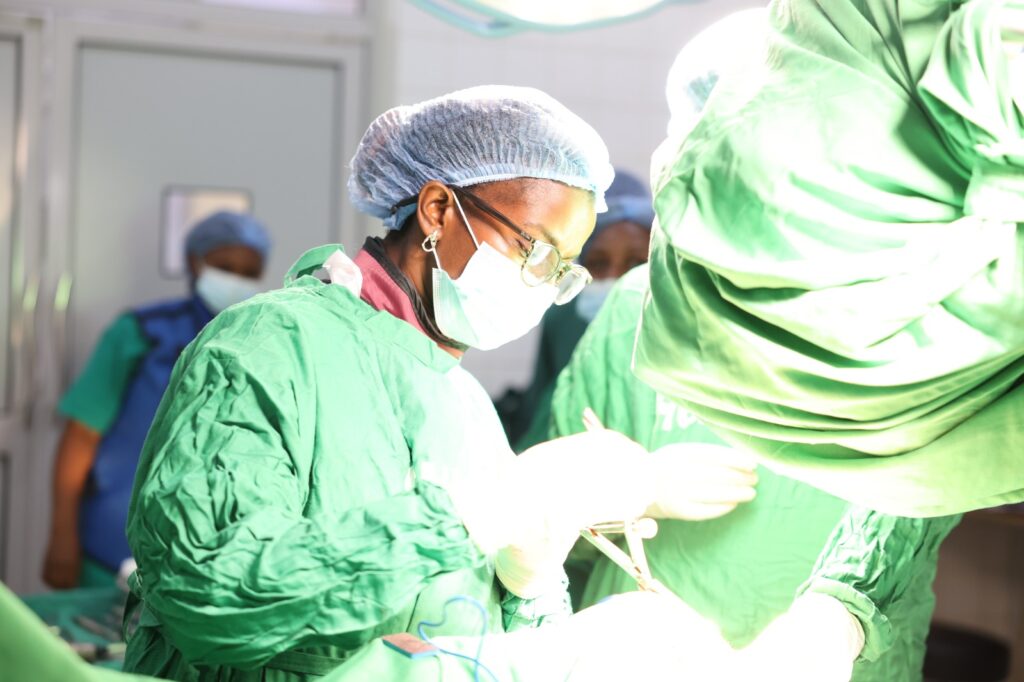
Choosing orthopedic surgery meant committing to years of intense training for Kansayisa.
For a long time, Marie Grace Kansayisa’s world was defined by the binary logic of numbers. Growing up in Rwanda, she watched her mother navigate the structured world of accounting and assumed her own life would follow a similar ledger—one grounded in finance, stability, and predictable outcomes.
But her mother offered her something more enduring than a career map: she instilled a sense of relentless discipline. “My child, always study with dedication,” she would say. It was a simple mantra that would eventually carry Kansayisa far beyond the world of spreadsheets.
By secondary school, her affinity for mathematics had deepened, fueled by a teacher who revealed the elegance of equations. At the time, the path seemed clear: engineering. It was the logical destination for a student excelling in math and physics at Lycée Notre Dame de Citeaux. Medicine, meanwhile, was a “quiet hope”—a second choice on her university application that felt more like a dream than a plan.
“I wanted to study medicine, but I felt my chances were low because of my subject combination,” she recalls. “When the results came and I was admitted, I was happy.”
It was the first of many pivots that would not only redefine her life but also challenge the gendered expectations of the Rwandan medical landscape.
Discovering a Calling
At university, Kansayisa didn’t just study medicine; she inhaled it. However, the true “lightning bolt” moment arrived in her third year during clinical rotations. She found herself drawn to the theater of orthopedic surgery—a field that is as much about structural engineering as it is about biology.
The work was unapologetically demanding: technical, physically taxing, and requiring a level of anatomical precision that left little room for error. It also carried a visible void.
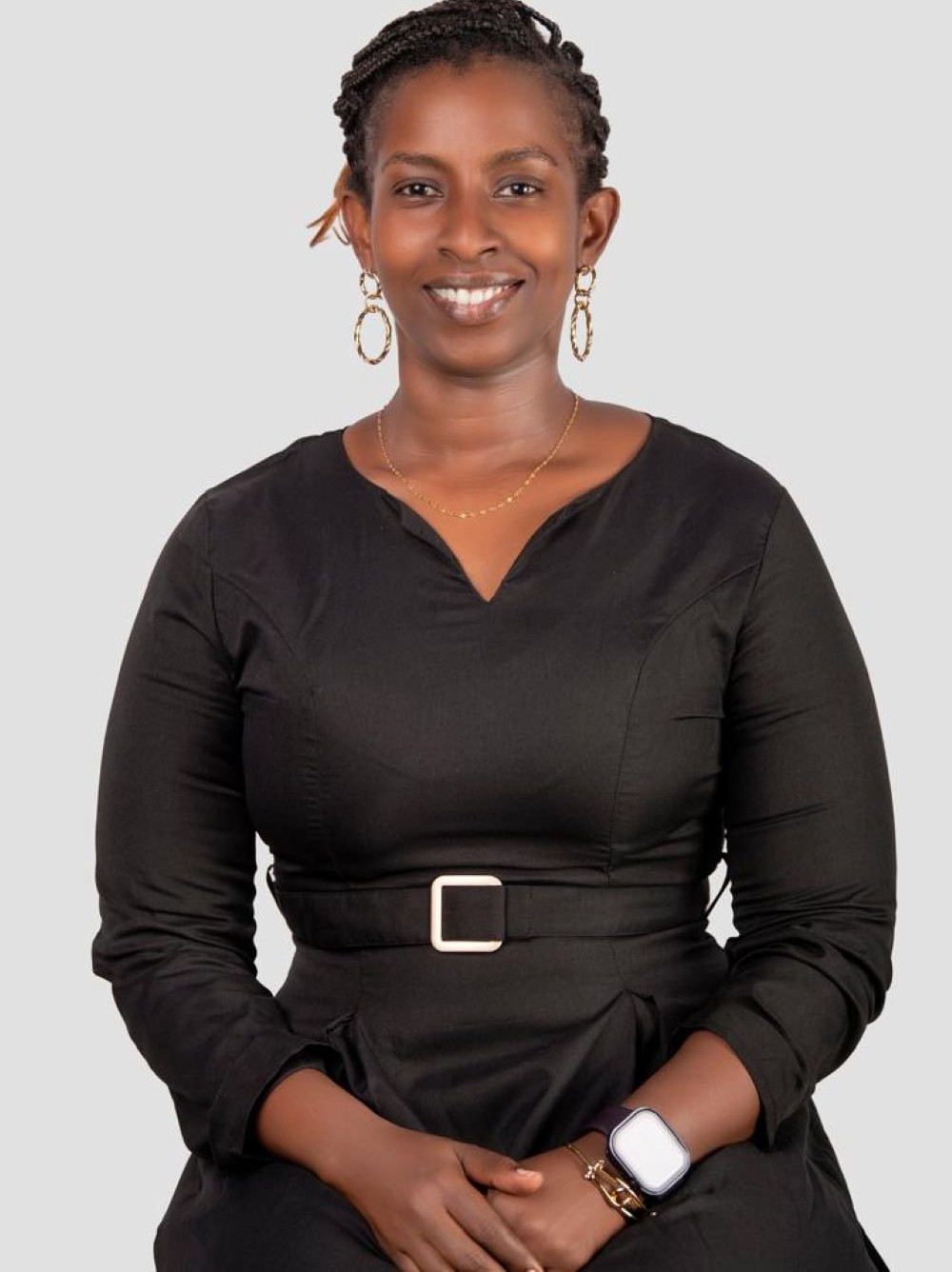
Kansayisa stands as one of the few women in Rwanda specializing in orthopedic surgery.
“I asked myself, ‘How can I choose this when no other girls are doing it?’” she says.
In some corners of the continent, a female orthopedic surgeon was a rarity; in others, they didn’t exist at all. The absence of role models could have been a deterrent, but for Kansayisa, it became a silent dare. Encouraged by senior male mentors who saw her aptitude rather than her gender, she leaned in.
The road was long—thirteen years of grueling preparation, including six years of general medicine, a year of internship, and a five-year specialization at the University of Rwanda.
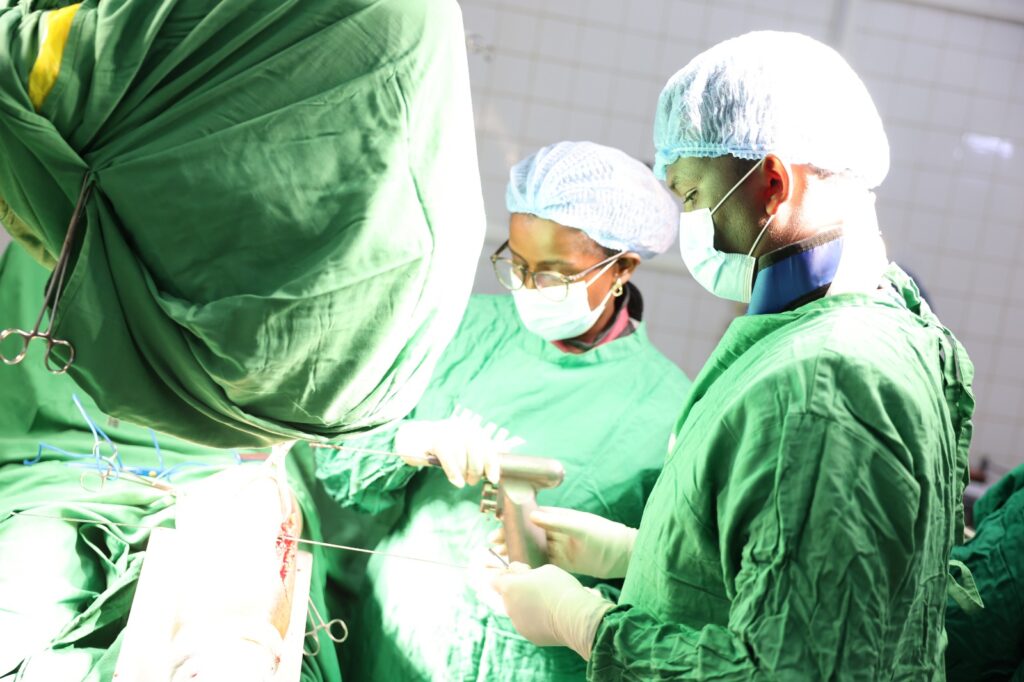
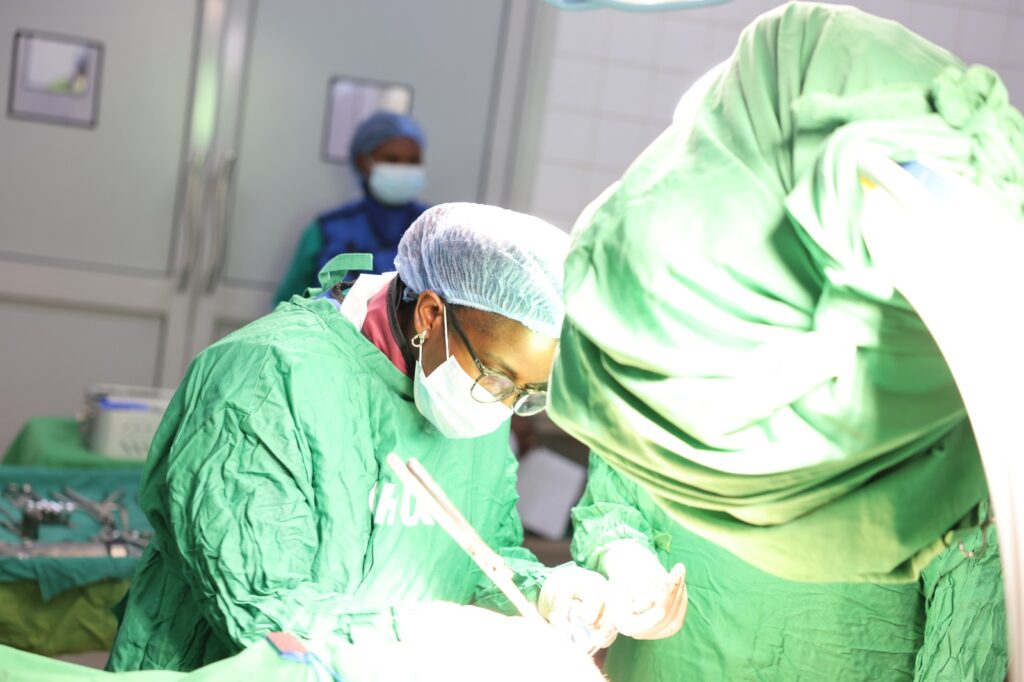
Dr. Marie Grace Kansayisa and her colleagues work on a patient in the theatre.
Mastering a Demanding Field
To Kansayisa, the human body is the ultimate piece of machinery. “For a bone to function, it depends on a complex web of structures,” she explains. “Ligaments connecting bone to bone, tendons anchoring muscle, and the intricate alignment of the spine. It all must work in harmony.”
After graduating in 2021, she began her practice at the University Teaching Hospital of Kigali (CHUK). But her pursuit of excellence took her further afield. In 2024, she moved to Singapore to sub-specialize in foot and ankle surgery—an area dealing with everything from congenital deformities like flat feet to the traumatic aftermath of accidents.
Now back in Rwanda, much of her daily life is spent in the high-stakes environment of the operating room. Many of her patients arrive broken—often the victims of motorcycle accidents. Using metal rods, plates, and prosthetic joints, she works to piece lives back together.
“When you see a patient who could not walk return to their normal life—returning to work or back to their farm—that feeling has no price,” she says.
The Quiet Revolution
Working within a developing healthcare system brings its own set of friction. Resources can be scarce, and the specialist-to-patient ratio remains a steep climb. Yet, Kansayisa remains a pragmatist. “We are moving in the right direction,” she says simply.
Her presence in the scrub room is a statement in itself. Her philosophy is stripped of ego: “Excellence has no gender.” It is a mantra she lives by, and one that is already bearing fruit. Today, she is no longer the “only” one; another young woman has followed her into the specialty, and the two now work side-by-side.
Outside the hospital, Kansayisa protects her peace. She finds balance in travel, exercise, and the simple restorative power of a good book. “Sometimes I just sit somewhere with a cup of coffee and read. It makes me happy,” she shares.
In a profession once deemed “out of reach” for women, Dr. Kansayisa has proven that with enough discipline, even the most rigid barriers can be reshaped—much like the bones she heals every day.
Beyond the Challenges
Like many doctors in Rwanda, Kansayisa works within the realities of a developing healthcare system. Resources can be limited, and workloads are often heavy due to a shortage of specialists.
Still, she remains pragmatic. “We would like to see improvements, of course. But we are given what is possible, and as a country, we are moving in the right direction,” she says.
Her journey has required not only professional dedication but also personal sacrifice. From the start of her university education, she spent 13 years in training, a commitment that can discourage many young women.
But she believes passion makes the difference. “If you study something you love, there is nothing you would trade it for,” she says.