



6
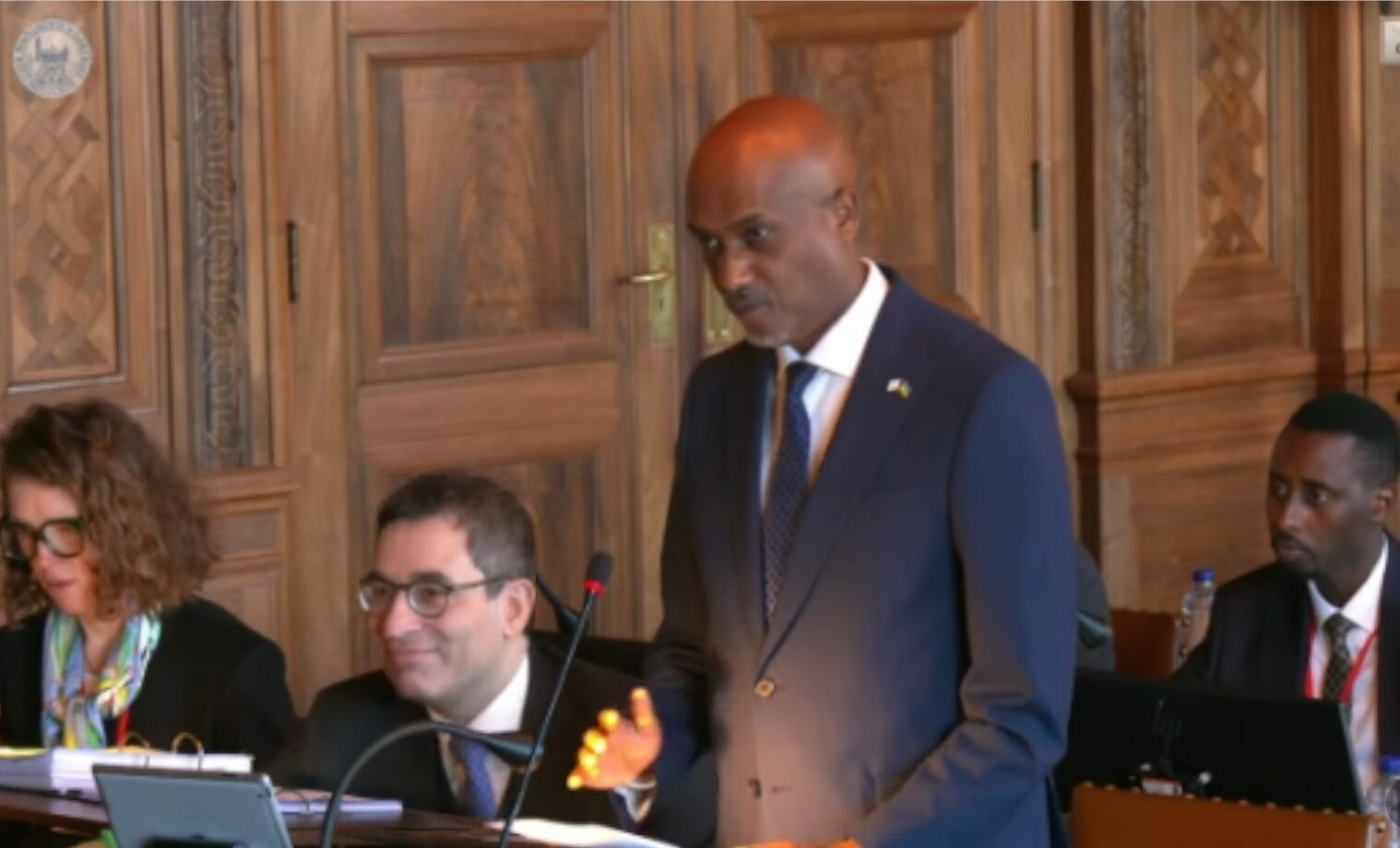
Justice Minister and Attorney General Dr Emmanuel Ugirashebuja speaking in the court this morning
The Rwanda has initiated arbitration proceedings against the United Kingdom under their asylum partnership agreement. Filed on November 24, 2025, the case is being administered by the Permanent Court of Arbitration in accordance with its 2012 arbitration rules governing disputes between states. Below was the full opening submission by Justice Minister and Attorney General Dr Emmanuel Ugirashebuja:
Rwanda v United Kingdom
PCA Case No. 45-2025
Opening remarks of Rwanda’s Agent
- Good morning, Mr President, and esteemed Members of the Tribunal. It is an honour to appear before you on behalf of the Republic of Rwanda.
- Rwanda has a deep connection to the plight of those seeking safety and security in a new land. Many Rwandans have experienced what it means to be displaced. It is this collective experience which has shaped the Rwandan Government’s policies on migration and asylum.
- Rwanda is proud to host a significant refugee population. The UNHCR has over 130,000 refugees and asylum seekers registered with it in Rwanda. Rwanda has a strong record of welcoming and hosting refugees and asylum seekers from around the world – from neighbouring countries such as the Democratic Republic of Congo and Burundi to countries further afield, such as Libya and Afghanistan. For example, as recently as last month, Rwanda received a further 164 asylum seekers from Libya on the basis of an agreement Rwanda has with UNHCR to alleviate the plight of asylum seekers in that country.
- Rwanda has long been ambitious with its refugee policies. Rwanda firmly believes that refugees make social, cultural and economic contributions to the societies in which they integrate, if they are allowed to do so.
- In May 2021, the UNHCR and Rwanda adopted a joint strategy on the economic inclusion of refugees and host communities in Rwanda. The philosophy underpinning this strategy is that the presence of refugees can be used as a catalyst for the economic development of both refugees and host communities. This is in contrast to the usual approach of ‘warehousing’ refugees, which marginalises them from their host communities and leaves them almost entirely dependent on humanitarian assistance for their livelihood.
- In September 2021, Rwanda agreed a plan with the International Organisation for Migration to resettle Afghan girls who had been excluded from secondary education by the Taliban regime. The School of Leadership, Afghanistan, was established in Kigali and continues to operate successfully, accepting applications from Afghan refugee girls all over the world.
- In August 2023, Rwanda again offered assistance to a group of students. In particular, over 200 Sudanese medical students from the University of Medical Sciences and Technology in Khartoum were welcomed to Rwanda. They had been stranded and unable to complete their studies due to the civil war and closure of universities in Sudan.
- So, when the United Kingdom sought a partner to develop a bold new approach to migration, Rwanda was an obvious choice.
- Both Parties described their partnership as the Migration and Economic Development Partnership, or MEDP.
- As the name suggests, the MEDP sought to do two things. It was aimed at deterring the dangerous migration journeys which are causing untold suffering. At the same time, it also sought to address the global imbalance of economic opportunity, which is one of the underlying causes of mass irregular migration. It reflected Rwanda’s commitment to protecting vulnerable people and built on Rwanda’s track record of welcoming and hosting refugees from around the world.
- The Partnership was one of mutual benefit. Rwanda assisted the United Kingdom in securing the policy objective of stopping illegal migration across the Channel, and the United Kingdom assisted Rwanda in improving its capacity to host and integrate refugees in Rwanda. By tying migration to economic development, as its title suggested, the MEDP would support Rwanda’s migration strategies, which, as I have explained, focused on creating opportunities for both host and refugee communities in Rwanda.
- Once the Partnership was announced in April 2022, Rwanda proceeded to implement its commitments at pace. By way of illustration, Rwanda embarked upon significant constitutional, legislative and administrative reforms to enable the implementation of the MEDP. It passed legislation. It created an appeals tribunal to hear asylum appeals under Rwandan law, which still exists today. It created at least 12 ministerial and administrative structures to deal with the MEDP. Rwanda also prepared reception facilities for the incoming refugees and incurred significant costs in doing so.
- As part of the Partnership, the Parties established the Economic Transformation and Integration Fund, or the ETIF. The funds committed under its auspices were intended to support “sustainable and inclusive economic growth within Rwanda” and to “improve the conditions of the existing refugee population and host communities”. They were originally paid under a non-binding April 2022 exchange of Notes. Once the MoU establishing the MEDP was upgraded to a binding treaty, a binding exchange of Notes followed in June 2024. It was this exchange that gave rise to what Rwanda has described as the 2024 Finance Note, under which the United Kingdom undertook to pay £50 million in ETIF funds in April 2025, and a further £50 million in April 2026.
- Shortly after the 2024 Finance Note was agreed, however, there was a change of government in the United Kingdom. The new Prime Minister declared the “Rwanda scheme” to be “dead and buried” on his first full day in office. The United Kingdom did not do Rwanda the courtesy of informing it in advance. Instead, Rwanda was left to read about these developments in the media.
- The United Kingdom then sought to walk away from its legal obligations. One of those was the United Kingdom’s obligation to pay ETIF funds to Rwanda. This led to several exchanges between the Parties, including the key November Notes Verbales, which this Tribunal will be called upon to construe.
- But the simple fact remains that the United Kingdom did not give notice to terminate the Treaty until December 2025. The termination took effect only on Monday. The MEDP was in force for just over two months under the previous British Government, and the Finance Note for just over two weeks. Both of these binding legal instruments have been in force for over 18 months under the British Government that won the elections in July 2024. Whatever assessment that British Government made of its policy interests, the obligations by which they have chosen to remain bound must be honoured.
- Rwanda’s case is straightforward. The United Kingdom may well have wished Rwanda to forgo significant sums of money. The Parties may well have had discussions on this matter but Rwanda ultimately chose not to provide its consent to the United Kingdom’s proposal. It did so in clear terms, by refusing to accept the language of “agreement” in the UK’s draft initiating Note and by omitting any language from its reply Note that could have indicated consent to be bound. The position would have been clear to the United Kingdom, as it was clear to Rwanda.
- The payment of ETIF funds is not the only obligation that the United Kingdom has sought to avoid after its change of government. The United Kingdom has also sought to avoid the resettlement of vulnerable refugees from Rwanda under Article 19 of the MEDP. In March 2025, Rwanda invited the Joint Committee, comprised of Rwandan and British representatives, to urgently finalise arrangements for the resettlement of refugees in the United Kingdom, noting that the United Kingdom had failed to take action to fulfil its obligations. As the Tribunal will see, the United Kingdom’s response was to refer to its intended termination of the Agreement, making it clear that it was going to take no steps to perform any of its obligations in view of its intentions. This, Rwanda submits, was a clear refusal to take steps to negotiate the resettlement of refugees under the Agreement. It could not have been anything else. Rwanda seeks a modest sum in compensation, less than 10% of the UNHCR’s budget for Rwanda for one year alone, or alternatively an apology for the United Kingdom’s blatant disregard of this obligation.
- Rwanda regrets that it has been necessary to commence this arbitration. At all times, Rwanda has sought to perform its obligations under the MEDP in good faith, in the spirit of the partnership that had always characterised the Parties’ cooperation on the issue of illegal migration. However, the United Kingdom’s intransigence on the two issues that I have outlined has left Rwanda with no other choice to vindicate its rights, and secure the substantial sums of money of which Rwanda has been deprived.
- Rwanda has enormous faith in this Tribunal to reach the right legal result. Whatever the outcome, Rwanda remains committed to finding solutions to the global migration crisis, including providing safety, dignity and opportunity to refugees and migrants who come to our country.
- Mr President, that concludes my remarks. I now invite you to give the floor to Lord Verdirame.
Visited 35 times, 35 visit(s) today
