


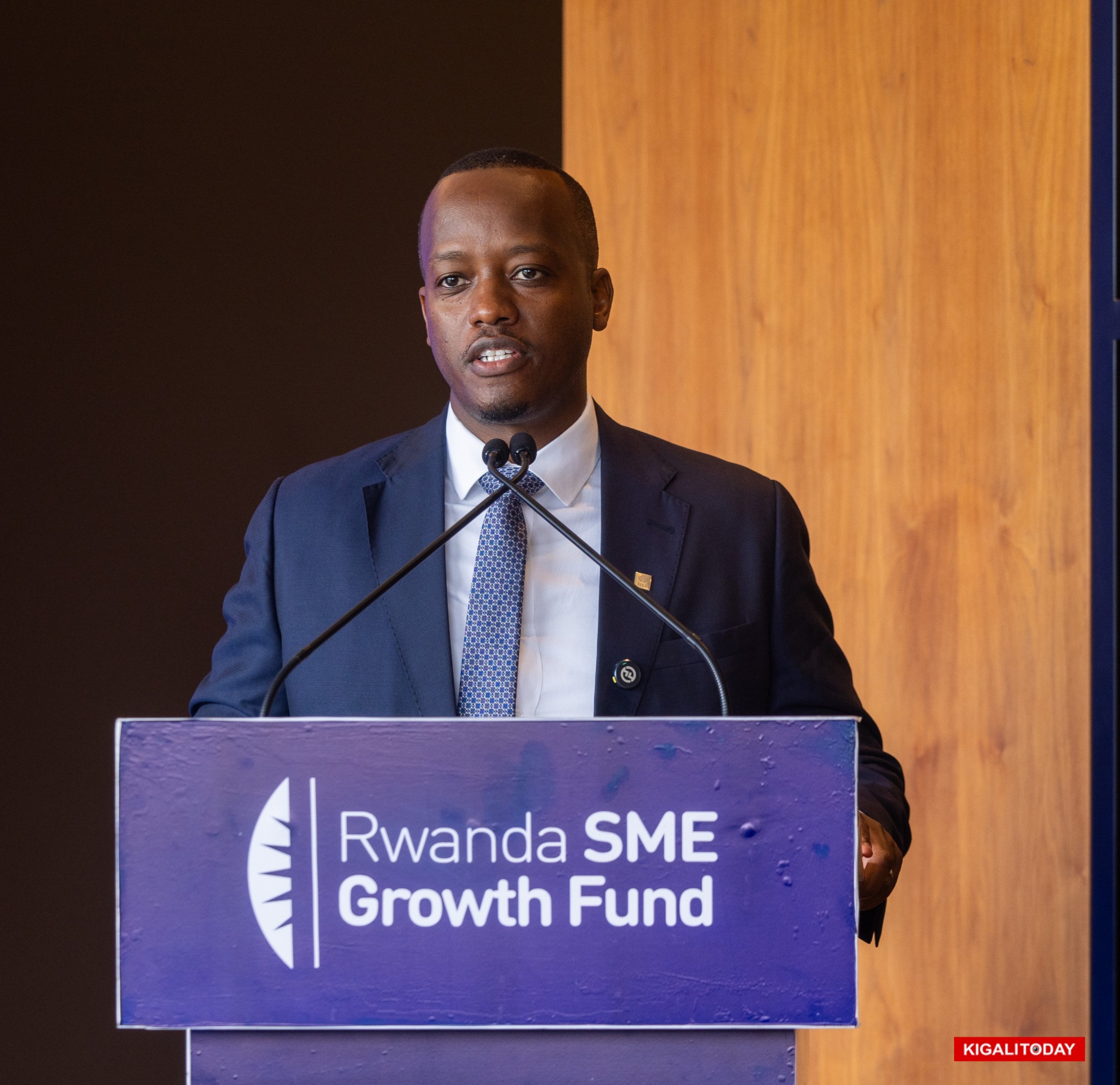
RSSB CEO Regis Rugemanshuro speaking on Monday during the unveiling of the scheme
KIGALI — When Rwanda Social Security Board (RSSB) announced a $30 million commitment to a new fund targeting small and medium-sized businesses, the headline figure was modest. The underlying shift, however, was not.
Across much of Africa, the challenge facing small businesses is well known: access to capital that is both affordable and patient. Banks tend to offer short-term loans, often at high interest rates and backed by strict collateral requirements.
International investors, when they step in, typically focus on larger or more mature markets, leaving a gap at the core of many economies.
What distinguishes Rwanda’s latest move is not the creation of another SME fund, but the source and structure of the capital behind it.
In developed economies, pension funds routinely invest in private companies, infrastructure and long-term credit vehicles, seeking returns that match their long-term liabilities. These investments help finance economic growth while generating income for retirees.
In Africa, by contrast, pension assets have historically been deployed more conservatively, concentrated in government bonds and real estate, with limited direct exposure to the private sector.
Rwanda’s approach begins to narrow that gap.
By acting as the anchor investor in a domestically managed fund, the social security board is effectively channeling national savings into national enterprise. The capital is structured in local currency, designed for longer investment horizons, and targeted at companies that have outgrown early-stage financing but remain constrained by traditional lending.
“This is a shift toward African capital driving African growth,” said Cyrille Nkontchou, co-founder of the fund’s managing partner. “It positions SMEs at the center of economic transformation.”
The implications extend beyond the immediate beneficiaries. Pension-led investment introduces a different kind of discipline into the system. Unlike donor-backed initiatives, which may be guided partly by development priorities, pension capital must ultimately generate returns. That requirement imposes constraints — and, potentially, credibility.
If successful, the model could help address a structural imbalance in African finance: the reliance on external capital to fund domestic growth.
By contrast, Rwanda’s initiative suggests a pathway in which internal savings are mobilized more directly, creating a feedback loop between workers, capital markets and the real economy.
The design of the fund reflects that ambition. Investments are expected to be deployed gradually, tied to performance milestones, with repayment periods extending well beyond typical bank loans.
The focus on sectors such as manufacturing, agro-processing and energy aligns with broader industrialization goals, including reducing import dependence and expanding exports.
Yet the innovation carries risks.
Deploying pension capital into relatively illiquid and uncertain investments exposes the system to potential losses, particularly if governance falters or investment decisions are influenced by non-commercial considerations. The success of such a model depends less on the concept itself — widely proven elsewhere — and more on execution.
There is also the question of scale. At $30 million, the fund is unlikely to transform the financing landscape on its own. Its significance lies more in precedent than in size. If the model proves viable, it could be replicated, expanded and adopted by other institutional investors across the region.
For now, the initiative represents a calculated step toward financial maturity — an attempt to align Rwanda’s capital allocation with practices more commonly associated with advanced economies, while adapting them to local realities.
The broader question is whether this marks the beginning of a sustained shift.
If pension funds across the continent begin to follow a similar path, the impact could extend well beyond individual investments, reshaping how African economies finance their own growth.
