


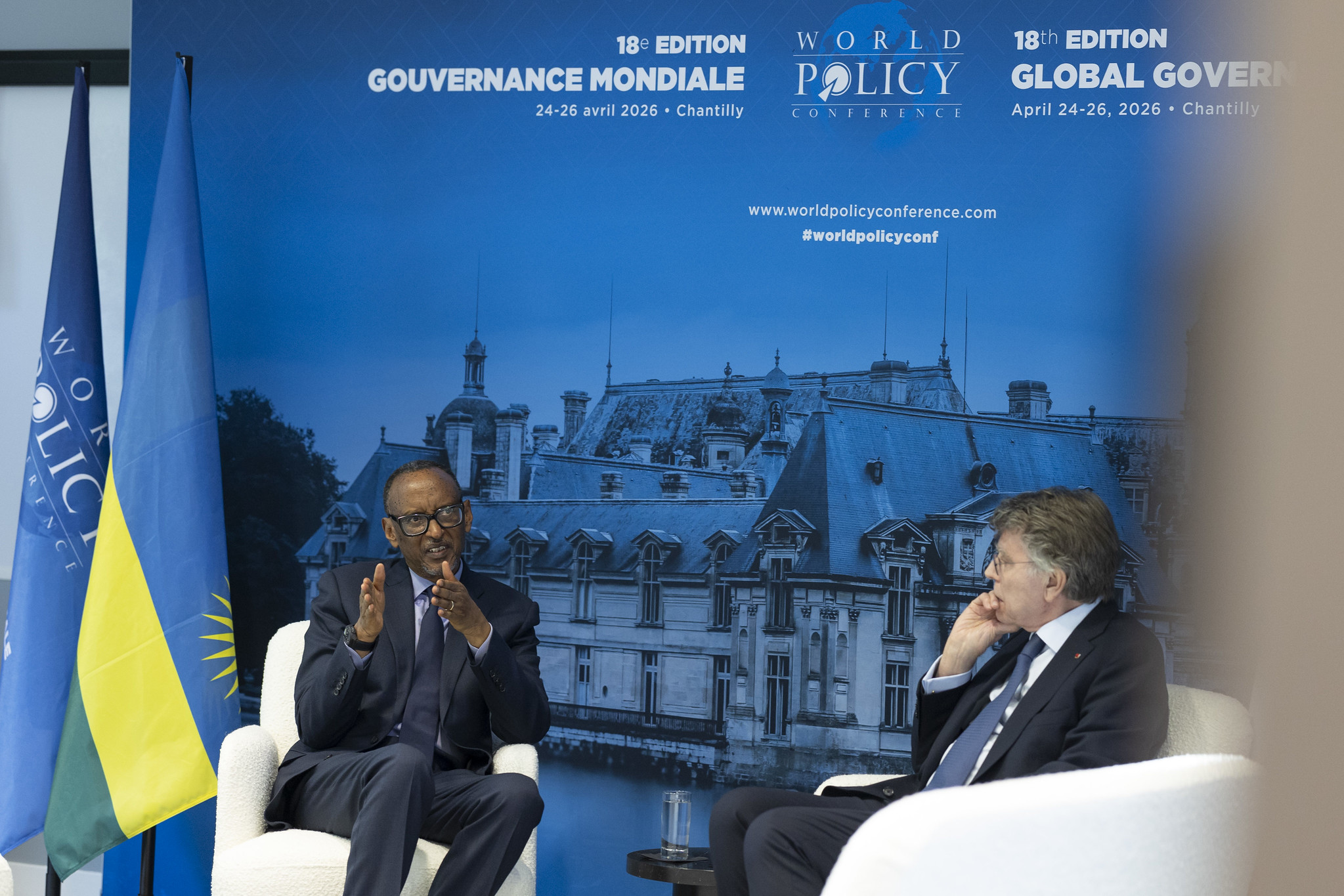
President Kagame in Q&A session with Thierry de Montbrial, the founder and Executive Chairman of the World Policy Conference (WPC)
At the recent World Policy Conference, President Paul Kagame did more than defend Rwanda. He spoke on behalf of Africa and the wider Global South, calling for a fundamental rethinking of an international system that, in his view, has long served the powerful while marginalizing everyone else.
In a wide-ranging discussion, Kagame warned that the global eagerness to return to normal overlooks a deeper structural problem. He urged his audience to reconsider what stability really means.
For decades, stability has often translated into a world in which violence and instability are displaced onto poorer nations, while wealthier countries enjoy peace and prosperity. What has appeared stable from one perspective has, for others, meant dispossession and insecurity.
Taking Kagame’s point into account, it became clear that returning to that same arrangement is not a solution but a regression to the very conditions that have produced today’s crises.
He also challenged the tendency to personalize global instability, as seen in expressions such as the “Trump phenomenon”. From his response, the issue is not individuals; it is about the political systems and what leaders they produce.
In his view, political developments in Western countries, along with their wider consequences, are rooted in “unresolved contradictions” within those societies.
For years, these tensions were allowed to persist, perhaps because instability was widely assumed to be a problem confined to poorer regions. That assumption is now proving dangerously misguided.
Kagame’s remarks pointed to a broader need to move beyond the idea that the Global North will always set the terms of global affairs. Countries such as Rwanda, along with other smaller states and middle powers, cannot be expected to fall into line indefinitely while their core interests are overlooked and the existential threats they face are dismissed.
A more balanced and inclusive approach to international relations is not simply desirable; it is necessary.
Notably, Kagame did not direct criticism solely outward. He was equally candid about Africa’s own shortcomings. He argued that Africans must take some responsibility for having internalized the notion that they have little to offer the world and accepted the dictates of the West.
Too often, Kagame suggested, African countries have struggled to build cohesive nation states, remaining constrained by tribal divisions that continue to fuel instability.
As a result, progress in development has frequently fallen short of expectations: “not much to be proud of”.
His assessment was blunt, but it was not intended as self-pity. Rather, it was a call for self-reflection and renewed effort. After all, Africa, Kagame insisted, possesses the resources, knowledge and rich cultures required to succeed.
Throughout his intervention, Kagame resisted portraying Africa as a passive victim of global forces. Instead, he emphasized agency and responsibility. He also rejected the lure of identity-driven responses that risk deepening divisions. His message was one of cooperation rather than confrontation.
Addressing global crises, the Head of State argued, demands greater collaboration across regions and perspectives, not further division.
Kagame could have limited his remarks to Rwanda’s immediate concerns. Instead, he chose to speak for Africa and the Global South. He focused not on personalities but on the structures that shape global outcomes.
In doing so, he issued a clear warning: the existing model, in which powerful nations dictate terms backed by implicit or explicit threats, is no longer sustainable. The consequences of this imbalance are increasingly visible in conflicts and tensions that are spiraling out of control if left unchecked.
Kagame’s intervention was a reminder that true leadership in turbulent times means taking a step back, having an aerial view of the problems at hand, and always choosing the path to more unity.
In fact, Rwanda’s own journey under his leadership can inspire the world to imagine the possibility that yesterday’s bitter enemies can become allies in the search for a common future of peaceful coexistence.
This is only possible under a new, more just world order. We cannot return to an old one that only ever worked for the few. The question is whether the Global North is ready to listen.
