


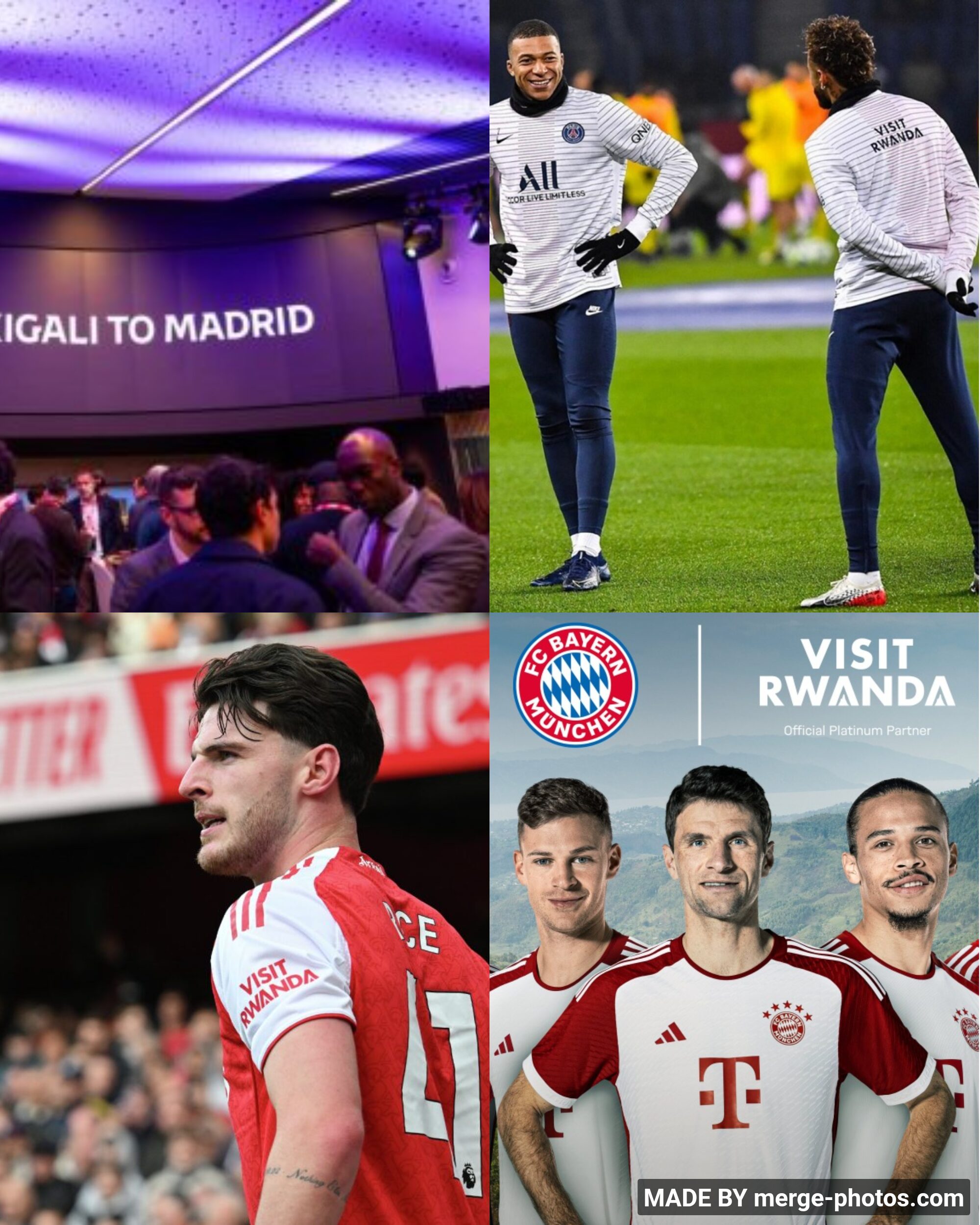
KIGALI — In 2018, when Rwanda first secured a sponsorship deal with Arsenal, the move was viewed as an unusual experiment: a small African country placing its tourism brand on the sleeve of one of Europe’s biggest football clubs.
Eight years later, that bet has converged in an unexpected way, with all four semifinalists in this season’s UEFA Champions League — Paris Saint-Germain, Bayern Munich, Atlético Madrid and Arsenal — linked, in different ways, to Rwanda’s “Visit Rwanda” campaign.
The alignment is improbable, but not accidental. Since that first agreement, brokered by the Rwanda Development Board, Rwanda has pursued a deliberate strategy of embedding its national brand across Europe’s top football leagues.
Partnerships with Paris Saint-Germain in 2019, Bayern Munich in 2023 and Atlético Madrid in 2025 extended the campaign’s reach across France, Germany and Spain, turning what began as a single sponsorship into a multi-club presence spanning the continent’s most-watched competitions.
At its core, the approach reflects a broader shift in how countries compete for attention. Rather than relying on traditional advertising or diplomatic channels, Rwanda has leveraged the global visibility of elite sport to position itself as a tourism and investment destination.
The exposure is vast: Champions League broadcasts reach hundreds of millions of viewers, offering repeated, high-impact visibility at moments of peak global attention.
Government has long argued that the strategy has translated into tangible economic gains. Tourism revenues have risen in recent years, reaching roughly $650 million annually, alongside increases in visitor numbers and longer stays.
The branding effort has also been tied to wider ambitions — attracting foreign investment, promoting conferences and elevating the country’s international profile.
The logic is cumulative. A single sponsorship may generate awareness; multiple partnerships across leagues create saturation.
By appearing simultaneously across different teams, competitions and markets, Rwanda’s message is reinforced rather than isolated — a network effect that is now visible on one of football’s biggest stages.
In that sense, Rwanda’s approach echoes a model more commonly associated with wealthier nations. Countries such as Qatar and the United Arab Emirates have long used sports partnerships to project influence and reshape their global image.
Yet Rwanda’s version differs in both scale and emphasis. Without the financial depth of energy-rich states, it has focused narrowly on tourism, using relatively targeted investments to maximize exposure rather than dominate entire leagues or competitions.
That constraint has, in some ways, sharpened the strategy. By selecting clubs with global followings and sustained competitive performance, Rwanda has effectively tied its brand to excellence and visibility — qualities that are amplified when those clubs advance deep into major tournaments.
Still, the approach carries risks.
Visibility, particularly on global platforms, invites scrutiny. Some fan groups in Europe have criticized the partnerships, raising concerns about governance and regional tensions the greatlakes.
Yet even with those caveats, the current moment represents a rare convergence of planning and outcome.
A strategy launched incrementally — one partnership at a time — has culminated in a scenario where Rwanda’s branding is embedded across every semifinal fixture of Europe’s most prestigious club competition.
It is, in effect, a demonstration of how smaller economies can leverage global platforms to extend their reach. By aligning national branding with the rhythms of international sport, Rwanda has inserted itself into a space typically dominated by far larger players.
As the semifinal matches unfold, the campaign has achieved something more immediate: it has made Rwanda visible, repeatedly and unmistakably, at the center of one of the world’s most-watched events.
No matter how the semifinal ties unfold in the days ahead — whether Paris Saint-Germain or Bayern Munich advances, or Atlético Madrid or Arsenal prevails — the visibility of the Visit Rwanda campaign is unlikely to fade with the final whistle.
The partnerships extend beyond a single match or even a single tournament, ensuring that the brand remains embedded in club competitions, domestic leagues and global broadcasts well into the next season, sustaining a level of exposure that outlasts the immediate drama of the Champions League.
