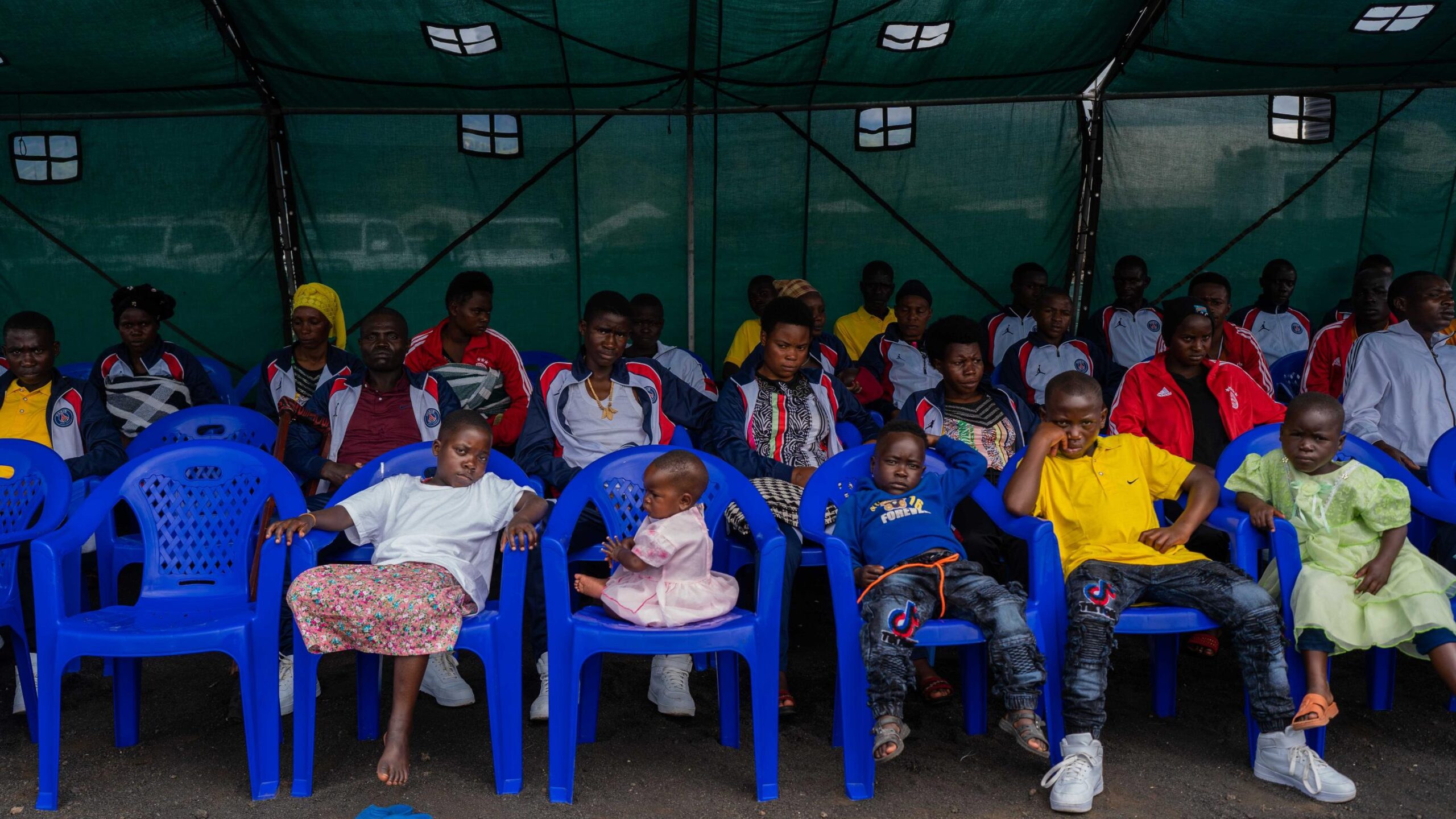
Contrary to false narrative that there is “No FDLR”, there are hundreds of FDLR combatants and their families currently inside a MONUSCO base in Mubambiro, 20km west of Goma. Beginning next week, over 70 FDLR combatants will be repatriated to Rwanda.
Recently, during the Kwibuka32 commemoration event, I watched a video that perfectly captured the paradox of our regional politics and the disconnect between international diplomacy and the reality of life on the ground in Rwanda.
One Kanimba – a staff member from the Rwanda Revenue Authority (RRA) stood up and directed a poignant, almost innocent question to the Rwanda Defence Force (RDF) spokesperson, Brig. Gen. Ronald Rwivanga.
“I have seen so many statements from Western powers putting Rwanda under pressure to lift its ‘defensive measures,’” the staffer said, his voice echoing the sentiments of many silent observers.
“But I ask myself,” he added: “Should a country leave its territories wide open without defensive arrangements? Is it possible?”
The room erupted in laughter—a mixture of irony and shared understanding. Even Gen. Rwivanga could not hide a smile, jokingly asking the staffer to pose that same question on his behalf.
It was a lighthearted moment, but it touched on a deadly serious reality: Why is the world asking Rwanda to lower its guard while the threats on its doorstep are louder, heavier, and more explicit than ever?
To understand why this question resonates so deeply, we must first strip away the clinical jargon of international diplomacy and look at what “defensive measures” actually mean.
To a diplomat in Washington or Brussels, “lifting defensive measures” is a line item in a communique.
To a resident of Rubavu District in the Western part of Rwanda which borders the Eastern DRC, or Musanze District – a few kilometers away in the Northern Rwanda, it is the difference between a peaceful night’s sleep and a morning spent dodging heavy artillery.
These measures involve the strategic deployment of personnel and advanced technology—like the sophisticated interceptor weapons that quietly neutralized heavy shellings directed at Rwandan soil just a year ago.
What surprised everyone on the ground during that period was the sheer volume of artillery heard, yet the minimal damage sustained on the Rwandan side. This was not luck. It was a calculated, defensive shield by the Rwanda Defence Force (RDF).
Without these measures, the “intentions to decimate” Rwanda, expressed by those staging thousands of heavy weapons in Goma, would have moved from rhetoric to a bloody reality.
We witnessed thousands of heavy weapons positioned at the border, aimed directly at our homes. We heard the Congolese leader openly state they had the capacity to “bomb Kigali” right from Kinshasa.
In such a climate, asking a nation to disarm is not a call for peace; it is a request for vulnerability.
The global community often watches the Democratic Republic of Congo (DRC) through a selective, almost filtered lens.
We hear the Congolese leadership openly offering minerals beneath their land — estimated at a staggering $34.1 trillion—to the United States and others in exchange for “taking care” of their security and development.
It is a transaction of earth for influence. Yet, we see a disturbing, hollow silence when drones and militias murder Banyamulenge and other Kinyarwanda-speaking Congolese in broad daylight.
Where are the alarm bells for those being slaughtered because of their language or their heritage?
Instead of addressing the root causes of instability—including the 130 militia groups operating in the Eastern DRC—the focus remains stubbornly fixed on Rwanda.
The UN Group of Experts reports seem to possess a singular obsession, a “Why always Rwanda?” complex that brings to my mind the famous undershirt of footballer Mario Balotelli.
As a diehard Manchester United fan, I keep memory of one horrible evening of October 2011. It was an evening of the famous “Manchester Derby” on October 23, 2011.
`The Derby ended in a 6–1 victory for Manchester City over my beloved Manchester United team at Old Trafford.
It was the largest home defeat for legendary coach Sir Alex Ferguson during his tenure at Manchester United and the first time United had conceded six goals at home since 1930.
During this Derby, Italian striker Mario Balotelli scored the opening goal in the 22nd minute. He calmly pulled up his jersey to reveal an undershirt with the message: “Why Always Me?”
For Rwanda, the question is equally pertinent. Why is the blame always directed toward the one country in the region that has managed to build a functional, secure, and accountable state from the ashes of total destruction?
I recently found myself pondering this phenomenon while on a sharp weekend walk through the mbanicured pathways of the Nyandungu Eco-Park, which has become my go-to place for weekend workouts.
The park itself is a symbol of the new Rwanda; orderly, beautiful, and reclaimed from wasteland. I love the place.
While on a sweaty walk through this park, I bumped into a veteran politician, an old friend I have interviewed during my time as a field journalist. He had also come for his weekend walk.
As we strolled along the paved pathways, I pushed him to explain the genesis of this friction. “Why is Rwanda perpetually at the crossroads of these international reports?” I asked.
His answer was a revelation that spanned three decades. He traced the friction back to 1994, to the moment the Rwanda Patriotic Front (RPF) stopped the Genocide against the Tutsi and established a Government of National Unity.
At that time, the country was a graveyard. There was no budget, no police force, and no infrastructure.
Western NGOs swarmed the country, bringing aid but also their own agendas. However, Rwanda’s new leadership did something “stubborn” and “disrespectful” to the established global order: they demanded accountability.
The government told these NGOs that to operate in Rwanda, they had to be registered through a formal Ministry and align their work with national priorities.
The NGOs mocked the idea. They could not believe that a nation so broken had the “guts” to force Western aid organisations to operate in a structured way.
When Rwanda stood its ground and eventually expelled those who refused to comply, those organisations moved across the border to Eastern DRC.
There, they built a $4 million-a-day humanitarian industry in refugee camps that were, in reality, being used as staging grounds by the FDLR—the remnants of the forces that perpetrated the 1994 Genocide against the Tutsi back in Rwanda.
By demanding sovereignty and later dismantling those camps to bring hundreds of thousands of Rwandans home, the government “broke their plate” twice.
Rwanda simply disrupted a lucrative, chaotic status quo. According to my friend, the relentless cycle of negative reports we see today is the long-term fruit of a coordinated “anti-Rwanda project” launched by a network that stretches from the DRC to New York.
It is a “beef” that the international NGO-industrial complex has never quite let go of.
This brings us back to the fundamental question of safety. Is Rwanda a house with an open fence and doors that the owners can simply leave ajar while they spend their day elsewhere?
The answer, as any young Rwandan who has seen the recent escalations will tell you, is a resounding “No.”
We have seen the staging of arms in Goma. We have heard the FDLR’s genocidal ideology persist, with relatives of those in the DRC warning people in Rubavu and Musanze to “vacate” because they were coming to “finish the job.”
If Rwanda were to “belittle” these threats or succumb to the pressure to lift its defensive measures, it would be a betrayal of the 1994 victims and a gamble with the lives of every citizen living today.
Security is not a luxury; it is a prerequisite for everything else—for the RRA staffer to collect taxes, for the children to attend school, and for the investor to put money into our economy.
President Paul Kagame has been the most consistent voice on this matter. He has frequently reminded the world that Rwanda’s safety is not a commodity to be traded or a point of negotiation. His words reflect a deep understanding of our history and a refusal to repeat it.
These are not just statements; they are the guiding principles of a nation that has learned the hard way that when the world says “Never Again,” it often lacks the conviction to back it up with action.
Therefore, Rwanda must be its own guarantor of “Never Again.”
For the young generation in Rwanda and those watching from abroad, the lesson is clear. The pressure to “lift defensive measures” is often a request to return to a state of dependency and vulnerability.
It is a request to allow the chaos of the region to spill over into a country that has worked tirelessly to contain it.
The over 130 militia groups in the DRC, the drones targeting civilians, and the heavy artillery staged at our borders are the realities we face. The “Why Always Rwanda?” reports are the noise designed to distract Rwandans from those realities.
The defensive measures that the West finds so inconvenient are the very things that allow Rwandans to build parks like Nyandungu and host international events in a safe Kigali.
So, as my friend says, “We keep our gates locked and our defenses sharp not because we are “stubborn,” but because we know exactly what happens when the door is left open.”
“Rwanda is a home that belongs to its people, and its people have decided that they will never again go to bed leaving the house wide open for those who have spent thirty years dreaming of its destruction,” he adds.
The answer to the RRA staffer’s question remains simple: No, it is not possible to leave the door open. And as long as the threats remain, the locks will stay in place.
The Writer, Dan Ngabonziza, is the Managing Director, Kigali Today Ltd, the parent company of KT Press, KT Radio 96.7FM, KigaliToday.com (Kinyarwanda) and Kigali Today TV channel.