


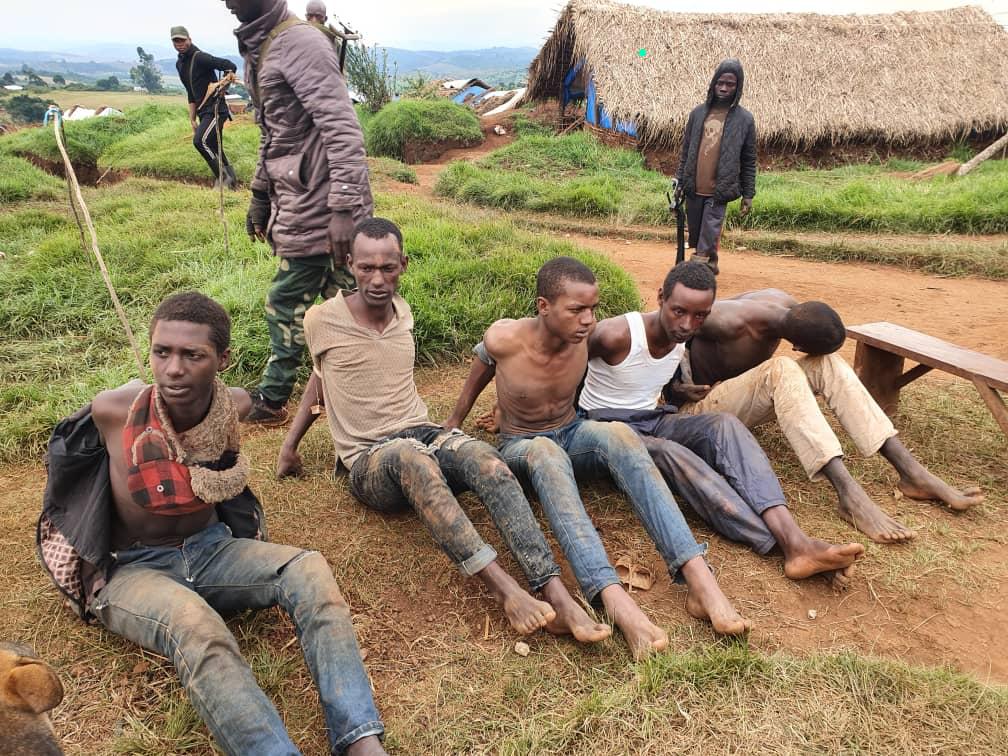
These are not combatants captured in the battlefield. They’re Congolese civilians rounded up simply because they are Kinyarwanda-speakers suspected of possible links to M23 rebels. Simply being Tutsi is equated to association. Their captors, the Congolese army and Wazalendo militias decided the fate without due process
In 1994, the world watched as one million Tutsi were slaughtered in Rwanda. We swore never again. Yet today, in eastern DR Congo, President Félix Tshisekedi’s regime is systematically carrying out acts of genocide against Congolese Tutsi, and the world is silent once more.
The evidence is overwhelming. Acts of cannibalism targeting Tutsi are a common occurrence. In August 2024, Mai Mai militiamen allied with the Congolese government lynched a Tutsi civilian in the Misisi area of South Kivu and then consumed his flesh.
The M23 reported that dozens of similar cases have been documented in the past two years. These acts of brutality are dehumanization made literal, the consumption of human flesh as an expression of genocidal hatred.
The destruction of entire Tutsi villages takes place in plain sight. Attempts to erase Banyamulenge from the face of the earth in South Kivu, which reemerged in 2017, echo a pattern seen in October 2023, when the village of Nturo in North Kivu, which contained around three hundred homes owned by Congolese Tutsi, was systematically annihilated.
Fighters from the FDLR, a militia founded by the perpetrators of the 1994 genocide against the Tutsi in Rwanda, attacked over three consecutive days. On the final day, they came with gasoline canisters, deliberately sprayed every house, and set them on fire.
Video footage shows the attackers acknowledging that they were wiping a Tutsi village off the map. Harvard scholar Bojana Coulibaly, who investigated the attack, concluded that this was proof of ongoing ethnic cleansing of Congolese Tutsi in eastern Congo.
As for the daily bombardments against Banyamulenge villages in Minembwe, the evidence abounds. Just to name of a few examples: in March 2025, the Congolese army and its allies deployed fighter jets and attack drones to bomb those villages.
In December 2023, over thirty Banyamulenge were killed in attacks by two Mai Mai factions allied with the army. Besides the killings, there is the destruction of livestock and cattle, which is deliberate: it targets the economic foundation of the Banyamulenge pastoralist way of life, the very means of survival of the group.
Starvation has been used as a weapon, not only in Minembwe where a medieval siege was imposed on Banyamulenge to prevent them from reaching markets and providing for their basic needs, but also in Bwiza and its surroundings, where in December 2022, Tutsi refugees who had sought shelter in M23 held areas were denied humanitarian aid. Kinshasa had threatened NGOs that they would lose their licenses if they operated in those zones, so the aid never came.
Nearly seventeen thousand displaced people were left without food, water, or medicine, deliberately subjected to conditions calculated to destroy them.
Massacres targeting Hema communities, assimilated to Tutsi, have also been relentless. In February 2024, at least 62 internally displaced Hema people were killed and 38 injured by the CODECO armed group in an overnight attack on the Plaine Savo camp.
Victims were shot or attacked with machetes and knives. In June 2023, CODECO fighters killed 46 civilians at the Lala camp, half of them children. They shot, hacked, or burned 23 children, 30 women, and 10 men, then burned down dozens of huts with civilians still inside.
Kenyan Masai and Somali truck drivers, all of whom are assimilated to Tutsi simply because of certain physical features, have also been murdered.
All of this is driven by state-sponsored hate speech. Patrick Muyaya, the Communications Minister, went on National Television and declared that women had been particularly victims of the atrocities committed by the Tutsi, thereby justifying attacks on them.
The FARDC spokesperson, General Sylvain Ekenge, went ahead and accused Tutsi women of all sorts of deceit, inviting Congolese not to marry them. Pro-government mobs routinely shout that Tutsi should go back where they came from, using the same dehumanizing terms like cockroaches and rats that were used in Rwanda before the genocide.
The former UN Special Advisor on Genocide Prevention Alice Wairimu Nderitu has warned that these are risk factors for atrocities.
Most damning of all, the Congolese government is arming and integrating into its army the FDLR, a militia founded by the actual perpetrators of the 1994 genocide against the Tutsi in Rwanda.
A UN Group of Experts report in May 2024 confirmed that the FDLR had been integrated into the Congolese military. Simply put, Kinshasa is actively partnering with an organization whose core purpose is the extermination of Tutsi.
The legal definition of genocide under the 1948 convention includes killing members of a group, causing serious bodily or mental harm, and deliberately inflicting conditions of life calculated to bring about the group’s destruction.
The Tshisekedi regime has demonstrated every single one of these elements, and most certainly it has demonstrated intent, which is the core element of the crime of genocide. The question is not whether acts of genocide are occurring. The question is how many make a genocide, and when the international community will act.
The only reason these atrocities have not reached the scale of 1994 is because the M23 and Twirwaneho have resisted in defense of these communities. To a certain extent, the Ugandan military presence has also restrained genocidal violence against Hema communities in areas where it can intervene. But this is not nearly enough.
The world must act now, not when a catastrophe has already unfolded. It must call a spade a spade. The United Nations Security Council must hold an emergency session.
The International Criminal Court must open a formal investigation into genocide charges.
Never again means acting before the bodies pile high enough to capture the world’s attention. The Tutsi of eastern Congo cannot wait any longer.
