


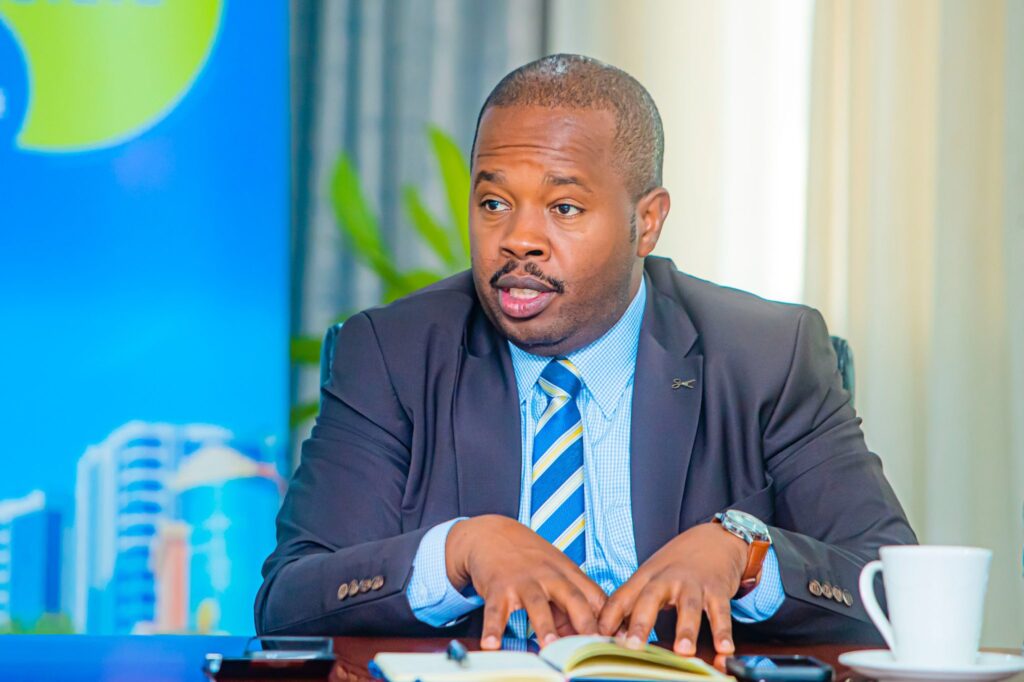
Kigali City Mayor Samuel Dusengiyumva.
KIGALI – At 13, Samuel Dusengiyumva stood on the fragile edge between childhood and responsibility. In another time, his life would have revolved around school and dreams still taking shape. Instead, in 1994, he was thrust into a reality defined by fear, loss, and the instinct to survive.
“I was still a child but my mother kept reminding me, ‘You are the man of the house.’ She trusted me with everything, decisions, responsibilities, even things far beyond my age,” he recalls,
As the eldest of five children in what was then Ntongwe commune, his world was anchored by faith and service. His mother, a midwife at Mukoma Health Center, was deeply respected, while his father, a Baptist pastor, dedicated his life to ministry. But beneath that stability, tension had been quietly building, until it exploded in April 1994.
A promise of safety that became a death trap
In the days following April 7, the signs of catastrophe became impossible to ignore. Smoke rose from burning homes, and bodies began to appear in rivers. “We saw it coming, but we didn’t understand how far it would go. At first, it felt like violence we might escape. Then it became something else entirely,” Dusengiyumva says.
On April 11, after what would be their final meal together, his mother made a decision that would linger in his memory. “She told us to wear as many clothes as possible. She didn’t explain, but you could feel the urgency in her voice,” he recalls.
That night, a warning reached them: their family was being targeted. They fled to the health center, where his mother hid four of her children under a delivery table, covering them carefully, while she remained exposed with the youngest.
“She believed that if the killers came, they would take her and leave us. It was her way of protecting us—offering herself first,” he says.
The next morning, still alive but deeply vulnerable, she sought protection from the local mayor, Charles Kagabo. His reassurance was calm and convincing: gather at the commune office, where security would be guaranteed.
Thousands followed the same instruction. “It felt organized, almost reassuring. There was no chaos on the way. We believed we were being protected.,” Dusengiyumva recalls.
But what appeared to be safety was, in reality, a calculated trap. More than 100,000 Tutsis had been assembled in one place, not for protection, but for extermination.
Encircled and attacked
The first large-scale assault came on April 19. Armed militias advanced in waves, supported by reinforcements. Those gathered at the commune resisted with stones, a desperate act against overwhelming force.
“We tried to defend ourselves, but deep down, we knew it couldn’t last,” he says.
Within days, the plan intensified. Soldiers were brought in, and escape routes were carefully controlled. Then came a final instruction, one that would seal their fate: they were told to flee toward Ruhango.
“At Nyamukumba, everything collapsed. Soldiers opened fire on us without warning. Grenades followed. People were falling everywhere,” Dusengiyumva recalls.
For nearly an hour, gunfire tore through the fleeing civilians. When it paused, militias descended from surrounding hills to finish the killings with crude weapons. “The noise was unbearable. Screams, gunshots, chaos, it’s something that never leaves your mind,” he says.
In the confusion, he fled with one of his younger siblings, climbing toward higher ground. Around him, families were torn apart in seconds. It was the moment he lost sight of nearly everyone he loved.
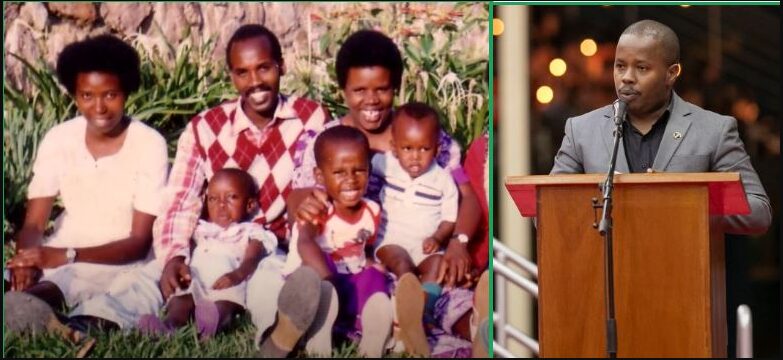
As the eldest of five children, Dusengiyumva stood on the fragile edge between childhood and responsibility.
Faith, loss, and a mother’s final choice
His father was captured at a roadblock while attempting to escape along another route. According to accounts later shared, he faced his killers with calm resolve. “They told him he was going to die. He didn’t resist. He asked to pray first,” Dusengiyumva says.
In his final prayer, his father did not ask for survival, but for mercy. “He said, ‘If any of you repent, may God forgive you.’ Then he told them he was ready.” He was killed moments later.
“My father accepted death with faith. He believed he was going to meet God,” Dusengiyumva reflects. Elsewhere, his siblings were hunted down and killed.
In the midst of this devastation, he saw his mother for the last time. A family preparing to flee to what was then Zaire offered to take one child with them. “She didn’t hesitate. She told them, ‘Please take my child. Maybe he will survive,’” he says.
It was a decision shaped by both love and clarity, a recognition that survival, even for one, mattered. “I didn’t get to say goodbye properly,” he adds. “Everything happened so quickly.” She and the youngest child were later killed.
A prayer that opened the path to survival
Even after escaping, Dusengiyumva’s life remained in danger. In another commune, he was recognized and surrounded by Interahamwe who had tracked him. “They told me, ‘We killed your father and your siblings. Now it’s your turn,’” he recalls.
As they prepared to kill him, one voice intervened: “Let him pray first. His father was a pastor.”
Standing on the edge of death, he prayed. “I prayed more than I had ever prayed before,” he says. “It was not just words—it was everything inside me.”
That moment bought him time. A child who had been with him ran to alert local authorities, and police arrived just in time to disperse the attackers.
“I was ready to die,” he says quietly. “Then suddenly, I was still alive.”
He eventually reached areas secured by the RPF Inkotanyi, where, for the first time in months, he felt safe. “I remember feeling like I could breathe again. Like I had been given another chance,” he says.
Dusengiyumva would go on to rebuild his life with determination. He returned to school, excelled, and eventually graduated. In 2008, he married a doctor, reflecting the path his mother had once walked, and together they built a family grounded in remembrance.
“On my wife’s advice, we named our children after my siblings. It’s our way of keeping them alive,” he says.
Today, as Mayor of the City of Kigali, he carries both responsibility and memory. His journey is not only one of survival, but of endurance, faith, and the quiet strength to rebuild after unimaginable loss.
“Those of us who survived must give our children the love we lost. We must fill that gap,” he says.