



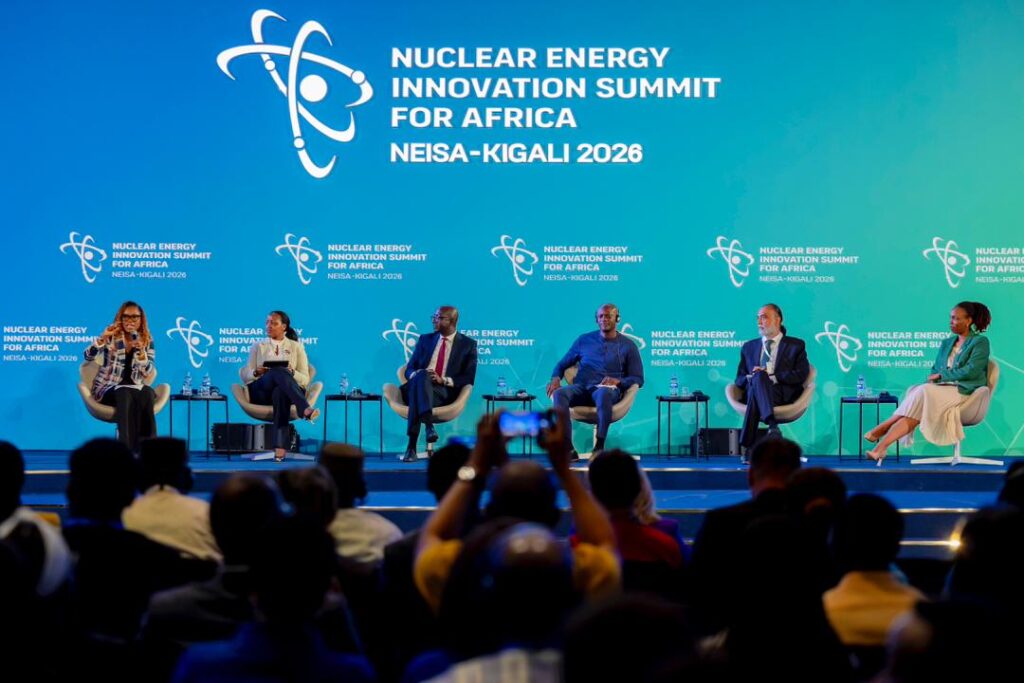
Speakers during a plenary session on industrial demand and nuclear deployment.
KIGALI — For decades, African countries have exported raw minerals while the real profits were captured elsewhere through refining, manufacturing, and advanced industrial production. Rwanda now aims to break that cycle, believing nuclear energy could be the missing link.
At the Nuclear Energy Innovation Summit on Africa (NEISA) 2026, government officials outlined a strategy tying Rwanda’s future small modular reactor (SMR) program directly to mining, industrialization, artificial intelligence infrastructure, and high-value mineral processing.
Speaking during a plenary session on industrial demand and nuclear deployment, Rwanda’s Minister of ICT and Innovation, Paula Ingabire, explained that the country refuses to remain a mere supplier of raw materials in a rapidly changing global economy.
She described nuclear energy as essential to Rwanda’s long-term economic competitiveness, especially as global industries increasingly depend on energy-intensive technologies like AI, advanced manufacturing, and mineral processing.
“For Rwanda being a landlocked country and import dependent country, especially when it comes to fossil fuels, investing in an SMR becomes a non-negotiable,” Ingabire said.
Her remarks reflect a broader global shift where energy planning is no longer viewed merely as a public utility challenge, but as the backbone of economic development.
Rwanda has already announced plans to deploy an SMR within the next decade. Unlike conventional nuclear plants, SMRs are smaller, scalable, and designed to provide stable electricity for industries, special economic zones, and large infrastructure projects.
Mining Sector Facing Energy Constraints
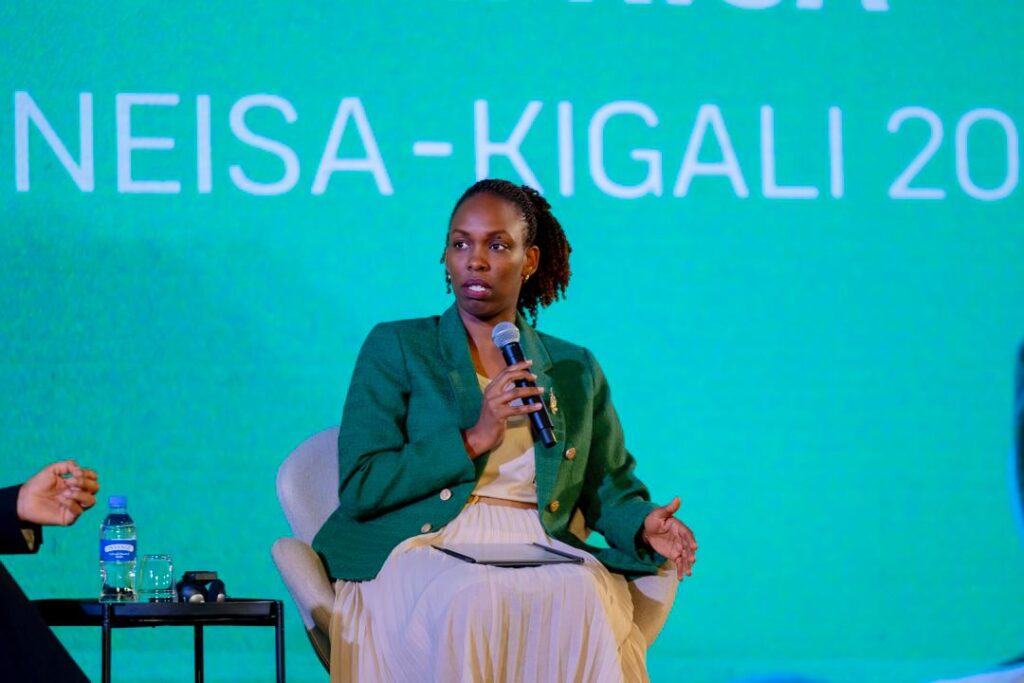
Alice Uwase, the Chief Executive Officer, Rwanda Mines, Petroleum and Gas Board (RMB) speaking during a plenary session.
Rwanda’s mining sector has grown into one of the country’s leading export industries. Government figures show mineral exports generated more than $1.1 billion in revenues in 2024, driven largely by tin, tungsten, tantalum, and gold.
However, officials say energy shortages continue to limit how much value the country can extract from those resources. Alice Uwase, Chief Executive Officer of the Rwanda Mines, Petroleum and Gas Board (RMB), said Rwanda is mechanizing mines nationwide, but inconsistent electricity remains a major obstacle.
“We are mechanizing all our mines, but we need a consistent supply of energy. There are some refineries and smelters currently on hold because we don’t have the right energy,” Uwase said.
She explained that some mining operators still rely on diesel generators because power interruptions damage industrial equipment and disrupt production. This challenge has become particularly critical as Rwanda seeks to increase local mineral value addition.
Uwase pointed to wolframite, the ore used to produce tungsten, as an example. Tungsten is widely used in defense systems, industrial drilling tools, aerospace manufacturing, and electronics due to its exceptional strength and heat resistance. Rwanda is also exploring lithium resources at a time when global demand for battery minerals is rising rapidly, driven by electric vehicles and energy storage technologies.
“What we’ve started to negotiate in agreements is that once the energy is available in Rwanda, we establish value-addition facilities here,” Uwase said.
Officials say the goal is to eventually process more minerals locally instead of exporting raw or semi-processed materials.
Nuclear Energy and Rwanda’s Industrial Future
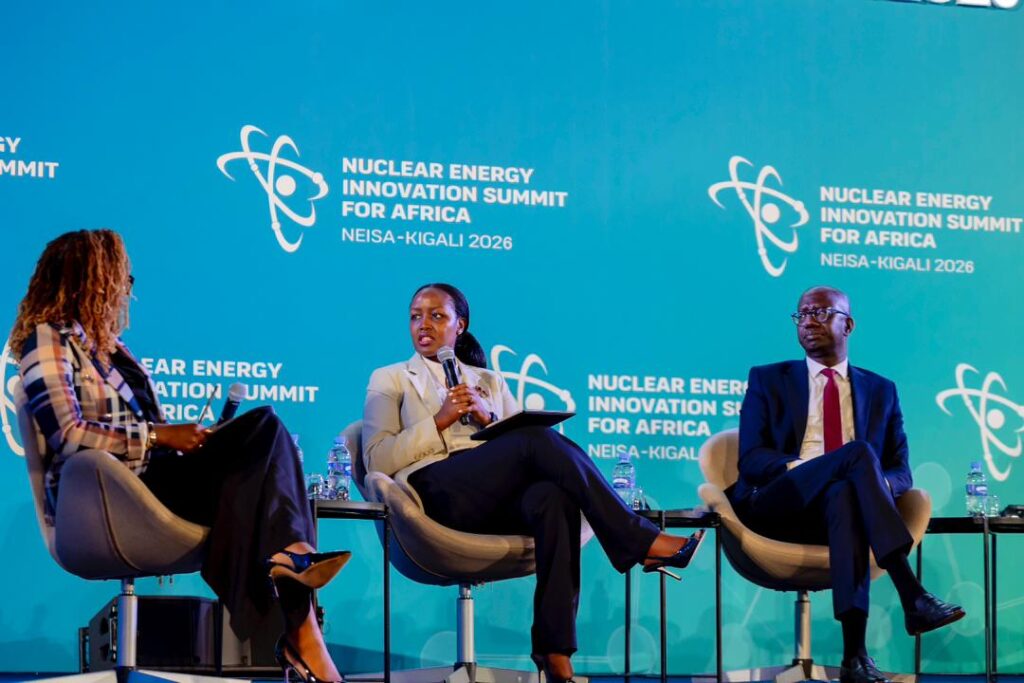
Minister of ICT and Innovation, Paula Ingabire says that Rwanda does not want to remain a supplier of raw materials in a rapidly changing global economy.
Beyond mining, Rwanda is linking nuclear energy to its growing digital economy.
Ingabire noted that sectors such as AI, cloud computing, and data centers are creating massive global demand for stable electricity, making energy infrastructure vital for countries hoping to compete in technology-driven industries.
According to the International Energy Agency, global data center electricity consumption now exceeds 400 terawatt-hours annually and continues to rise due to AI-related workloads.
Rwanda seeks to position itself as a regional technology and innovation hub, aiming to attract large-scale data center investments and hyperscalers. However, such facilities require an uninterrupted power supply.
“AI’s main constraint globally has always been reliable energy availability,” Ingabire said, adding that major technology companies increasingly prefer clean energy sources to meet their climate commitments, strengthening the case for nuclear power.
Officials say Rwanda is already planning for future electricity demand ahead of the SMR construction, identifying mining companies, manufacturers, and digital infrastructure projects as long-term industrial off-takers.
For policymakers, the strategy goes beyond electricity production. Rwanda is also preparing the regulatory systems, industrial planning frameworks, and skills development programs needed to support a future nuclear economy.
“As countries, we cannot afford to remain with traditional models of energy production. Otherwise we will end up exporting raw materials and not benefiting from what we have within our jurisdictions,” Ingabire said.
At NEISA 2026, Rwanda made it clear that it views nuclear energy not simply as a power source, but as a tool to industrialize its economy, strengthen mineral value chains, and compete in a technology-driven global market.