



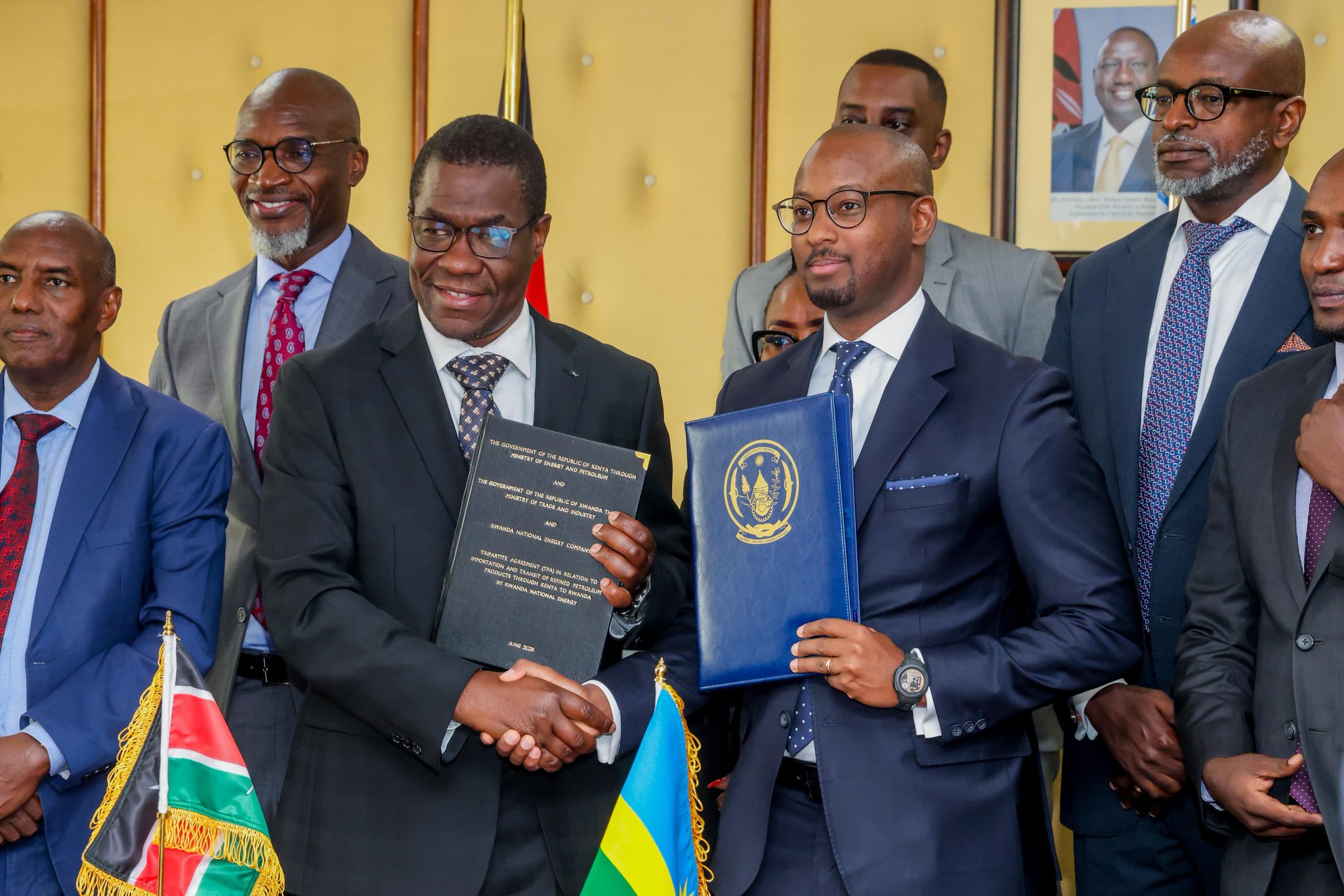
Kenya’s Energy and Petroleum Cabinet Secretary Opiyo Wandayi (LEFT) and Rwanda’s Minister of Trade and Industry Antoine-Marie Kajangwe today in Nairobi
NAIROBI / KIGALI — Rwanda has signed a landmark energy agreement with Kenya that could significantly reshape regional fuel trade routes in East Africa, marking a strategic shift in petroleum logistics even as traditional corridors remain active.
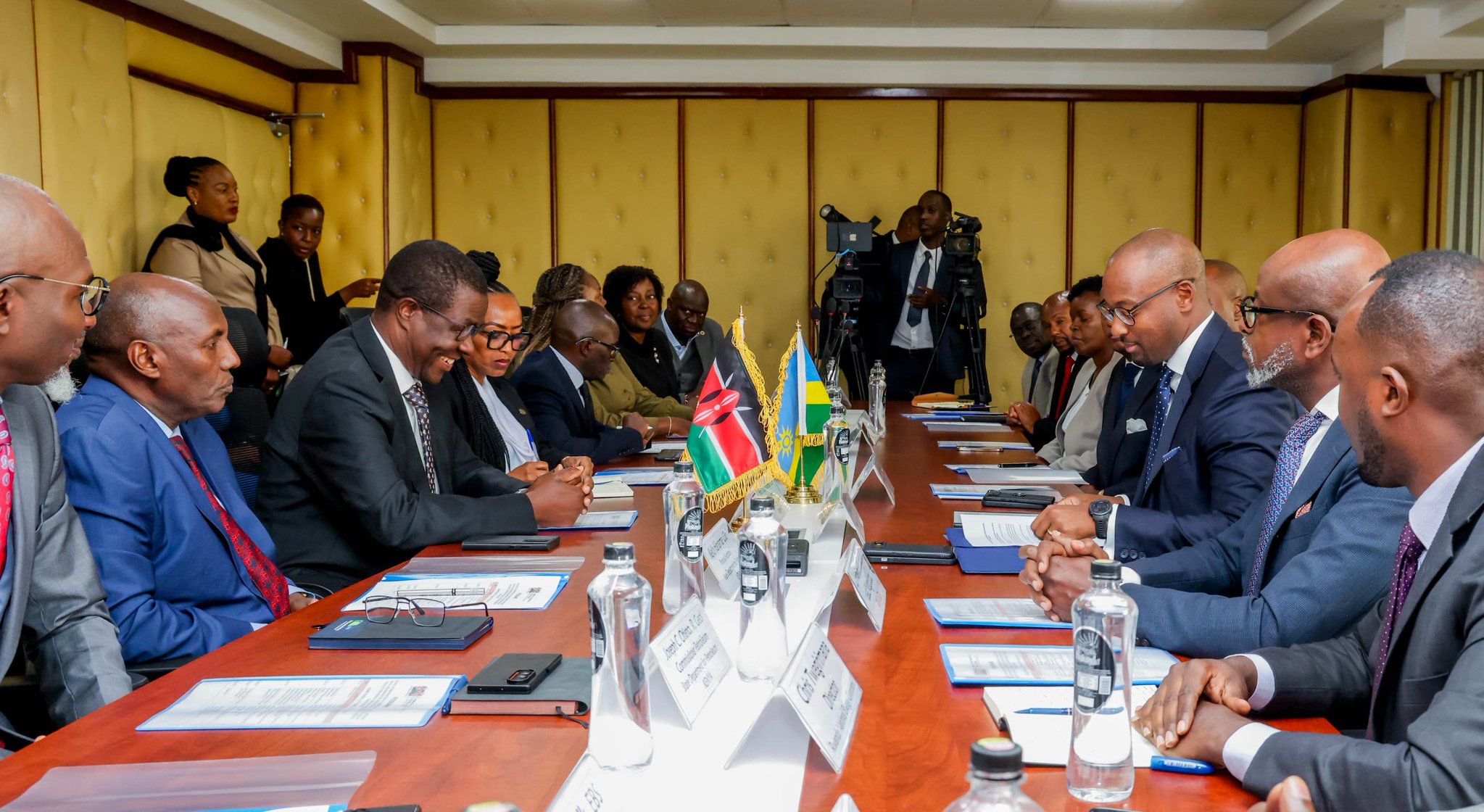
The agreements, signed on June 29, 2026 at KASNEB Tower in Nairobi, establish a Government-to-Government (G2G) framework allowing Rwanda to import refined petroleum products through Kenya’s Port of Mombasa and the Northern Corridor infrastructure, via Uganda.
The deal was signed between Kenya’s Energy and Petroleum Cabinet Secretary Opiyo Wandayi and Rwanda’s Minister of Trade and Industry Antoine-Marie Kajangwe, with senior officials from both countries, including the Kenya Pipeline Company (KPC) and Rwanda National Energy Company (RNEC), in attendance.
READ MORE – Why Rwanda Pays More For Oil When the Middle East Burns
A structural shift
The arrangement is anchored on three agreements — a Memorandum of Understanding, a Tripartite Agreement, and a Transport and Storage Agreement — which collectively govern commercial, legal, and logistical aspects of the fuel supply chain.
Under the framework, Rwanda will now access fuel through the Port of Mombasa, transported via Kenya’s 1,342-kilometer pipeline network and associated storage facilities. The system includes capacity at key depots and the Kisumu Oil Jetty, positioning Kenya as a growing transit hub for Rwanda’s bulk petroleum imports.
Rwandan and Kenyan governments say shipments through the Northern Corridor could rise more than tenfold — from roughly 42,000–50,000 cubic metres annually to over 500,000 cubic metres (or 500 million litres)
The first shipment, identified as RNEC 001/2026, is expected to arrive in Mombasa between September 4 and 6.
Why Rwanda is shifting north
For decades, Rwanda — a landlocked country — has relied heavily on the Central Corridor through Tanzania for imports, with over 70% of all goods still moving through Dar es Salaam. That dominance is expected to continue for most product categories, especially consumer goods and general cargo.
However, petroleum imports are expected to gradually diverge from that pattern. While Tanzania Ports Authority has recently strengthened its presence in Kigali through a local office to streamline logistics and maintain competitiveness, Rwanda’s fuel imports are likely to see a significant shift toward Kenya under the new government-to-government framework.
Private oil marketers are expected to continue using the Dar es Salaam route, meaning the Tanzanian corridor will remain relevant but with reduced dominance in the petroleum segment.
Kenyan and Rwandan officials involved in the Kenya deal describe it as a long-term effort to strengthen energy resilience, reduce transport bottlenecks, and deepen integration within the East African Community.
Kenya, meanwhile, is positioning itself as a regional logistics hub. Kenya Pipeline Company has emphasized its expanded storage capacity — now extended to 90 days for Rwanda-bound cargo — as a key competitive advantage.
Global supply chain
Under the G2G arrangement, Rwanda’s imports will be coordinated through its National Energy Company (RNEC), which is registered in Kenya and licensed to handle import, export, and wholesale petroleum trade.
Reports indicate that initial supplies will be sourced through OQ Trading, the international trading arm linked to Oman’s energy sector.
The arrangement reduces reliance on private Kenyan oil marketers, centralizing fuel imports under state-to-state coordination.
A regional trade ripple effect
Beyond energy logistics, the shift carries wider regional implications. Eastern Democratic Republic of Congo — particularly Goma, Bukavu, and surrounding areas, with a combined population of up to 10 million people — depends heavily on re-exported refined fuel that moves through Rwanda.
This cross-border fuel trade has become a significant component of Rwanda’s external commerce, making re-exports to DRC one of the country’s top export streams.
Any changes in import routes and fuel pricing structures therefore have the potential to influence not only Rwanda’s domestic market but also supply chains deep into eastern Congo, where fuel access remains fragile and heavily dependent on informal and formal cross-border flows.
Implications

The deal also reflects a broader balancing act in Rwanda’s trade geography. While Tanzania remains a critical partner and will continue handling the majority of non-fuel imports, Kenya is emerging as a strategic alternative for energy security.
Rwanda’s annual petroleum consumption is estimated at 700–900 million litres, driven by transport demand, industrial growth, and regional trade activity. Officials argue that improved supply efficiency could help stabilize costs and strengthen resilience against global price volatility.
Kenya’s Energy Cabinet Secretary described the agreement as part of a broader directive from President William Ruto to deepen regional infrastructure integration, while Rwanda’s trade minister called it a “turning point” in securing reliable and affordable energy supplies.
A shifting regional corridor map
The agreement reflects a gradual but significant realignment of East Africa’s transport corridors, where landlocked economies increasingly diversify routes to reduce dependence on single ports or transit systems.
While the Dar es Salaam route remains structurally dominant for most imports, the Nairobi-Mombasa corridor is now set to become a major artery for petroleum flows into Rwanda.
The development underscores both economic pragmatism and geopolitical balancing in a region where infrastructure corridors are increasingly strategic assets rather than purely commercial routes.
The success of the agreement will depend on implementation efficiency — particularly pipeline logistics, storage coordination, and global supply contracts.
If fully operational, the Kenya-Rwanda fuel corridor could become a model for state-to-state energy partnerships in Africa.
But for now, it signals a more immediate shift: Rwanda is not abandoning Tanzania, but it is no longer dependent on a single corridor for one of its most strategic imports — and East Africa’s fuel geography is quietly being redrawn.
