



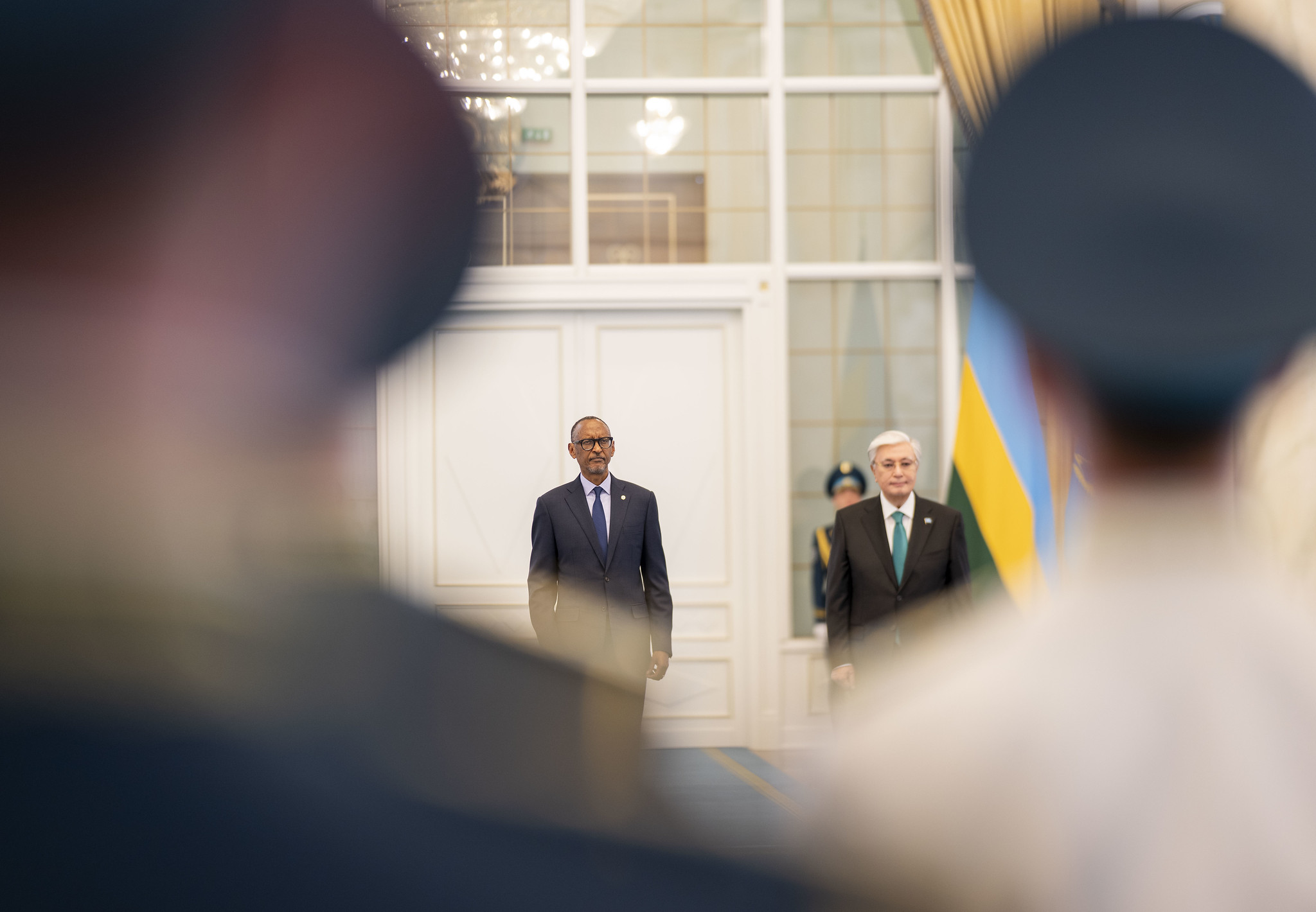
In May 2025, President Paul Kagame made an official visit to Kazakhstan, where he held talks with President Kassym-Jomart Tokayev.
KIGALI, Rwanda — Rwanda has approved a strategic partnership with Kazakhstan’s state-owned mining company, Tau-Ken Samruk, in a move expected to strengthen the country’s mining sector and deepen its role in the fast-growing global market for critical minerals.
The decision was approved during a Cabinet meeting chaired by President Paul Kagame on Friday.
Under the agreement, the Government of Rwanda and JSC National Mining Company Tau-Ken Samruk (TKS) will establish a joint venture to undertake mineral exploration and mining activities across Rwanda.
The Cabinet statement did not specify which minerals the new company will explore, where exploration will take place, or the size of the planned investment.
Even so, the choice of partner is significant. Tau-Ken Samruk has emerged as one of the world’s fastest-growing critical minerals companies. It is investing heavily in projects designed to diversify global mineral supply chains beyond China, which dominates the production of many strategic minerals.
The partnership also follows growing diplomatic ties between Kigali and Astana.
In May 2025, President Paul Kagame made an official visit to Kazakhstan, where he held talks with President Kassym-Jomart Tokayev.
The two leaders agreed to deepen cooperation in trade, technology and critical minerals. Various agreements were signed during the visit.
Friday’s agreement marks one of the first major investment outcomes of those discussions.
The deal brings together Africa’s largest producer of tungsten and one of the world’s fastest-growing mining companies.
Tau-Ken Samruk is playing an increasingly important role in the global race for critical minerals. Through a $1.1 billion joint venture with U.S.-based Cove Capital, the company is developing some of Kazakhstan’s largest tungsten deposits.
The project is expected to produce about 15 percent of the world’s tungsten within the next few years, making Kazakhstan the world’s second-largest producer after China. China currently accounts for roughly 80 percent of global tungsten production.
The company is also expanding beyond Kazakhstan. Rwanda is among the first countries where Tau-Ken Samruk is investing in mineral exploration outside its home market, highlighting the growing international interest in Africa’s mineral resources.
The partnership is expected to attract fresh foreign investment into Rwanda’s mining sector. It will also bring advanced geological exploration technology and technical expertise to help identify and develop new mineral deposits.
The agreement comes as countries compete to secure reliable supplies of critical minerals. These resources are increasingly needed for clean energy technologies, artificial intelligence, electronics, aerospace and defence industries.
Among them is tungsten, one of the world’s most strategic metals. It is one of the hardest materials found in nature and can withstand extremely high temperatures without melting.
The metal is used to make aircraft engines, industrial drilling and cutting tools, mining equipment, smartphones, semiconductors and electric vehicles. It is also widely used in military equipment, including armour-piercing ammunition, missile components and armoured vehicles because of its exceptional strength and heat resistance.
Rwanda is already Africa’s largest producer of tungsten, exporting the mineral mainly as wolfram concentrate.
Tungsten is one of the country’s three major “3Ts” minerals, alongside tin (cassiterite) and tantalum (coltan). Together, they account for a significant share of Rwanda’s mineral exports.
In recent years, Rwanda has sought to move beyond exporting raw minerals by attracting investment in exploration, mineral processing and value addition.
Government believes partnerships with experienced international mining companies are key to unlocking the country’s untapped mineral potential.
For Rwanda, the agreement marks another step in its effort to modernize the mining sector and position itself as a reliable supplier of critical minerals that are becoming increasingly important to the global economy.
