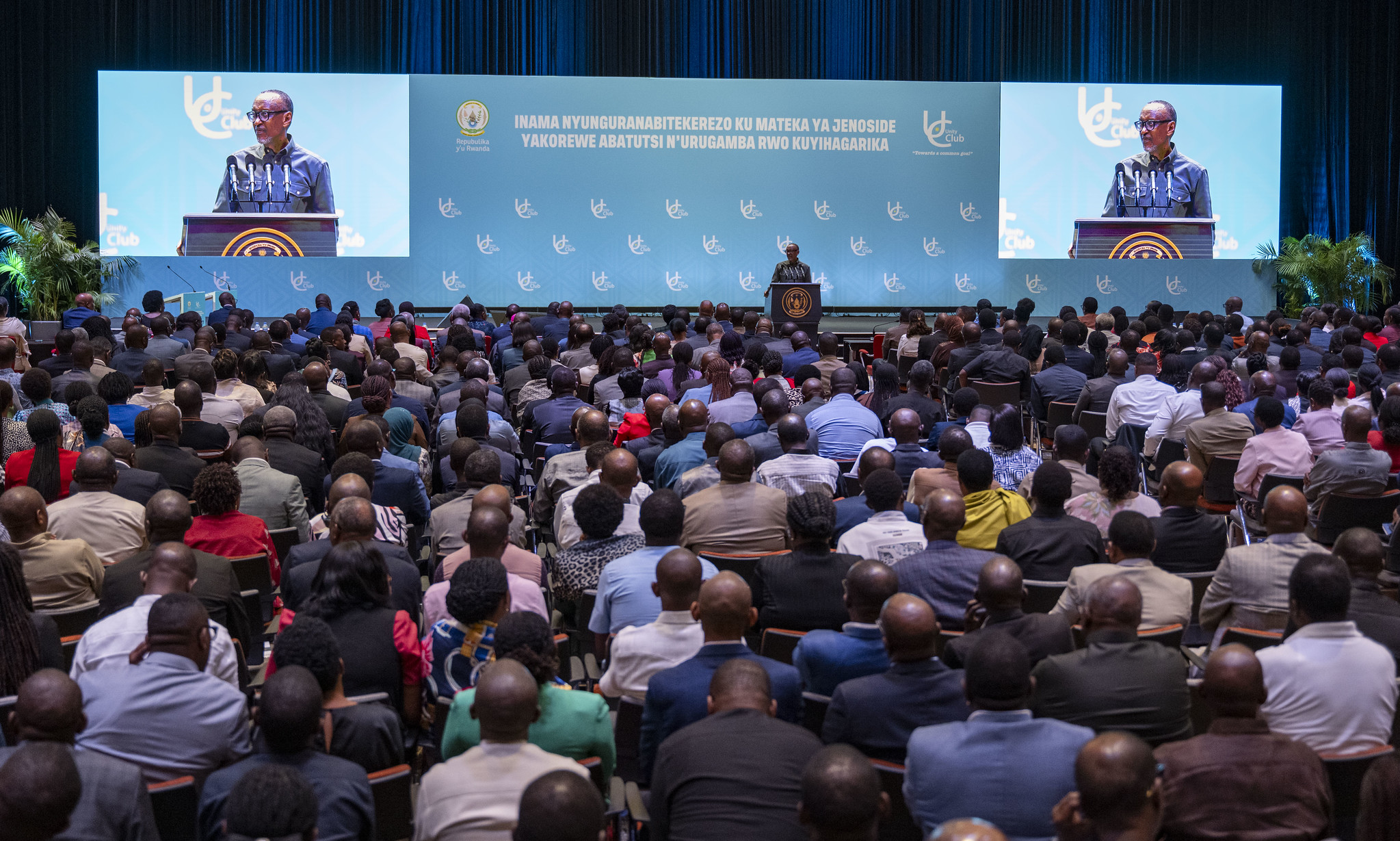
President Paul Kagame giving the opening speech
There is a quiet, gentle magic that settles over the green hills of Rwanda’s capital, Kigali, in the very early hours of the morning, just as the golden sun begins to clear the soft white mist from the valleys.
For anyone who has grown up in Rwanda, or for anyone who has walked through its busy, clean streets, the morning has a very familiar rhythm.
You hear the low hum of motorcycle engines warming up, the steady, rhythmic sweep of wooden brooms cleaning the roads, and the friendly, quiet greetings of neighbours calling out to one another as they start their day.
It is a beautiful, peaceful routine that makes the city feel like a large home.
But on the morning of a Unity Club gathering, the air feels a little different. It is warmer, filled with a sweet sense of anticipation. I was invited to attend a recent one.
What is wonderful about this gathering is that the excitement does not start with the blare of police alarms, heavy security barriers, or the stiff, intimidating rules that you might expect at a high-profile state event.
Instead, the journey begins days earlier in the calmest way possible. It begins with the simple, friendly sound of a human voice speaking directly to you through your phone.
It is a personal call from one of the organisers. There is no cold, automated recording, and no formal, distant secretary speaking to you.
It is just a real person calling to ask you to save the date warmly. Shortly after, an official invitation drops into your inbox. But it is the final phone call, received just a day before the main event, which truly shows what this gathering is all about.
The voice on the other end of the line offers a simple, practical, and kind suggestion. They say, “To avoid the traffic jam on the way to the venue, we have organised buses that will take you directly there and bring you back. However, you can choose to drive yourself, or you can come to the venue to join the others and ride together in the buses.”
In a world where success is so often measured by how far we can keep ourselves apart from others, or by how private we can make our lives, who could possibly turn down an invitation like this?
Choosing to ride the bus is not just a smart way to avoid traffic. It is an invitation to leave your titles, your pride, and your worries at the door. It is a chance to step into a rolling space where everyone, for a moment, is exactly the same.
By six in the morning, the air around the BK Arena is cool, crisp, and fresh. As the large doors of the shuttle buses open with a soft jeer, the invisible walls that so often separate people in their daily lives simply melt away.
Once you step up the metal steps of the bus, there are no reserved seats. There are no special rows for the important, the wealthy, or the highly educated. You simply find an empty seat and sit down next to whoever is already there.
Because of this simple arrangement, the short, twenty-minute drive to the Intare Conference Arena in Rusororo, which sits in the Gasabo District, becomes perhaps the most beautiful and meaningful part of the entire day.
If you look around the bus, you will see things that seem almost impossible in any other country. A highly respected, senior government official slides into a seat right next to a young, nervous entrepreneur who is still trying to figure out how to start his very first small business.
A commercial bank CEO, who spent the previous day making massive financial decisions in a high-rise office, sits shoulder-to-shoulder with a local farmer from a rural village, whose hands are rough and calloused from years of working the soil.
A local neighborhood leader, who has spent months trying to book a brief appointment with a busy national director, suddenly finds himself sitting right next to that very person.
Inside the bus, the steady hum of the engine is quickly joined by the rising sound of laughter, friendly teasing, and deep conversations. In that short drive, the huge gap that we often think exists between our leaders and ordinary citizens completely disappears.
Business deals are proposed and agreed upon right there between the vinyl seats. Hard-to-reach appointments are finally scheduled with a simple nod and a quick exchange of phone numbers.
Church leaders sit with folders held closely to their chests, pitching community development projects directly to banking executives who listen with real, uninterrupted curiosity.
It is a rare, beautiful moment—a lesson in true community happening on wheels, long before the official program even begins. Who would want to drive alone in a car when they could be part of a journey like this?
When the buses finally pull up to the beautiful entrance of the Intare Arena, the passengers step off the buses together. They do not walk through the doors as separate groups of important bosses and simple workers. They walk in together, talking and laughing, as one big family.
To truly understand why this feeling of family is so deep and so unique, we have to look back thirty years into our history.
In 1996, Rwanda was a very dark, quiet, and deeply wounded place. The country was still struggling to catch its breath after the unspeakable tragedy of the 1994 Genocide against the Tutsi. The social fabric of the nation was completely torn apart, and the soil was still heavy with fresh grief and anger.
It was during this fragile time of rebuilding that Rwanda’s First Lady, Jeannette Kagame, came up with a simple but revolutionary idea. She understood that you cannot heal a broken nation with laws and speeches alone; you have to bring people together face-to-face in a space of safety and trust.
She brought together the wives of male cabinet ministers and the women who were serving as cabinet ministers themselves. Her goal was simple: to create a space where they could promote cohesion, encourage genuine collaboration, build deep friendships, and contribute directly to the peace and growth of their country.
From this small, loving circle of leaders, Unity Club Intwararumuri—which translates beautifully to “The Torch-Bearers”—was born. In 2007, during its tenth anniversary, the club decided to expand its family, welcoming husbands as associate members so that the shared responsibility of leading and healing the nation could be carried by everyone.
They adopted a powerful, lifelong philosophy: “Once a member, always a member.” This meant that even when a government minister lost their job or retired during a cabinet reshuffle, they never left the Unity Club. They remained a permanent part of this family, forever committed to helping Rwanda grow.
Many of us have sat in large halls or watched on our televisions during the National Dialogue, known as Umushyikirano, where people from every corner of the country and the diaspora ask direct questions to the President.
But the Unity Club gathering is something altogether different. It is more intimate, quieter, and incredibly open. It is a sacred space where the real, painful, and beautiful story of Rwanda is told by the very people who lived through it.
During the recent Unity Club gathering, President Paul Kagame shared a profound thought that captures the essence of our journey: “Rwanda has been a centre of everything bad and good.”
Inside the Intare Arena, you see exactly what those words mean.
On one of the discussion panels, a survivor who was blocked from getting a school education during the pre-1994 regime simply because they were Tutsi sits peacefully on a stage.
Sitting right next to them is an older, retired official who worked directly in the state offices that wrote and enforced those cruel, discriminatory laws.
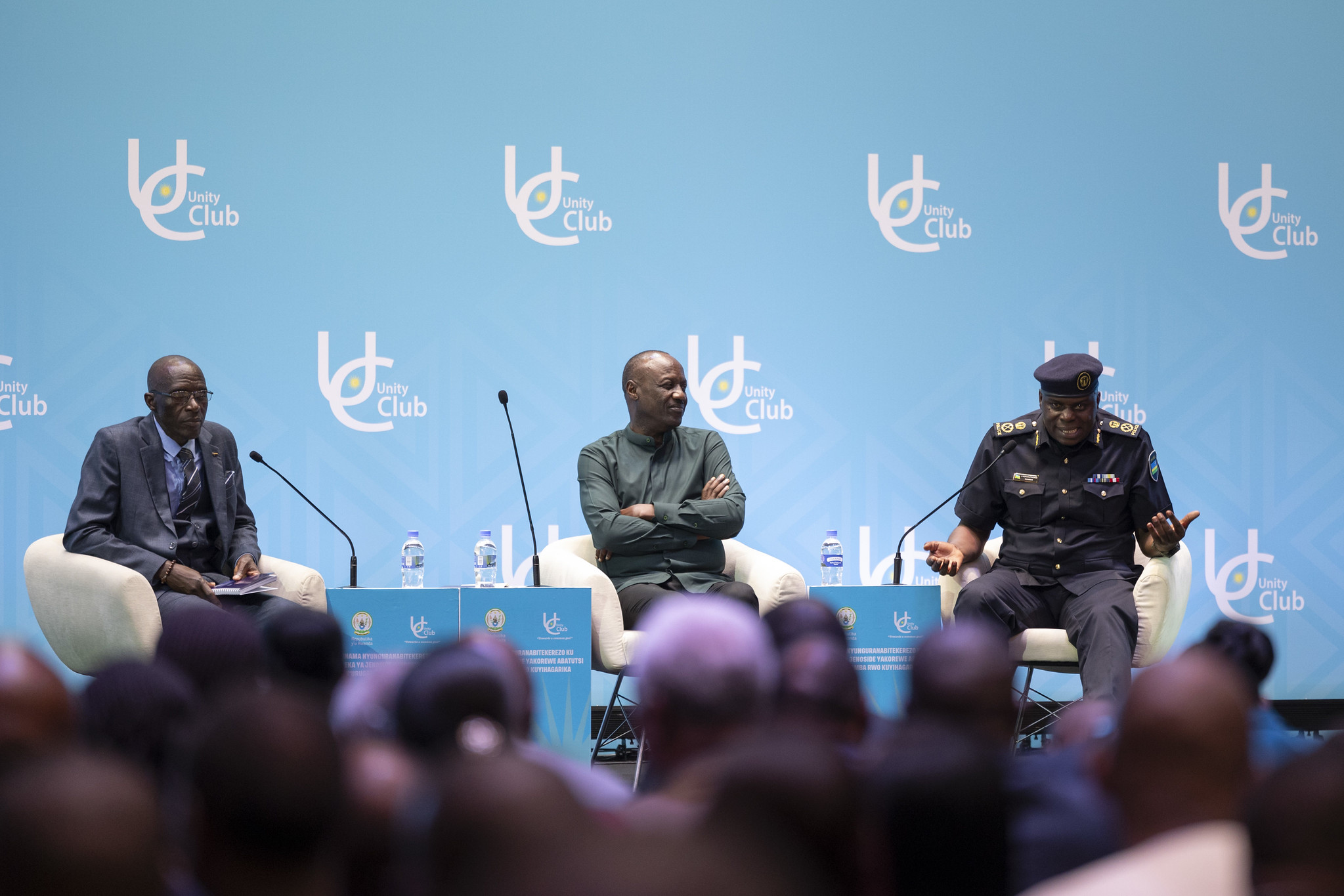
Col. (Rtd) Augustin Nshimiyimana (Bora), Lt Gen (Rtd) Fred Ibingira, and ACP Augustin Kuradupagase – spoke on the same panel
On another panel, a seen in photo above – highly decorated, veteran Generals from the Rwandan army sit side-by-side with former commanders of the FDLR—a rebel group that once hid in the forests and fought bitterly against the country. Together, they talk openly and calmly about the dark years when they faced each other through the sights of their guns, explaining how they fought and how the rebel forces were ultimately defeated.
To a young person growing up today, or to a stranger visiting Rwanda for the first time, this sight is almost impossible to understand.
How can people who once represented each other’s destruction sit on the same stage, sharing a microphone and a cup of water? How do you move past such immense pain to sit as equals?
The secret lies in Rwanda’s strange, courageous choice to choose forgiveness and unity over revenge and division.
During the panel, one of the former rebel officers shares a detail that makes the entire room go completely silent.
He explains that, because of Rwanda’s decision to offer equal opportunities to every single citizen, his own child was sent to study at the world-famous Sandhurst military academy in the United Kingdom—learning and training side-by-side with President Kagame’s own child.
If you stop and think about that for a moment, it is breathtaking. In just one generation, the children of two men who were once sworn enemies on a battlefield are now standing together as classmates and brothers-in-arms, wearing the same uniform and representing the same flag.
This is not a fictional story written for a movie; it is the living, breathing reality of modern Rwanda.
As a young person who has grown up watching this complex story unfold, and having had the privilege of traveling through almost every single one of the 416 administrative sectors of our country, I have seen this miracle of reconciliation happening quietly on every single hill.
It is built slowly, day by day, through small acts of kindness, honest conversations, and a shared determination to never let the dark past win.
In the afternoon, the formal panels end, and the microphone is passed around to anyone in the audience who wishes to speak. This is when the true heart of the Unity Club gathering shines brightest.
People do not stand up to give long, polished speeches or read from papers. They speak from the absolute depths of their souls. Some stand up to confess their past wrongdoings, their voices trembling with emotion as they look across the room and ask for forgiveness.
Others use their time to loudly applaud and thank ordinary citizens—the Abarinzi b’Igihango, or the Guardians of the Covenant—who risked their own lives to protect others during the genocide, or who have dedicated their lives to lifting their poor neighbors out of poverty.
It is a beautiful, deeply moving cycle of truth-telling, healing, and overwhelming gratitude.
As the sun begins to set over the hills of Gasabo and the gathering finally winds down, there is no exhaustion in the room. Instead, there is a warm, glowing sense of hope.
From the youngest teenager to the oldest elder, everyone walks out of the arena with a lighter step and a stronger spirit.
When they board the waiting buses to head back to the BK Arena, the mood is bright and joyful. The quiet nervousness of the early morning is completely gone, replaced by the warm chatter of a family that has spent the day sharing its deepest truths.
As the buses roll back through the evening streets, watching the lights of Kigali twinkle to life like stars across the ridges, everyone carries the same quiet promise in their heart: to go home, to do better, to reach out a helping hand, and to keep carrying the bright torch of unity for the beautiful future of Rwanda.
The Writer, Dan Ngabonziza, is the Managing Director, Kigali Today Ltd, the parent company of KT Press, KT Radio 96.7FM, KigaliToday.com (Kinyarwanda) and Kigali Today TV channel.