



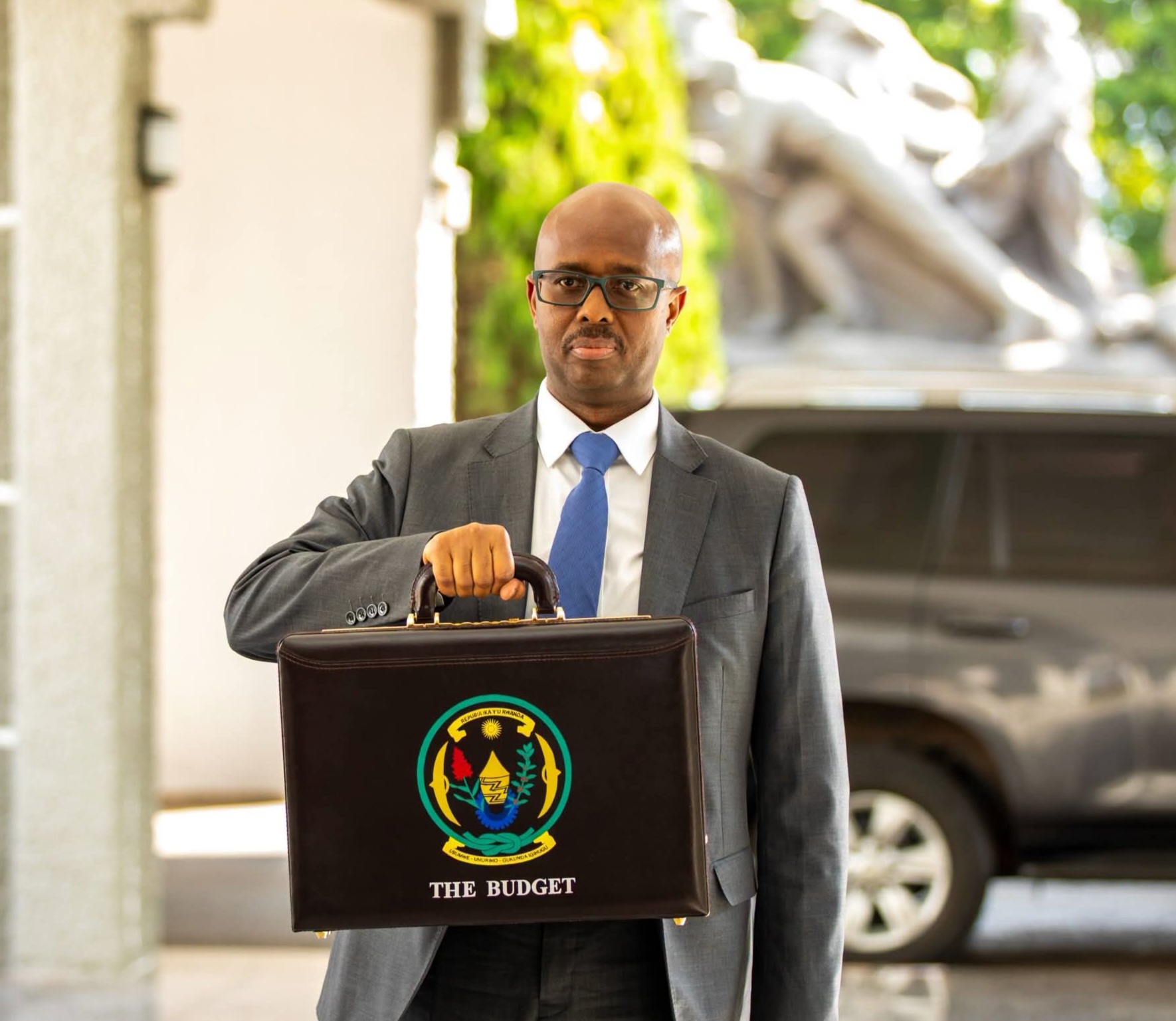
Finance Minister Yusuf Murangwa arrives at Parliament to present the national budget
KIGALI, Rwanda — A landlocked economy that spent decades better known for its post-genocide recovery than for its bond market has claimed an unlikely distinction.
It is now one of the most transparent government borrowers on the African continent, according to a new assessment from a Washington-based finance industry group.
Rwanda tied with South Africa for the highest score in Africa in the 2026 Investor Relations and Debt Transparency Report, published this month by the Institute of International Finance, an association representing banks, asset managers and other financial institutions worldwide.
Both countries scored 43.4 out of a possible 50 points, placing them well ahead of regional peers like Kenya, Nigeria and Ghana.
The ranking marked Rwanda’s first appearance in the report, which the institute has published annually since 2005 and which this year evaluated 57 emerging and developing economies.
Rwanda was one of only four countries added to the assessment this year, and the institute singled out the country’s disclosure practices as an example for other governments to follow.
The report attempts to measure something that can be difficult to quantify: how clearly and consistently a government communicates with the investors who buy its bonds and other debt.
Analysts compile the scores using a combination of surveys sent to finance ministries and debt offices, followed by independent checks of what governments actually publish — investor relations websites, debt bulletins, disclosure of loans from state-owned enterprises and other data.
The institute’s researchers describe the payoff for high scorers as a “transparency dividend.” Governments that disclose their finances predictably tend to face lower borrowing costs and maintain steadier access to international capital, particularly during periods of economic stress, the report found. It also linked stronger investor relations practices to more stable sovereign credit ratings over time.
Rwanda’s performance is notable in part because of how recently the country built the infrastructure behind it. Its investor relations program, housed within the Ministry of Finance and Economic Planning, was established only in 2025 — decades after counterparts in South Africa, Nigeria and several other African nations.
Despite that late start, Rwanda’s score surpassed those of countries with far longer track records, including Kenya, whose program dates to 2020, and Ivory Coast, which launched its effort in 2024.
The country’s strongest showing came in a subcategory measuring the disclosure of environmental, social and governance data, where it scored 3.9 out of a possible 4 — among the highest marks recorded in the entire 57-country sample, and well ahead of other nations in East Africa.
The findings arrive as Rwanda’s public debt has been climbing, driven in part by major infrastructure spending, including construction of a new international airport outside Kigali.
The International Monetary Fund has projected that Rwanda’s public debt could approach over 70 percent of gross domestic product by 2027, even as the country’s overall economic performance has remained resilient.
However, the IMF and World Bank have both consistently affirmed the debt is sustainable, and government will have no trouble repaying. In addition, the majority of the debt is at very small interest rates, and long term.
Rwanda’s immediate neighbors offer a study in contrast, though a direct comparison is not fully possible: Uganda, Burundi and the Democratic Republic of Congo were not included in this year’s assessment at all, leaving a gap in the regional picture. Their absence from the sample means the institute has not evaluated their investor relations practices using the same criteria, though all three governments have faced persistent questions from independent economists and international lenders about the completeness of their public debt reporting, particularly around loans to state-owned enterprises and, in Congo’s case, resource-backed financing arrangements tied to its mining sector.
Kenya, the region’s other major economy, was assessed and scored 42.8 — just behind Rwanda despite a five-year head start in building its own investor relations program.
Sub-Saharan Africa as a whole continued to register the lowest median transparency scores among the world’s regions in this year’s assessment, though the report noted modest improvement compared with the previous year.
Researchers who study sovereign debt say governments sometimes withhold detailed financial information for political reasons — to avoid alarming domestic audiences, preserve leverage in negotiations with creditors, or sidestep scrutiny from international lenders — a dynamic that has made hidden or underreported debt a persistent problem across developing economies.
