



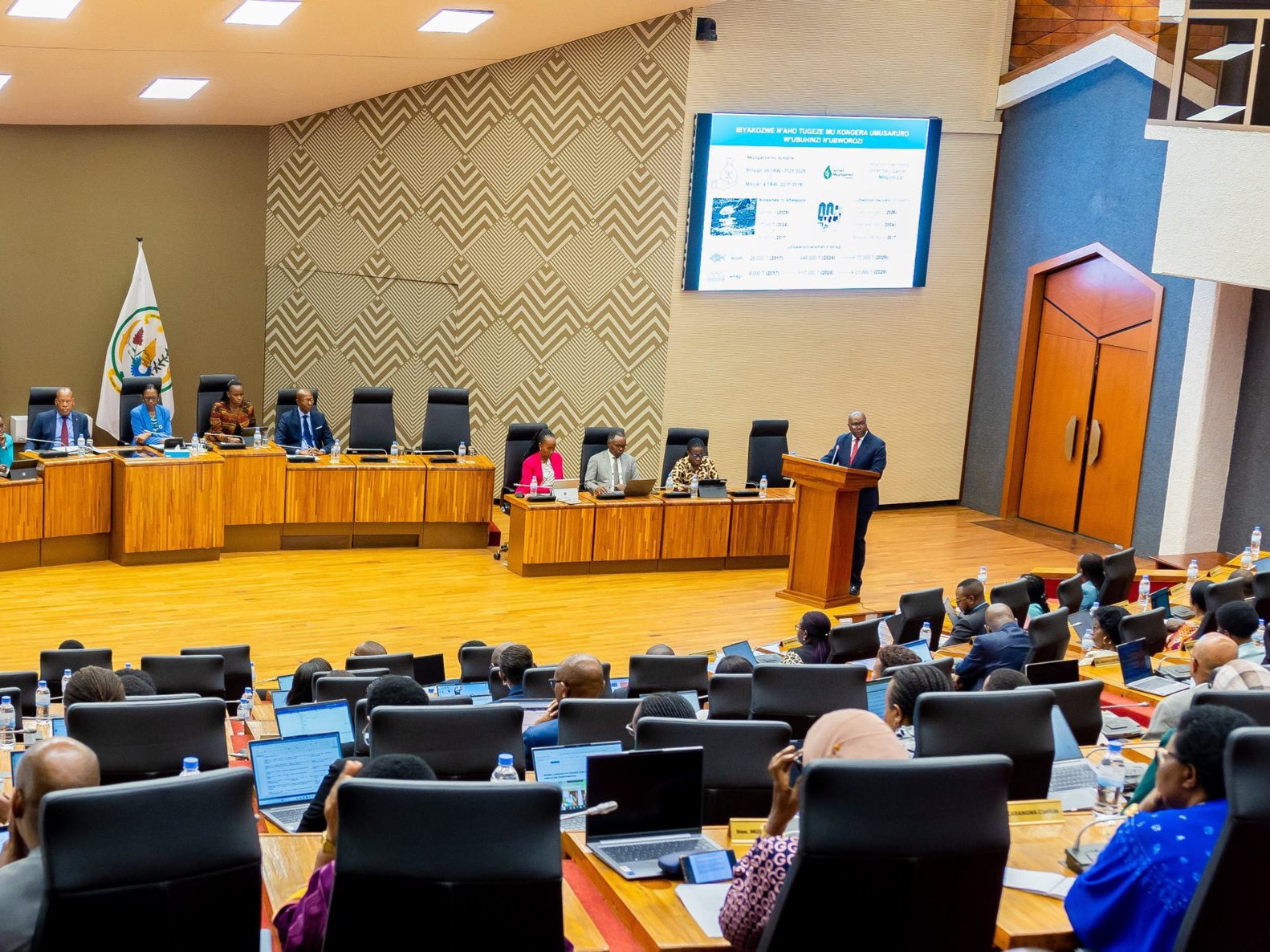
The Prime Minister Dr Justin Nsengiyumva speaking Thursday in Parliament
KIGALI – Rwanda’s government has spent nearly Rwf48 billion over the past four months to shield consumers and businesses from soaring global fuel prices, Prime Minister Dr. Justin Nsengiyumva told Parliament on Thursday.
The subsidy has kept the retail price of diesel at Rwf2,927 per litre, well below the estimated Rwf3,600 motorists would be paying if local prices fully reflected movements on international markets.
Speaking during a joint sitting of Parliament, Dr. Nsengiyumva said the intervention was introduced between March and June after global crude oil prices surged sharply amid escalating tensions in the Middle East, sending fuel prices soaring across international markets.
Between February and June, the price of crude oil climbed from about US$70 to more than US$126 a barrel, driven largely by conflict involving the United States and Iran and renewed disruption to shipping through the Strait of Hormuz, a vital passage that carries roughly one-fifth of the world’s oil supply.
Today, petrol sells for Rwf2,938 per litre, while diesel costs Rwf2,927 per litre. Although diesel has also become more expensive in recent weeks, the government deliberately kept its price below market levels because it powers most public transport vehicles, freight trucks and agricultural machinery.
Government argued that allowing diesel prices to rise unchecked would have pushed up the cost of transporting people and goods, fueling inflation across the economy.
Instead, the government permitted only a modest increase in pump prices while maintaining a substantial subsidy, keeping diesel affordable despite sharp increases in global oil prices.
According to figures presented to lawmakers, international petrol prices rose by nearly 48 percent, while diesel prices increased by about 50 percent over the same period.
For Rwanda, which imports nearly all of its petroleum products, such increases threatened to drive up transport costs, food prices and production expenses across the economy.
“There was adverse impact on international trade,” Dr. Nsengiyumva said, noting that the disruptions had affected global trade and placed additional pressure on Rwanda’s economy.
The Prime Minister said the diesel subsidy formed part of a broader strategy to cushion the country against external shocks while strengthening long-term energy security.
As part of that strategy, Rwanda is expanding its petroleum storage capacity from the current 118 million litres to 230 million litres by 2029, reducing the country’s vulnerability to supply disruptions.
He also announced that Rwanda’s first jointly procured fuel shipment of 40,000 tonnes is expected to arrive at the Port of Tanga in Tanzania later this month through the newly established Rwanda National Energy Company, which will purchase fuel directly from producing countries.
Dr. Nsengiyumva added that investments in electric public transport are also helping reduce dependence on imported fuel. Electric buses and dedicated bus lanes introduced in Kigali have increased public transport usage by 15 percent over the past six months while lowering fuel consumption and emissions.
Strong Growth
The Prime Minister presented the fuel subsidy as one element of an economy that has remained resilient despite global uncertainty.
He told lawmakers Rwanda’s economy expanded by 10 percent during the first quarter of 2026, up from 9.4 percent during the same period last year and well above projected global and regional growth rates.
Industry grew by 13 percent, services by 7 percent, while agriculture and livestock expanded by 8 percent.
Dr. Nsengiyumva also said Rwanda created more than 240,000 jobs since the beginning of 2025, putting the country close to achieving its annual target of 250,000 jobs under the Second National Strategy for Transformation (NST2).
He added that exports increased by 42 percent during the first quarter, helping reduce the country’s trade deficit by 13.8 percent, while the Rwandan franc depreciated by less than one percent against major international currencies over the past six months.
Support Farmers
The Prime Minister said rising global commodity prices have also affected agriculture, particularly fertilizer, whose prices increased by between 15 percent and 66 percent between February and June following the spike in global energy prices.
To cushion farmers, the government will absorb half of the latest increase in fertilizer prices in addition to existing subsidies.
As a result, total government support for fertilizer will rise to approximately Rwf64 billion during the 2026/27 fiscal year, up from about Rwf39 billion the previous year.
He also highlighted ongoing efforts to improve resilience against climate change, including expanding irrigated farmland from about 76,000 hectares to 82,000 hectares by the end of 2026, with a target of reaching 132,000 hectares by 2029.
Water and Energy Infrastructure
Addressing infrastructure, Dr. Nsengiyumva said the government is working to tackle water shortages caused by rapid urbanisation, aging infrastructure and prolonged dry seasons.
Plans are underway to increase treated water production from about 367,000 cubic metres per day to 688,000 cubic metres by 2029 while reducing water losses through leaks from 35 percent to 25 percent.
He said electricity generation capacity has already increased from 406 megawatts in 2024 to 471 megawatts, with a target of 615 megawatts by 2029 through investments in hydropower, methane gas and other energy projects.
The Prime Minister also confirmed that preparatory work has begun on Rwanda’s planned nuclear power programme, although he did not indicate when construction would begin.
Concluding his address, Dr. Nsengiyumva said Rwanda’s long-term objective is to build an economy that is less vulnerable to global disruptions by strengthening domestic production, expanding strategic infrastructure and improving energy security.
He said the government’s investments in fuel reserves, agriculture, water, electricity and transport are intended not only to respond to current challenges but also to position the country for sustained economic growth in the years ahead.
