



KIGALI – Thirty-two years after Rwanda’s liberation struggle ended the rule of a system defined by exclusion and violence, President Paul Kagame has described the country’s journey not as a completed historical milestone.
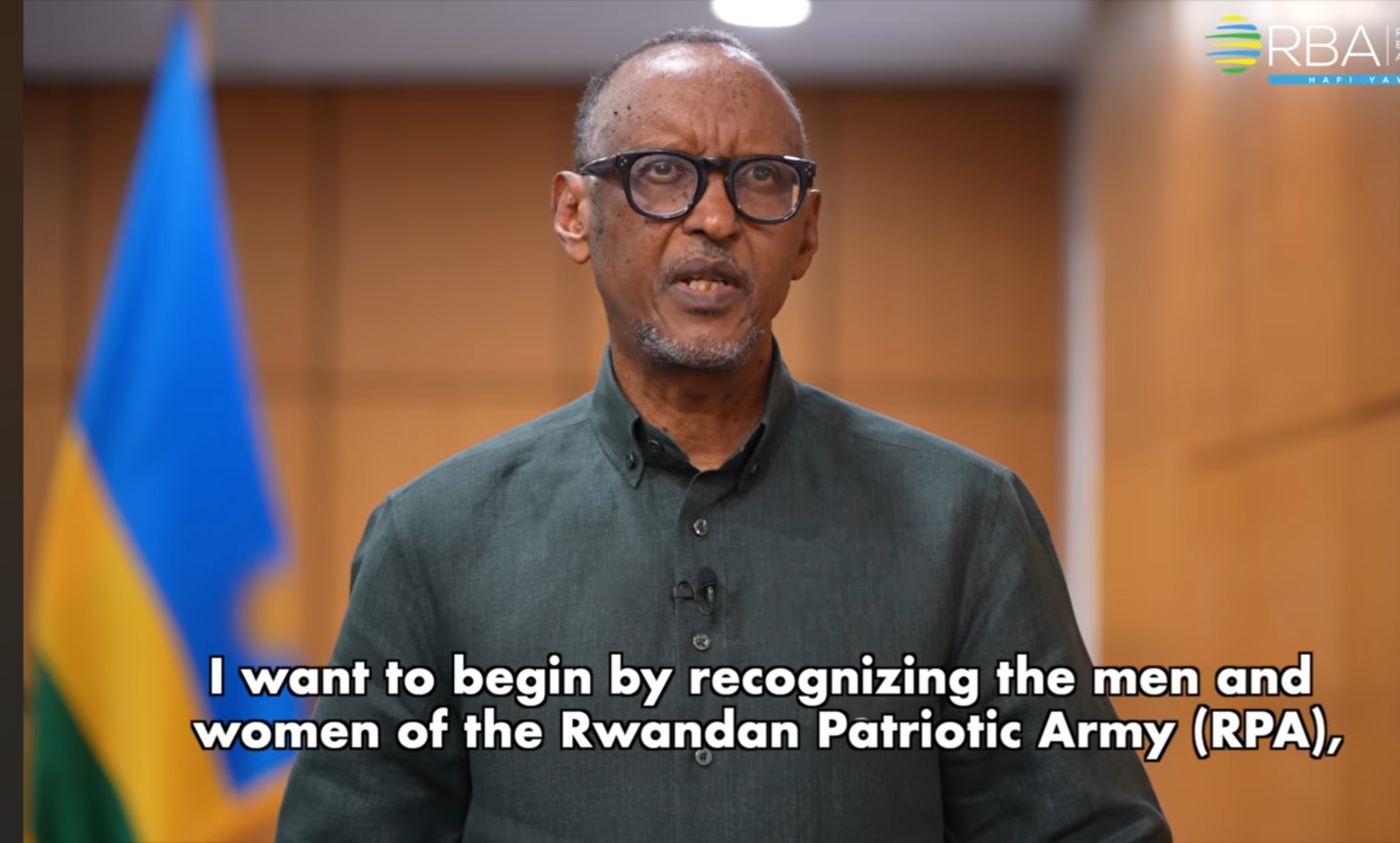
In his Liberation day message marking more than three decades since the Rwanda Patriotic Army (RPA) halted a state shaped by division and fear, the Head of State labelled the liberation as an ongoing revolution that continues to shape its present and future.
Kagame situated the struggle within a longer historical arc of Rwanda’s political evolution marked by cycles of exclusion that culminated in the 1994 Genocide against the Tutsi.
He paid tribute to those who fought in the liberation struggle, including many who did not live to witness the country they helped to build.
Some of those fighters, he noted, paid the ultimate price and never saw the transformation of Rwanda into a stable and developing nation. Yet their sacrifice, he suggested, remains deeply embedded in the foundation of the modern state.
Looking back at the roots of the liberation struggle, Kagame placed it in the context of what he described as decades of structural exclusion that stripped Rwandans of dignity and belonging. The purpose of the struggle, he said, was not simply political change, but restoration.
“The purpose of the liberation struggle was to restore what had been taken away; the right of Rwandans to live in dignity,” he noted.
But even as Rwanda marks more than three decades since that turning point, Kagame warned that the ideas which shaped that violent history have not entirely disappeared. Instead, they persist in different forms across the region, requiring continued vigilance.
“We have seen and suffered too much to ever take this threat lightly,” he noted, underscoring what he described as the permanent nature of Rwanda’s security concerns.
That historical memory, he argued, is central to Rwanda’s governance philosophy today. According to him, security is not a policy choice subject to debate, but the very condition on which survival depends.
“Security is a matter of survival, not external approval. Without it, nothing else holds together,” Kagame said.
He added that Rwanda’s commitment is not only to preserve stability, but to ensure that the past is never repeated under any circumstance. “What happened here will never happen again for one simple reason: we will not allow it,” he said.
A key theme of the message was the responsibility of a new generation that did not experience the liberation struggle or the genocide firsthand. Kagame said their role is not optional, but foundational to the continuation of Rwanda’s progress.
He emphasized that while international partners may offer support or differing interpretations, the primary responsibility for Rwanda’s future rests internally. “It’s our duty to ensure that every Rwandan can live in peace, and build a good life here,” he said.
Liberation not as a closed chapter in Rwanda’s history, but as a continuous process that evolves with each generation, anchored in unity, survival, and national self-determination.
As Rwanda marks 32 years since liberation, that the revolution which began in armed struggle did not end with victory in the field, but continues today through governance, security, and the ongoing effort to sustain unity across generations.

1 comment
I Rwanda ni American yo muri African
Comments are closed.