



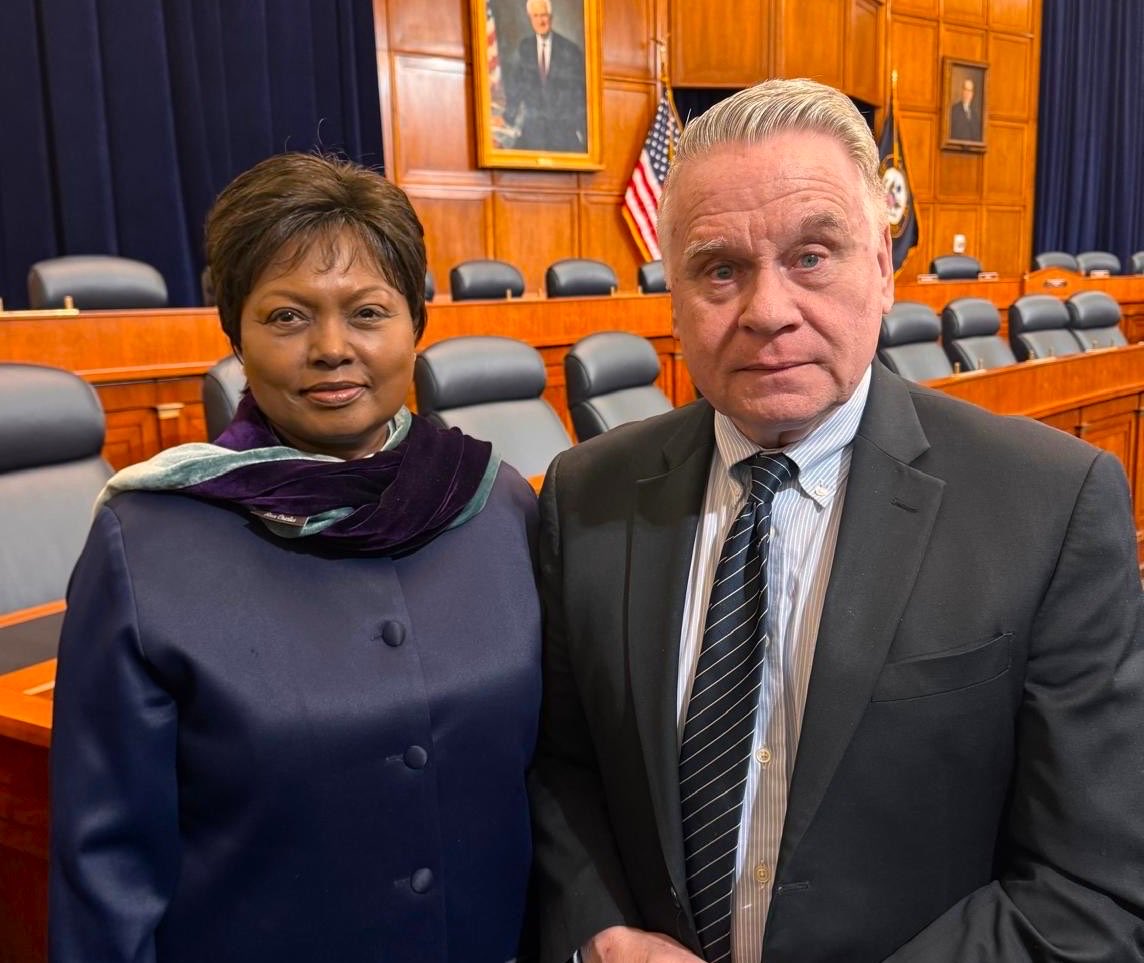
Rwanda’s to Washington, Mathilde Mukantabana with Rep. Chris Smith at earlier event
Washington – The U.S. Congressional Foreign Affairs Subcommittee on Africa, chaired by Rep. Chris Smith (R-NJ), held a hearing this Thursday on implementing the Washington Accords signed December 4, 2025 between Rwanda and DR Congo.
State Department Deputy Assistant Secretary Sarah Troutman was in the committee for the Trump administration. She emphasized U.S. monitoring, potential sanctions for violations, neutralizing FDLR threats, and securing critical mineral supply chains.
Smith called the deal historic but noted ongoing violence and compliance issues.
FDLR militia is “legitimate threat” to Rwanda and “they cannot be allowed to operate in eastern DRC”, said Troutman.
Rwanda’s Ambassador Mathilde Mukantabana submitted a statement for the record to the committee. Government thanked the Trump administration, and raising various serious security concerns. Here is the full statement:
Statement for the Record
H.E. Ambassador Mathilde Mukantabana
Ambassador of the Republic of Rwanda to the United States of America
January 22, 2026
Mr. Chairman, Ranking Member, and distinguished members of the Subcommittee:
On behalf of the Government of Rwanda, I am honored to submit this statement regarding President Trump’s historic peace agreement between the Democratic Republic of Congo and Rwanda.
Gratitude for American Leadership
Rwanda extends its profound gratitude to President Trump and his administration for prioritizing the Rwanda–DRC peace process, working in parallel with Qatar’s mediation efforts between the DRC and AFC/M23. The Washington Accords represent serious progress toward permanent stability, security, and prosperity in the Great Lakes region.
We thank President Trump, Secretary Rubio, Vice President Vance, Senior Advisor Massad Boulos, and every U.S. official who made this achievement possible.
December Violence and Unaccountable Actors
Unfortunately, violence escalated in eastern DRC in December 2025, shortly after the signing of the Washington Accords, due to an ongoing military buildup of unaccountable actors on the ground, including mercenaries, government-supported militias, and one state. These unaccountable actors—operating outside the framework of both the Rwanda–DRC agreement and the DRC–AFC/M23 negotiations—represent a fundamental challenge to lasting peace and seek to spoil the gains that have been made through the Washington Accords.
These spoilers consciously acted in November and December 2025, in coordination with the DRC Government, to incite large-scale violence in the lead-up to the signing of the Washington Accords, and immediately following, believing they could win favor by casting responsibility on Rwanda.
In the aftermath of this escalation, AFC/M23, in order to make clear that they are not the instigators, and with my Government’s strong encouragement, recently undertook a unilateral withdrawal from Uvira, demonstrating commitment to de-escalation.
The events of December demonstrate that unaccountable actors cannot be allowed to roam Eastern DRC with impunity, threatening peace and security, destabilizing the region, and undermining the Washington Accords.
The Historical Imperative: The Abacengezi Insurgency of the Late 1990s
What happened in December illustrates precisely why Rwanda requires a security buffer. For Rwanda, this is not merely about the intensity of existing security threats emanating from Eastern DRC—it is fundamentally about the history of an insurgency, known as the Abacengezi, that nearly destroyed our nation following the 1994 Genocide against the Tutsi.
The Abacengezi was a genocidal insurgency waged by former Rwandan Armed Forces (Ex-FAR) and Interahamwe militia who fled to refugee camps in Eastern DRC following their defeat in July 1994. Beginning in August 1994, these forces—numbering approximately 40,000—launched a concerted insurgency from DRC territory with a singular objective: to complete the genocide and return to power in Rwanda.
From 1994 through 1999, the Abacengezi killed thousands of Rwandan civilians in systematic attacks targeting Tutsi genocide survivors and Hutu who had remained in the country. These genocidal forces attacked schools, ordering students to separate into Hutus and Tutsis before murdering the Tutsi children. Critically, the insurgents also murdered Hutus who supported Rwanda’s new government of national unity.
The Abacengezi ideology was not simply anti-Tutsi; it was fundamentally opposed to any Rwandan—Hutu or Tutsi—who embraced reconciliation and rejected extremism. They raided communal prisons to free imprisoned génocidaires and recruit new fighters.
Operating from refugee camps that provided shelter, supplies, and manpower, they reorganized into the Army for the Liberation of Rwanda (ALIR), a precursor of today’s FDLR, with external support from the Mobutu regime and, later, other regional actors.
In May 1999, ALIR/FDLR murdered eight Western tourists in Bwindi, Uganda, including two Americans, which led the U.S. State Department to add the group to the terrorist exclusion list in 2001.
In May 1997, battalion-size Ex-FAR elements—300 to 500 fighters—launched coordinated attacks that caught Rwandan forces off guard and inflicted heavy casualties. By October 1997, approximately 1,200 insurgents attacked Gisenyi town itself, Rwanda’s northwestern economic center. Only through changed tactics and significant military commitment did Rwanda prevent the insurgents from overrunning northwestern prefectures.
This genocidal threat did not end in 1999—it has persisted for three decades, mitigated only by the defensive measures Rwanda has kept in place continuously to counter it.
Throughout the 2000s and 2010s, FDLR forces continued systematic atrocities against Congolese civilians. In 2010, FDLR burned 96 civilians alive in Busurungi, Walikale territory, as confirmed in UN sanctions statements. In 2012 alone, UN investigations documented FDLR fighters using machetes and knives to hack dozens of civilians to death, including numerous children, and documented 106 incidents of sexual violence between December 2011 and September 2012.
In 2015, FDLR was accused of training Burundi’s extremist youth militias, raising fears of regional genocide and forcing over 100,000 Burundians to flee. Despite periodic promises to disarm—in 2005, 2008, and 2013—FDLR has never genuinely demobilized.
Between 2015 and 2020, Rwanda and the DRC conducted informal joint operations against FDLR hideouts, but this cooperation ended abruptly for reasons that remain unclear. Since then, documented evidence shows that the Congolese military has resumed active collaboration with FDLR forces, reaching unprecedented levels from 2021–2022.
Today, FDLR remains operational in Eastern DRC, integrated within Congolese military operations, and UN experts continue to document their activities. The genocidal insurgency that began in 1994 has not been defeated—it has been sustained, protected, and at times actively supported by successive Congolese governments.
The scale of this threat, and its impact on Rwanda’s subsequent security doctrines, cannot be overstated.
Rwanda’s Defensive Measures and Transparency
For this reason, Rwanda does engage in security coordination with AFC/M23. I state this clearly to build trust through transparency. AFC/M23 is an independent Congolese group with its own legitimate grievances against Kinshasa, including killings, rape, and systematic discrimination against Congolese Tutsi populations, broken commitments under previous peace agreements stretching back two decades, and exclusion from political processes.
While Rwanda and AFC/M23 share a common interest in protecting Tutsi in DRC from the Forces Démocratiques de Libération du Rwanda (FDLR) and other FARDC-backed extremist militias, my country’s interest extends beyond this: to prevent another genocidal cross-border insurgency, like in the late 1990s, that could threaten Rwanda’s very existence.
However, Rwanda does not seek to determine political outcomes within DRC, nor does it endorse armed movements as a substitute for inclusive governance. Our actions are narrowly focused on protecting the people of Rwanda by preventing cross-border genocidal threats.
Rwanda’s defensive measures will adjust as the level of threat reduces, as laid down in the implementation roadmap of the Washington Accords.
Path Forward under the Washington Accords
The Concept of Operations (CONOPS) included in the Washington Accords establishes clear, measurable benchmarks. As Kinshasa fulfills its core obligations—especially the neutralization and repatriation of FDLR fighters, the dismantling of FDLR command structures embedded within FARDC operations, and the cessation of support to associated militias—Rwanda commits to a phased, simultaneous, and independently verified drawdown of its security coordination measures with AFC/M23.
This drawdown will occur in direct proportion to FDLR disarmament milestones, culminating in complete termination upon full CONOPS implementation.
Rwanda’s security coordination and defensive measures are time-bound, conditional, and threat-based. They are not open-ended and will cease in parallel with independently verified implementation of the CONOPS benchmarks through mutually agreed monitoring mechanisms.
Kinshasa has, for years, incorporated FDLR elements into FARDC operations against AFC/M23 and other groups, and more recently sought to redirect them against Rwanda itself. FDLR fighters have operated alongside Congolese military units, received logistics and arms, and used Congolese territory as a base for operations.
Despite multiple international commitments dating back to 2009, including more than 20 UN Security Council resolutions, FDLR has persisted for three decades because successive Congolese governments have leveraged these forces as proxy militias rather than fulfilling disarmament obligations. The Washington Accords provide a framework to end this unacceptable reality.
A Vision for Shared Prosperity
The Washington Accords go beyond security commitments. They establish a comprehensive pathway to economic transformation for the entire region through the Regional Economic Integration Framework (REIF).
The REIF outlines key areas for fostering economic cooperation and development between Rwanda and the DRC, demonstrating the tangible benefits of peace and creating opportunities for investment and growth that directly benefit people in the region.
Cross-border trade between Rwanda and the DRC could flourish, creating jobs and lifting millions out of poverty. Regional economic integration would position the Great Lakes as a hub for investment and development, particularly in critical minerals mining and processing, wildlife conservation, and tourism.
Shared infrastructure—roads, energy, telecommunications—could connect peoples and markets.
This is the future the Washington Accords make possible: a future where Rwandan and Congolese entrepreneurs trade freely across borders; where young people find employment in joint ventures rather than conflict; and where shared natural resources become engines of development rather than sources of discord.
Rwanda is ready to work toward this vision alongside the DRC, the African Union, the United States, and all partners.
The memories of genocide survivors, the graves of one million victims, and the documented history of the Abacengezi insurgency—which killed thousands more after 1994—compel Rwanda to maintain defensive capabilities until credible security assurances are established and the threat is gone, once and for all.
President Trump’s leadership has created an unprecedented opportunity for lasting peace and transformative economic development. Rwanda stands ready to work with all partners—the United States, the DRC, Qatar, regional mediators, and international stakeholders—to transform this opportunity into permanent reality.
Thank you, Mr. Chairman.
