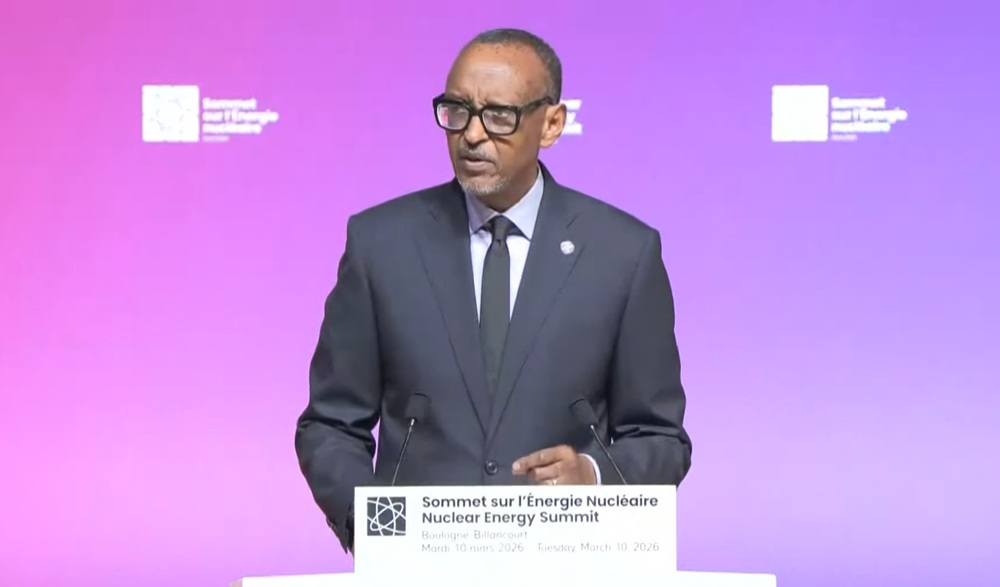
President Paul Kagame addressing the Nuclear Energy Summit, Paris, March 10, 2026
PARIS — President Paul Kagame on Tuesday appealed for enhanced international investment in nuclear energy, framing access to reliable electricity as a cornerstone of Africa’s economic transformation.
Speaking at a global nuclear energy summit in Paris hosted by French President Emmanuel Macron, Kagame said Rwanda had placed nuclear power at the center of its long-term strategy to meet growing energy demands as the country pursues its goal of becoming a high-income economy by 2050.
“Rwanda aims to be a high-income country by 2050,” Kagame told leaders, industry executives and international regulators gathered at the meeting. “That requires abundant electricity, and that is why we have decided to make nuclear central to our strategy.”
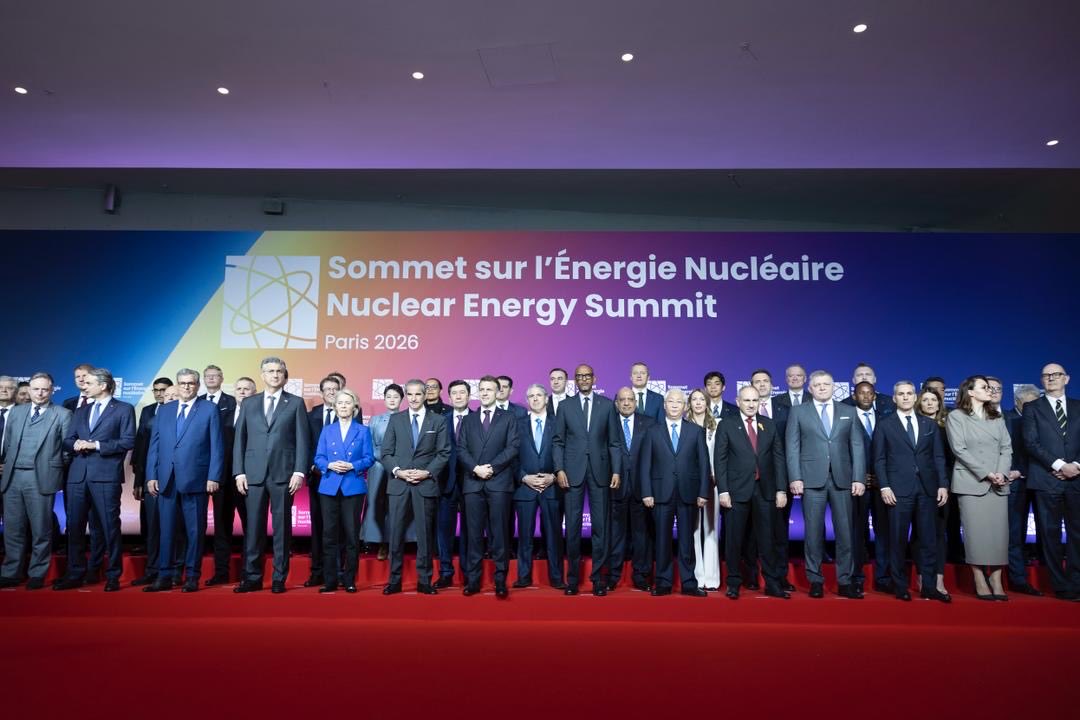
The summit brought together policymakers and industry leaders from across the world, including the director general of the International Atomic Energy Agency, Rafael Grossi, at a time when nuclear energy is gaining renewed attention as a low-carbon source of large-scale electricity.
Kagame said nuclear power would help diversify Rwanda’s energy mix while providing the stable baseload electricity required for industrial growth and long-term economic transformation.
Rwanda is preparing a major investment in nuclear energy as part of this strategy. The government plans to invest between $5 billion and $6 billion in its first nuclear power plants, focusing on small modular reactors (SMRs) suited to the country’s electricity grid.
As part of preparations, Rwanda has already trained hundreds of specialists in nuclear science and engineering, while working to build a workforce of about 230 highly skilled professionals by 2028 to operate and regulate the sector.
The nuclear program is intended to help Rwanda expand its generation capacity toward an ambitious 5 gigawatts by 2050, while providing reliable baseload power for industries such as manufacturing, data centers and mineral processing.
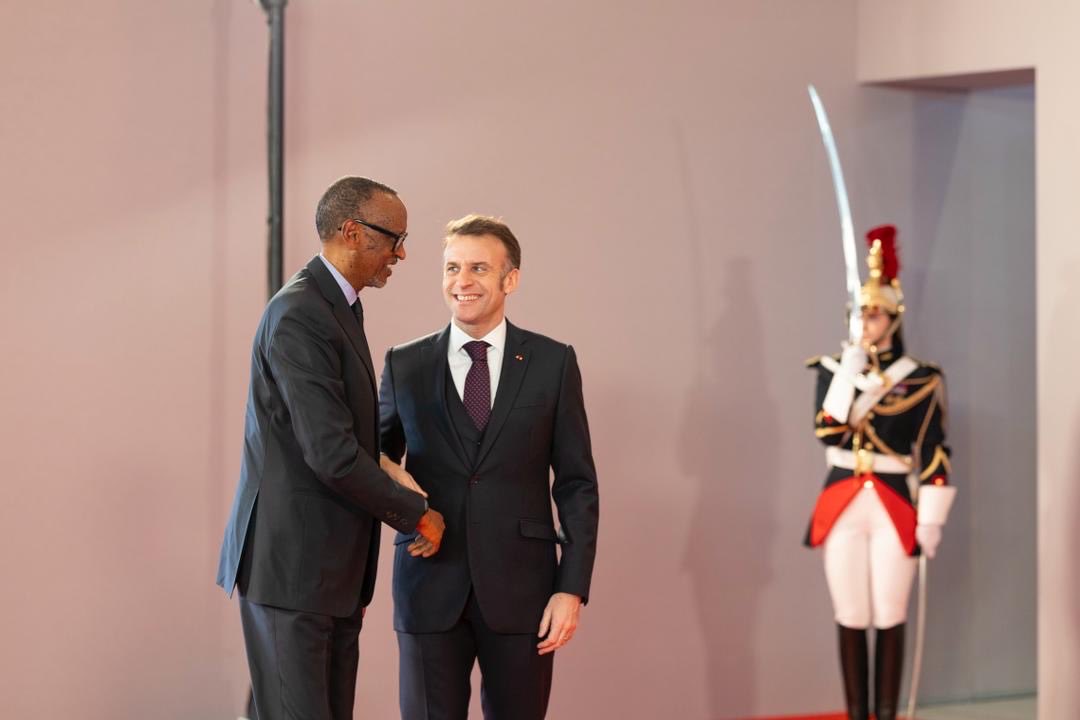
President Kagame is welcomed by French counterpart Emmanurl Macron at the Nuclear Energy Summit in Paris
Over the past several years, Rwanda has begun laying the institutional and technical foundations for a future nuclear program. The country established the Rwanda Atomic Energy Board and has been working closely with the IAEA to strengthen regulatory frameworks and technical capacity.
According to Kagame, a recent Integrated Nuclear Infrastructure Review conducted by the IAEA confirmed Rwanda’s progress in building the key pillars required for a nuclear energy program and indicated that the country is ready to move to the next stage of development under the agency’s milestone approach.
Rwanda’s plans focus in particular on small modular reactors, a new generation of compact nuclear reactors designed to be smaller, more flexible and better suited to countries with relatively small electricity grids.
“Small modular reactors are especially suited to Africa’s requirements,” Kagame said at the Paris summit, adding that the continent could become one of the most important global markets for the technology in the coming years.
But he emphasized that financing remains one of the most significant barriers facing countries seeking to develop nuclear energy.
“Nuclear energy projects require tailored financing packages, which are still unfamiliar to many development banks,” he said, urging international financial institutions to expand their support for such investments.
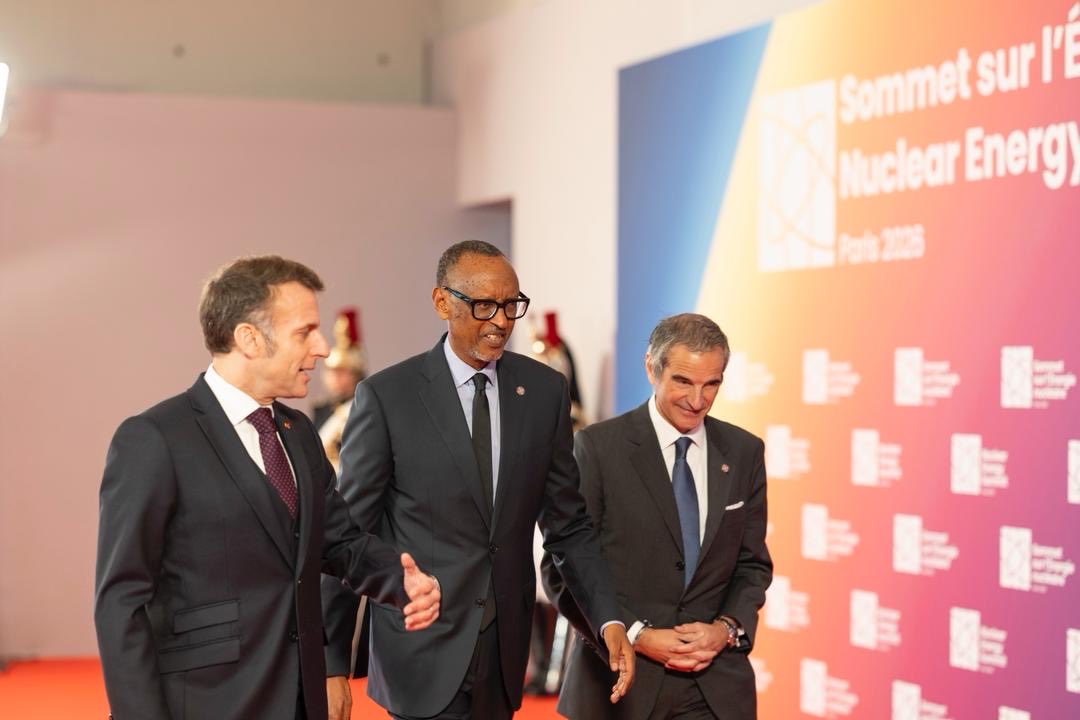
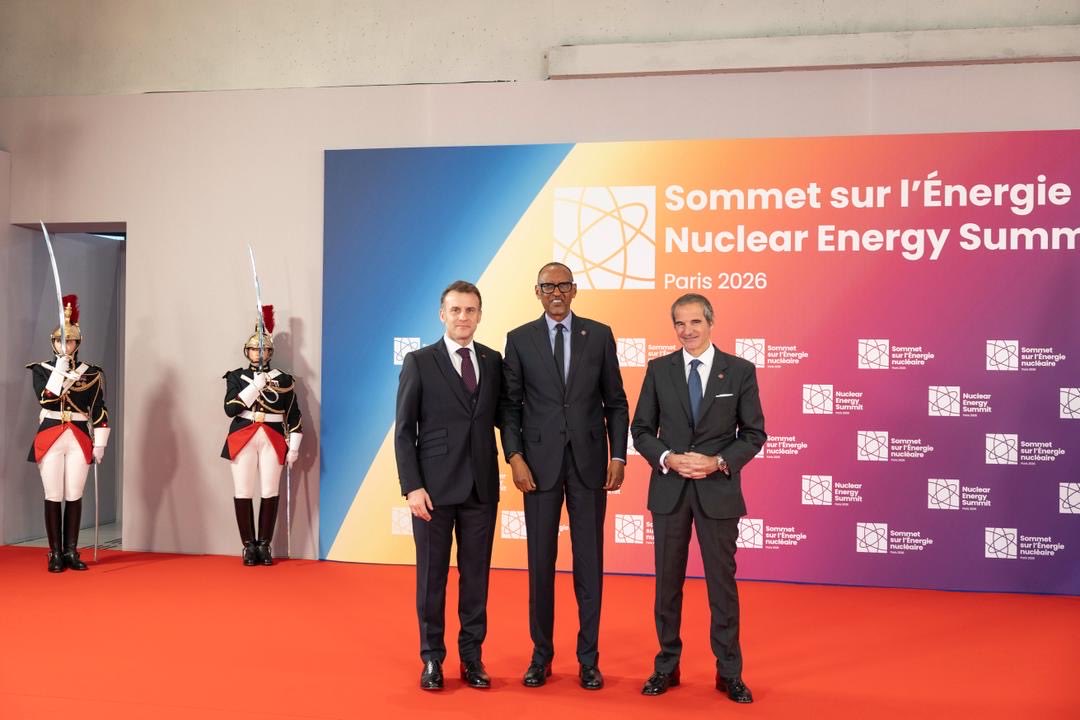
President Kagame is welcomed by French counterpart Emmanurl Macron, and Director General of the International Atomic Energy Agency, Rafael Grossi
Kagame noted that the World Bank had recently moved to reconsider its long-standing restrictions on financing nuclear energy projects, following calls from governments during global climate discussions.
He said the shift should now be translated into practical support that allows developing countries to access the capital needed to build new nuclear infrastructure.
Beyond financing, Kagame also called for greater international cooperation in technology development and the integration of new nuclear countries into global supply chains so that local skills and industrial capacity can grow.
“Nuclear energy is not too complex or risky for developing countries,” he said, adding that international standards established by the IAEA provide a universal framework that can be applied by countries at every income level.
Kagame also announced that Rwanda will host the 2026 Nuclear Energy Innovation Summit for Africa in Kigali, bringing together leaders from government, finance and the nuclear industry to advance discussions on the continent’s role in the future of nuclear energy.
“Rwanda is ready to do what it takes to power our development with nuclear energy,” he said. “We look forward to working with partners across the world to make that vision a reality.”