


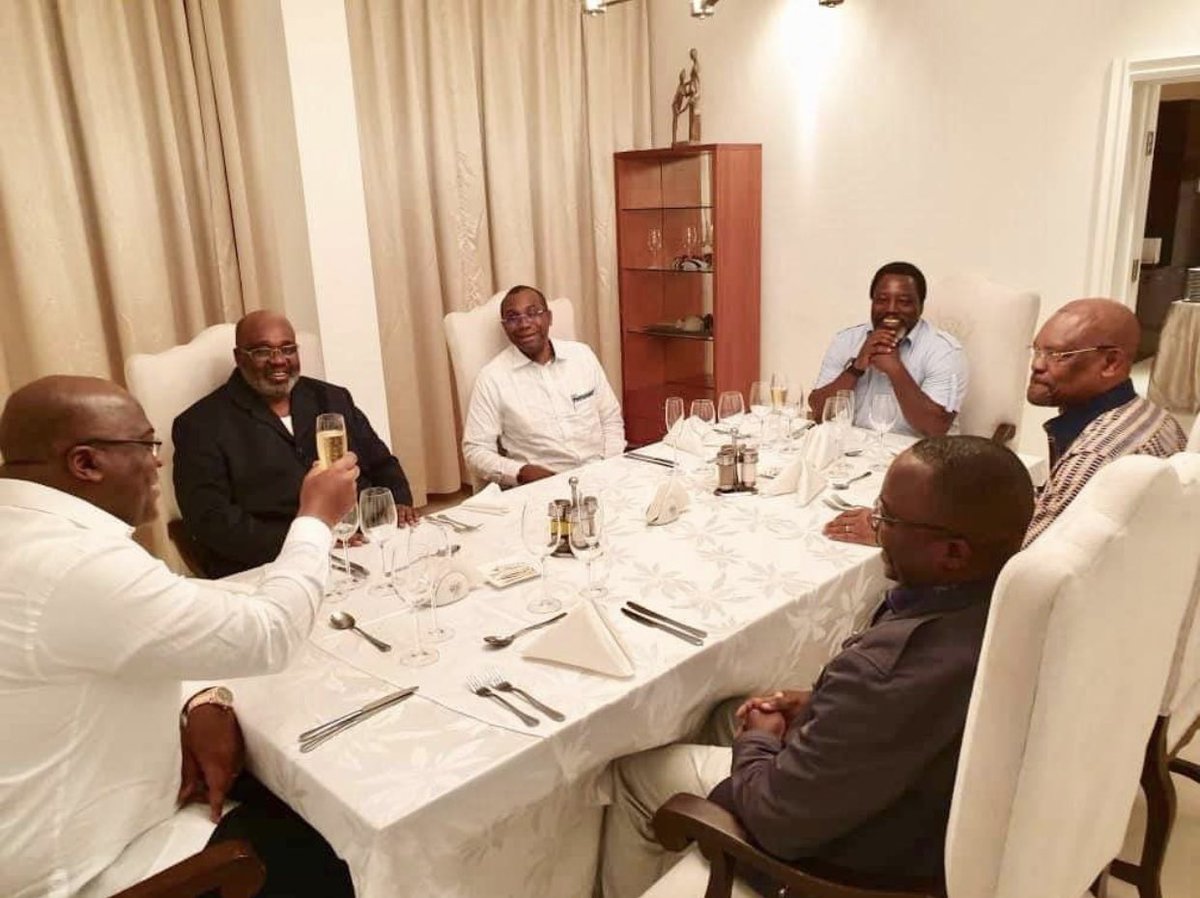
Félix Tshisekedi on left end and Joseph Kabila on right. This is one the follow up meetings that came after two men signed confidential agreement which effectively handed Tshisekedi power
KINSHASA — In a revelation with the intrigue of a Cold War spy novel, Joseph Kabila said this week that he still holds the only existing copy of a secret 2019 agreement that paved the way for his successor, Félix Tshisekedi, to take power.
Kabila, in a rare interview published Monday by the Belgian newspaper La Libre Belgique, described the document — formally titled “Accord pour la Stabilité et la Paix au Congo” — as a single sheet of paper signed at his private Kingakati farm on Jan. 8, 2019.
It was, he said, the negotiated price of a peaceful transfer of power after disputed elections that many Congolese believe were won by another candidate.
Tshisekedi’s allies, he added, “swore that no such agreement had ever existed.”
He kept the only copy.
“I knew that if I gave it to them,” he said, “it would end up immediately on social media.”
The agreement itself, by multiple accounts, was less a formal state document than a tightly controlled political understanding. It was signed at Kingakati in a closed setting, with only a handful of aides present and no official record of the proceedings.
Rather than being exchanged or archived through state channels, the document remained in Mr. Kabila’s possession from the outset, as discussions moved immediately beyond the signature to the real question: how power would be shared.
Under the arrangement, Tshisekedi’s CACH platform secured the presidency, while Kabila’s FCC coalition retained control of Parliament, the army, intelligence services and much of the state’s economic machinery.
In return, the new president was expected to consult his predecessor on major appointments — a structure that effectively preserved the old order beneath the surface of a new administration.
The deal was backed by regional leaders, including Kenya’s Uhuru Kenyatta, South Africa’s Cyril Ramaphosa and Abdel Fattah el-Sisi of Egypt, who served as international guarantors.
Several years later, the arrangement remains officially unacknowledged by the current government, even as the country faces deepening instability.
Eastern Congo is again gripped by armed conflict. Political tensions in Kinshasa have intensified, including debates over possible constitutional revisions that could extend presidential term limits.
Kabila, now based in Goma, has re-emerged at a moment of mounting crisis. His interview coincides with renewed fighting in the east, reports of drone strikes near his residence, and growing public skepticism about whether the 2019 transition was ever a genuine transfer of power.
The symbolism of his claim is striking. If the country’s president does not possess — and may never have possessed — the foundational document of his political authority, it raises questions about the nature of governance in a nation long shaped by opaque deals and elite power-sharing.
Kabila warned in the interview of the risk of “Sudanization,” a reference to state fragmentation into competing armed factions, and invoked Article 64 of the Constitution, which calls on citizens to resist unconstitutional rule.
Tshisekedi’s office has not directly addressed the claim about the agreement. A presidential spokesman told local radio that “the people of Congo elected President Tshisekedi in 2018 and re-elected him in 2023; everything else is ancient history.”
In Congolese politics, such history rarely fades.
For many citizens, the disclosure is less a revelation than a confirmation of a long-held suspicion: that power in Congo is not cleanly transferred through elections, but informally negotiated and quietly retained.
