



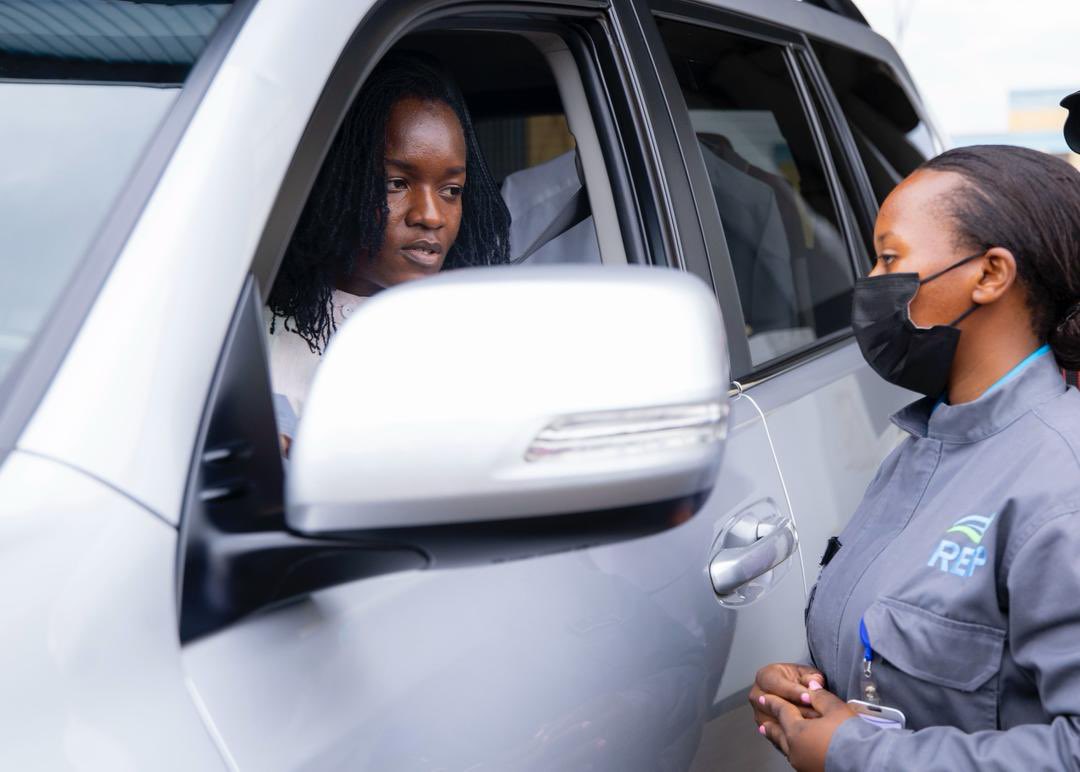
Dr. Bernadette Arakwiye, the Minister of Environment, here took her personal car for emissions test. She uses the car for government work, but it’s her personal vehicle, like all other colleagues
KIGALI — Rwanda has directed all public institutions to ensure that at least 30 percent of newly purchased vehicles are electric, in a policy shift that signals a deeper push toward clean transport and reduced reliance on fuel imports.
The directive, issued by the Ministry of Infrastructure (MININFRA), took effect on April 14, 2026. In a letter to budget managers across government institutions, State Minister Jean de Dieu Uwihanganye instructed agencies to align vehicle procurement with national sustainability policies.
The guidance states that all institutions must ensure “at least 30 percent of newly acquired vehicles are electric,” as part of efforts to cut emissions, reduce dependence on petroleum products, and promote environmentally sustainable transport.
Cost and Energy Pressures
The move comes at a moment of sharp fuel price increases, both globally and domestically. Within just one month, petrol prices in Rwanda surged from Rwf 1,989 to Rwf 2,938 per litre—an increase of nearly 48 percent—while diesel rose from Rwf 1,948 to Rwf 2,205.
These increases have placed growing pressure on government spending, particularly for institutions that still operate vehicle fleets.
By pushing electric vehicle (EV) adoption, authorities are not only targeting emissions but also long-term fiscal exposure to volatile fuel markets.
No Government Vehicles
To understand the significance of this directive, it sits within a broader system Rwanda has used for over two decades.
Since the early 2000s, the government shifted away from assigning official vehicles to senior public officials.
Instead, ministers and top officials acquire vehicles in their own names, supported by financing arrangements, while receiving a monthly lump-sum allowance to cover transport costs such as loan repayments, fuel, and maintenance.
The vehicles are privately owned, not state assets, and remain with the individual even after leaving office—though they can be repossessed by lenders if loans are unpaid.
This model sharply reduced misuse of government vehicles and cut fleet management costs.
However, institutional fleets still exist, particularly for operational and public service functions. These vehicles—identified by GR (Government of Rwanda) number plates—are used by:
- Security agencies such as the Rwanda Defence Force and Rwanda National Police
- Emergency and response services
- Technical and infrastructure agencies like Rwanda Transport Development Agency
- Local government units for field operations
Even so, the scale of this fleet is relatively small. Rwanda has around 400,000 registered vehicles nationwide, with only a very small fraction operating as part of the government fleet.
The vast majority of vehicles are privately owned or commercially operated.
It is within this limited but strategically important government fleet that the new 30 percent EV requirement will have its most direct impact.
Electric Mobility
Rwanda has already been expanding its electric mobility ecosystem. The government recently acquired hundreds of buses for public transport in Kigali, including electric models, while the total number of electric vehicles in the country had surpassed 7,000 by the end of 2024.
Public transport is increasingly insulated from fuel shocks, with a growing share of buses powered by electricity—reducing both operating costs and fare volatility.
The policy aligns with Rwanda’s broader development framework under the National Strategy for Transformation (NST2) 2024–2029, which targets a 38 percent reduction in greenhouse gas emissions, equivalent to 4.6 million tonnes of carbon dioxide.
By mandating EV adoption in public procurement, the government is effectively using its own purchasing power to accelerate market transition, create demand, and normalize electric mobility at scale.
Not a Symbolic Shift
This is not just an environmental gesture. It is a continuation of Rwanda’s approach to public sector reform—reducing direct state ownership where possible, while tightening control where it matters.
The earlier shift away from official cars transferred costs and responsibility to individuals. This new directive reshapes the remaining state-controlled fleet, aligning it with energy, fiscal, and climate priorities.
In practical terms, Rwanda is moving from owning fewer vehicles to owning smarter ones.
