



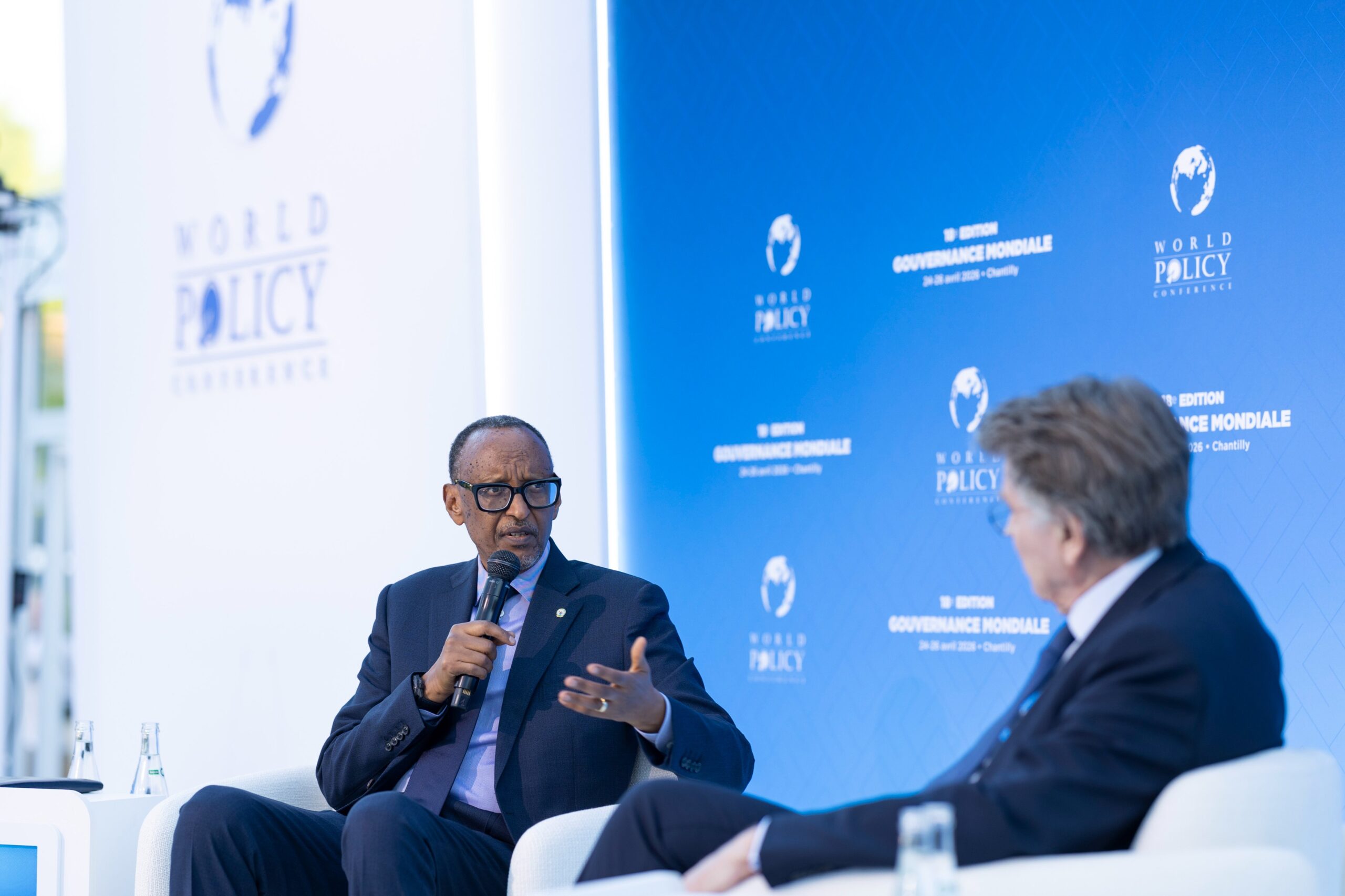
President Kagame peaking in a question-and-answer session moderated by Thierry de Montbrial, the founder of the forum
CHANTILLY, France — At a moment of widening geopolitical strain and eroding global consensus, President Paul Kagame used a public exchange at the World Policy Conference on Friday to deliver a blunt critique of the international system, arguing that today’s instability is less a rupture than the exposure of long-standing imbalances.
Speaking in a question-and-answer session moderated by Thierry de Montbrial, the founder of the forum, Mr. Kagame framed global disorder not as a sudden breakdown but as the logical outcome of decades of unequal power relations between major and smaller states.
“There is a lot to be done to go back to some kind of order,” he said. But even the earlier order, he added, was incomplete and exclusionary. “Many things needed to change… to make it more stable, reach more parts of the world and therefore more people.”
A System Long Under Strain
Pressed on what rising global tensions mean for Africa, Mr. Kagame rejected the premise that the continent is only now being affected.
“Africa has been affected all along,” he said. “It’s not just around this crisis… even when things looked stable globally.”
He described a system in which power, rather than principle, determines legitimacy.
“Who decides what is wrong? Who decides what is right — and on what basis?” he asked, before answering his own question: “Is it just that you have the power? Therefore, you decide.”
The asymmetry, he argued, is most visible in how nations are treated when they act in their own interest.
“When big powers feel threatened, they will do anything… and nobody should complain,” he said. “When smaller countries… see something that threatens them… the immediate thing is blame, punishment, criticism.”
Eastern Congo
Turning to conflict in Central Africa, including tensions involving Rwanda and the Democratic Republic of Congo, Mr. Kagame warned against expectations of quick diplomatic fixes.
“Problems cannot be addressed overnight. Crisis cannot be overcome in such a short time,” he said.
He emphasized that durable solutions depend on confronting root causes rather than managing symptoms.
“There is a need to look at the root causes of everything and then give time to dialogue… to find a win-win kind of solution,” he noted
While acknowledging international efforts — including those involving the United States — he suggested that external mediation can sometimes be misdirected.
“Sometimes… the dialogue is not about the issues affecting people, Kagame said. “It’s just how interests play into all that to determine the outcome.”
Global Conflicts, Local Consequences
Asked about escalating tensions in the Middle East and their potential global repercussions, Mr. Kagame was unequivocal: “Things are bad. They can get worse.”
He pointed to cascading economic effects already being felt worldwide.
“You can see the oil prices… fertilizer, food prices… affecting hundreds of millions of people,” he said. “That will cascade into many other things and regions.”
For countries like Rwanda, he added, the impact is disproportionate and unavoidable. “A small country like mine… doesn’t have much say… other than having to pay a very huge price for what is happening.”
The West Under Scrutiny
In response to questions about political shifts in the United States and Europe, including the long-term implications of Donald Trump’s influence, Mr. Kagame shifted focus away from individual leaders to broader systemic dynamics.
“I talk more about the West than Trump,” he said.
He argued that Western societies are now confronting internal contradictions that were long ignored.
“The West has taken things for granted… that they know everything… can decide on everything, and the others don’t matter,” said Kagame
The emergence of disruptive political figures, he suggested, reflects deeper social and political tensions.
He noted: “There are contradictions within the society that have not been properly addressed… and in the end, they have to surface.”
Africa’s Responser
Mr. Kagame used Rwanda’s own history — from devastation to recovery — to argue for a shift in how African countries approach development and global engagement.
“We had to build from nothing,” he said. “We started with ourselves… even if we partnered with others.”
He warned against internalizing narratives of dependency.
He said: “We tend to look somewhere else… and then we find these powers also want to impress upon us that we don’t have much… that we can only survive because of them.”
That perception, he said, must be actively rejected. “This notion has to be challenged… by all of us.”
Questioning the ‘Rules-Based Order’
Throughout the exchange, Mr. Kagame returned to skepticism about the fairness of the global system, particularly the idea of a “rules-based international order.”
“People talk about the rules-based system. Which rules? Who makes them?” he asked.
He pointed to contradictions between stated principles and actual behavior.
“If we really were to respect the rules, why then do we have these troubles… even originating from the big powers?”
A Call for Rebalancing
Despite his criticism, Mr. Kagame stopped short of proposing a specific alternative framework. Instead, he emphasized the need for broader inclusion and mutual respect.
“More cooperation, more respect for each other,” he said, urging a system in which “everyone should have some space to express themselves and contribute.”
Even smaller nations, he added, have a role. “We can at least raise a voice… and say maybe if we did this, we could…”
Mr. de Montbrial, closing the session, thanked the President for what he described as “words of wisdom,” and encouraged attendees to engage more directly with Rwanda.
The exchange, though brief, underscored a deeper divide shaping current geopolitics: not simply between regions or powers, but between competing interpretations of how the global system works — and for whom.
