



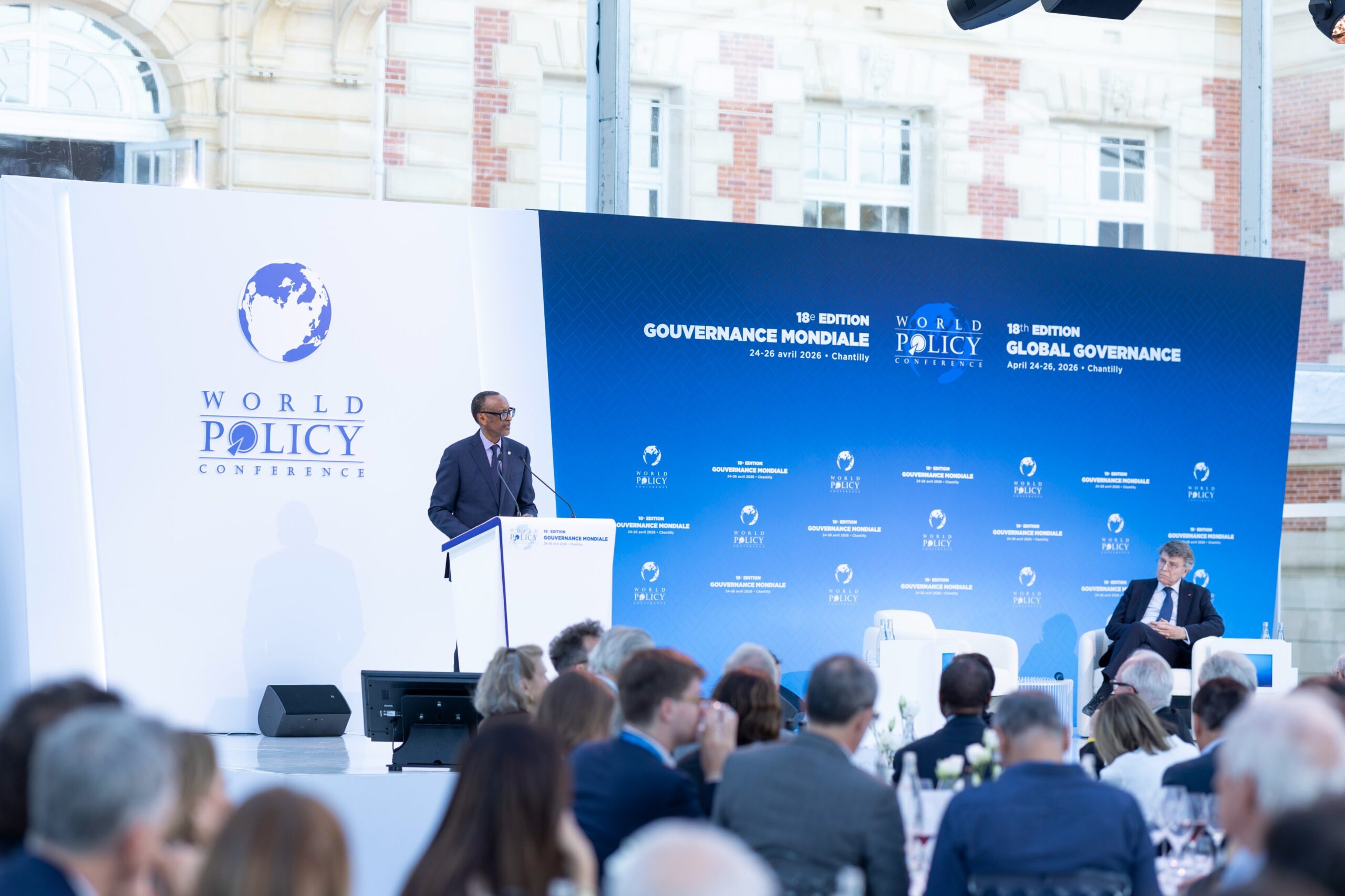
Chantilly, France — President Paul Kagame on Friday warned against what he called a culture of “making excuses,” saying it prevents countries from addressing the structural causes of underdevelopment, even as he pointed to global economic fragility and dependency risks.
He spoke at the 18th edition of the World Policy Conference in Chantilly, hosted by the French Institute of International Relations.
Kagame said the assumptions that shaped globalization are no longer holding.
“For decades, the golden age of globalization was built on the assumption that economic ties would make war more expensive and peace easily attainable,” he said, in an 8-minute speech. “Today, the very global networks that were supposed to bring us closer together have become a source of vulnerability.”
He said global integration delivers shared gains in normal times. But in crises, it creates choke points. Supply chains can fail at a single point.
He cited the COVID-19 pandemic as a turning point. The crisis exposed how shocks spread quickly across borders. It also showed the risks of concentrating production in a few countries.
“When there is a shortage, those nations will prioritize their citizens,” he said.
He added that ongoing conflicts are exposing the same weakness. Essential goods can be blocked. The impact spreads widely.
President Kagame referred to this as “weaponized interdependence.”
For Africa, he said, these shocks reinforce the dangers of dependency. He noted that many attribute this to colonial history and structural adjustment policies.
“While true in a sense, the habit of making excuses only traps us in a cycle,” he said. “We see ourselves as victims with no power to change our circumstances, and that is completely false.”
He said countries must focus on solutions within their control.
Kagame pointed to Rwanda’s experience after the 1994 genocide against the Tutsi. He said recovery was driven by homegrown solutions tailored to local realities.
“The best solutions are homegrown,” he said. “Those that come from within yield the highest returns.”
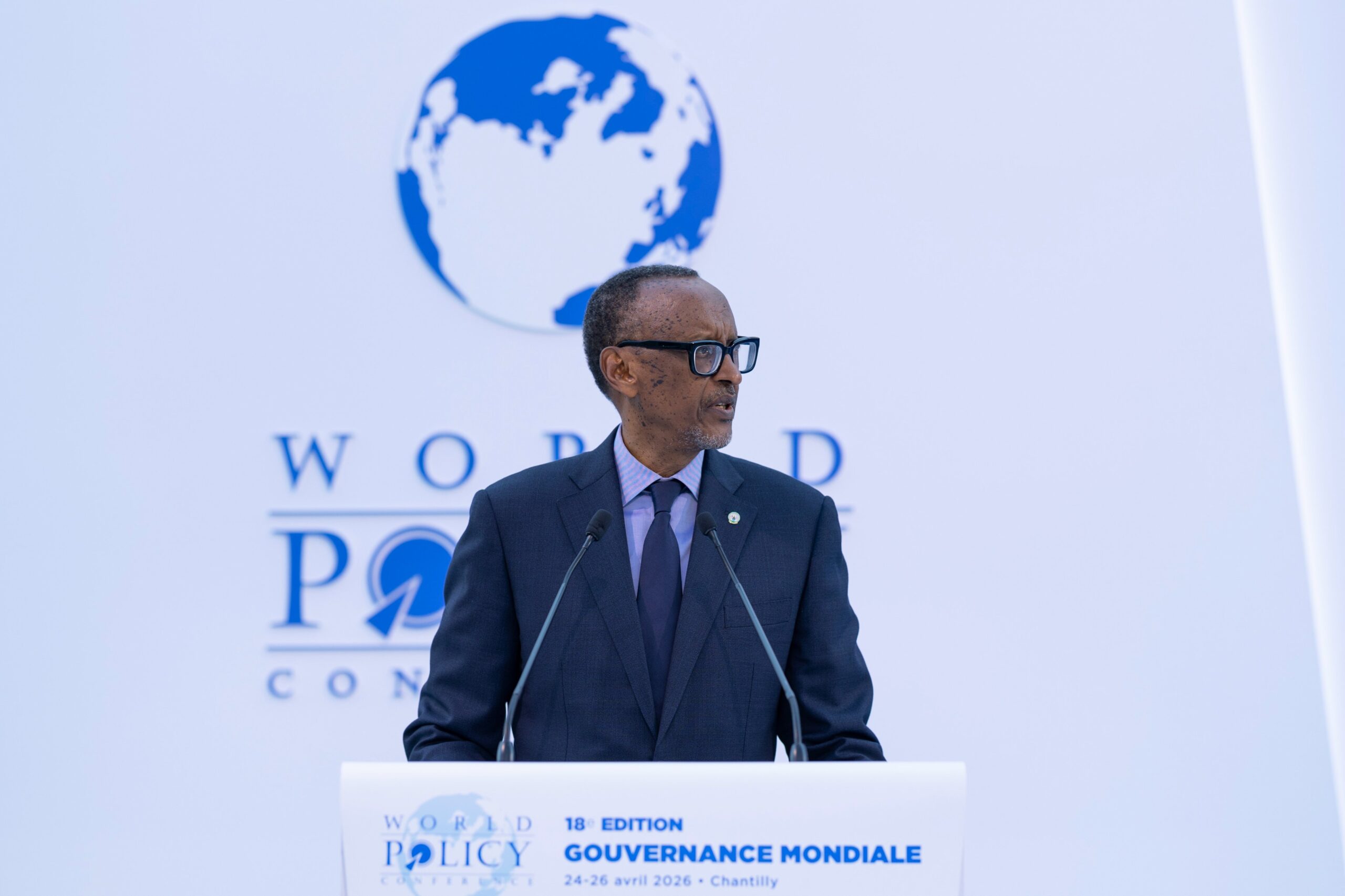
He said similar thinking is emerging across Africa. Governments are working to mobilize domestic resources. They are investing in local production. They are strengthening supply chains and regional integration.
“A more self-reliant Africa, with its own fertilizer plants, oil refineries and pharmaceutical firms, will contribute more positively to global stability,” he said.
At the same time, he cautioned against retreating from global cooperation.
“With the fragmentation we are seeing, more isolation is not the solution,” he said. “It will bring rivalry and breed division.”
The Head of State urged a shift in how development is viewed. He said it should not be treated as competition.
“Viewing development as a positive-sum game can bring the predictability and coherence the global system needs,” he said.
Kagame noted the goal is not to build a perfect global order.
“The question is not whether we can build a perfectly balanced world,” he said. “It is whether we can coexist, even with our differences, and still prosper together.”
The conference brings together global leaders, policymakers and experts to discuss governance, multilateralism and international cooperation. It was founded by Thierry de Montbrial.
The Kagame gave the keynote address, he moved on to a question-and-answer session moderated by Thierry de Montbrial, the founder of the forum.
