



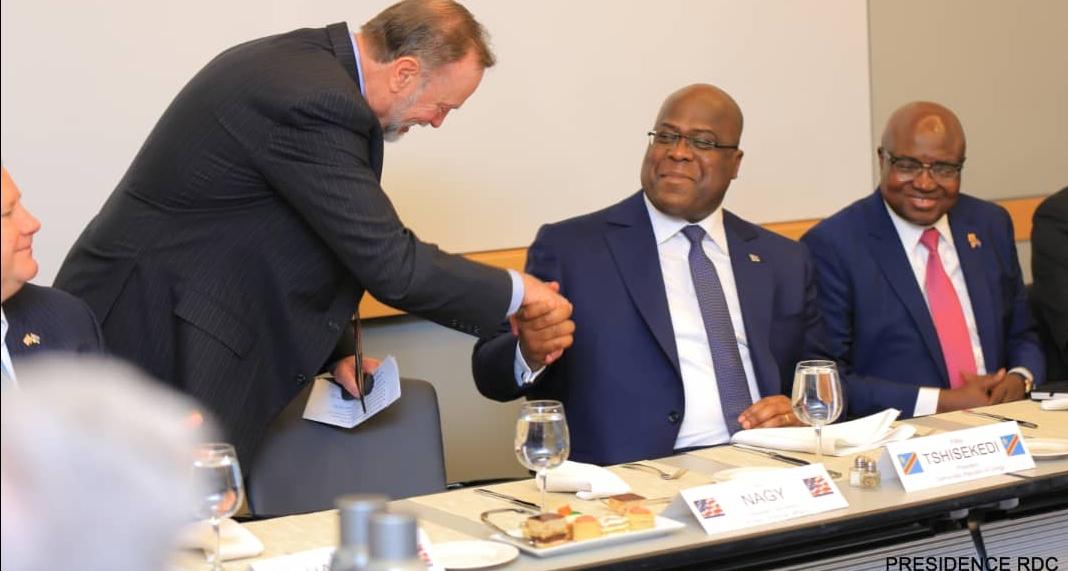
Tibor Nagy welcomes President Tshisekedi on visit to Washington in 2019
WASHINGTON — Tibor Nagy, the former senior American diplomat who helped shape Washington’s Africa policy during the first Trump administration, has publicly expressed regret over backing Félix Tshisekedi as the winner of the Democratic Republic of Congo’s disputed 2018 presidential election.
In a post published Wednesday on X, Nagy described his support for Tshisekedi as one of the biggest disappointments of his time in office.
“I thought he would really be different and advance the Congolese people’s interests. How wrong I was!” Nagy wrote, in remarks that quickly drew widespread reaction online.
The unusually blunt statement comes as political tensions rise once again in DRC following Tshisekedi’s recent remarks suggesting that continued insecurity in the country’s east could affect the timing of presidential elections expected in 2028.
Opposition figures have accused the Congolese leader of laying the groundwork for a potential extension of his rule, allegations his administration has repeatedly denied.
As U.S. Assistant Secretary of State for Africa, Nagy played a visible role in the United States’ recognition of Tshisekedi after the 2018 election, despite persistent claims by opposition leaders and independent observers that opposition candidate Martin Fayulu had won the vote.
At the time, the transfer of power was widely presented internationally as Congo’s first peaceful democratic transition since independence.
But Tshisekedi’s presidency has increasingly come under pressure over governance concerns, political tensions, and the continuing conflict in eastern Congo, where armed violence and regional instability have persisted despite multiple diplomatic initiatives.
Nagy’s remarks are significant not only because of his previous role in shaping U.S. policy toward Africa, but also because former senior American officials rarely publicly acknowledge misjudgments involving high-level foreign policy decisions.
His comments may also reflect growing unease among some Western policymakers over the direction of Congolese politics ahead of the next electoral cycle.
