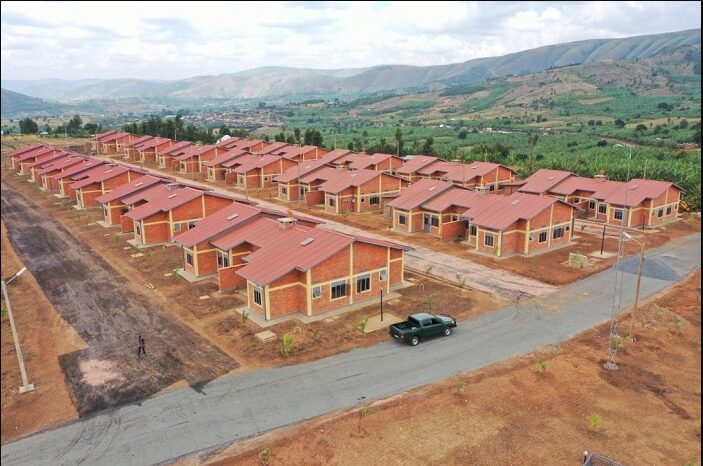
Model village for vulnerable citizens in Gishuro in Nyagatare district.
The Government of Rwanda has announced plans to integrate housing support for survivors of the 1994 Genocide against the Tutsi into broader national programmes that provide shelter to vulnerable citizens.
The Ministry of National Unity and Civic Engagement (MINUBUMWE) says the move will improve coordination, make better use of resources and ensure that survivors who still live in poor conditions are prioritised within existing housing initiatives.
The issue was raised in Parliament after lawmakers expressed concern that some survivors remain homeless or live in dilapidated houses more than three decades after the Genocide against the Tutsi.
MP Mukampunga Epiphanie cited statistics showing that 29,232 houses owned by survivors still require rehabilitation, while 6,973 new houses need to be constructed.
She also questioned why some districts were not included in the current housing support plan.
“Sixteen districts and the City of Kigali have been allocated budgets to build houses for survivors of the Genocide against the Tutsi. However, districts such as Kayonza, Nyanza, Rwamagana, Muhanga, Rusizi, Rubavu, Karongi, Nyamasheke, Rutsiro, Burera, Musanze and Gakenke are not included. We would like to know what is being planned to ensure these areas are also covered,” she said.
Mukampunga noted that survivors do not always benefit adequately from general housing programmes for vulnerable citizens.
“You may find vulnerable people being relocated or given new homes while some survivors are not reached. This gap needs to be addressed,” she said.
Responding to the concerns, Minister of National Unity and Civic Engagement Dr Jean Damascène Bizimana said MINUBUMWE has already reached an agreement with the Ministry of Local Government (MINALOC) and the Ministry of Finance and Economic Planning (MINECOFIN) to ensure survivors are fully included in all government housing programmes for vulnerable citizens.
“We have agreed with MINALOC and MINECOFIN that survivors of the Genocide against the Tutsi must be included in all programmes designed to provide housing to vulnerable Rwandans,” Dr Bizimana told lawmakers.
He said the approach is also intended to strengthen national unity by ensuring social protection programmes are implemented inclusively.
“This contributes to building unity among Rwandans. We should not continue separating one category of citizens from another,” he said.
Dr Bizimana added that MINUBUMWE is working with the Ministry of Defence (MINADEF), the Ministry of Infrastructure (MININFRA) and MINALOC to improve construction methods and reduce costs.
He noted that building costs vary by district due to differences in material and transport costs, citing sand prices in Muhanga and Nyamasheke as an example.
“The cost of each house depends on its condition, location and the needs of the beneficiaries. We are also exploring approaches such as community work and local contractors so that available resources can help more people,” he said.
MINUBUMWE said consultations with partner institutions have already been completed and the new framework is expected to accelerate efforts to provide decent housing to survivors who still need support.
Over the years, Rwanda has built and renovated thousands of homes for survivors of the Genocide against the Tutsi through government programmes, community initiatives, local authorities and survivor support organisations.
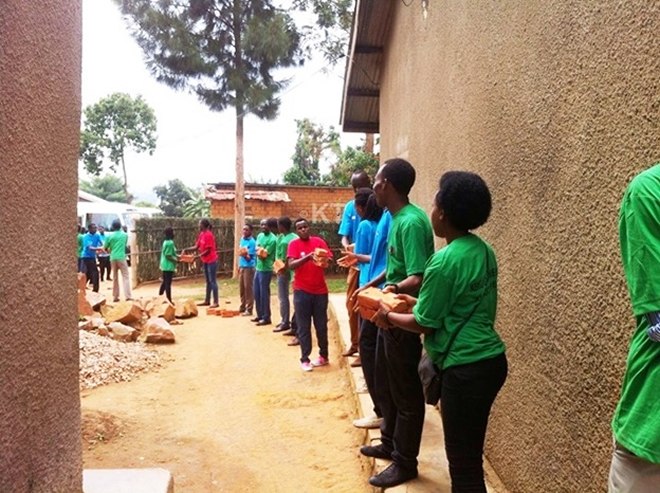
Members of AERG/GAERG (now IBUKA) exchanging bricks to the house being constructed for genocide survivors