



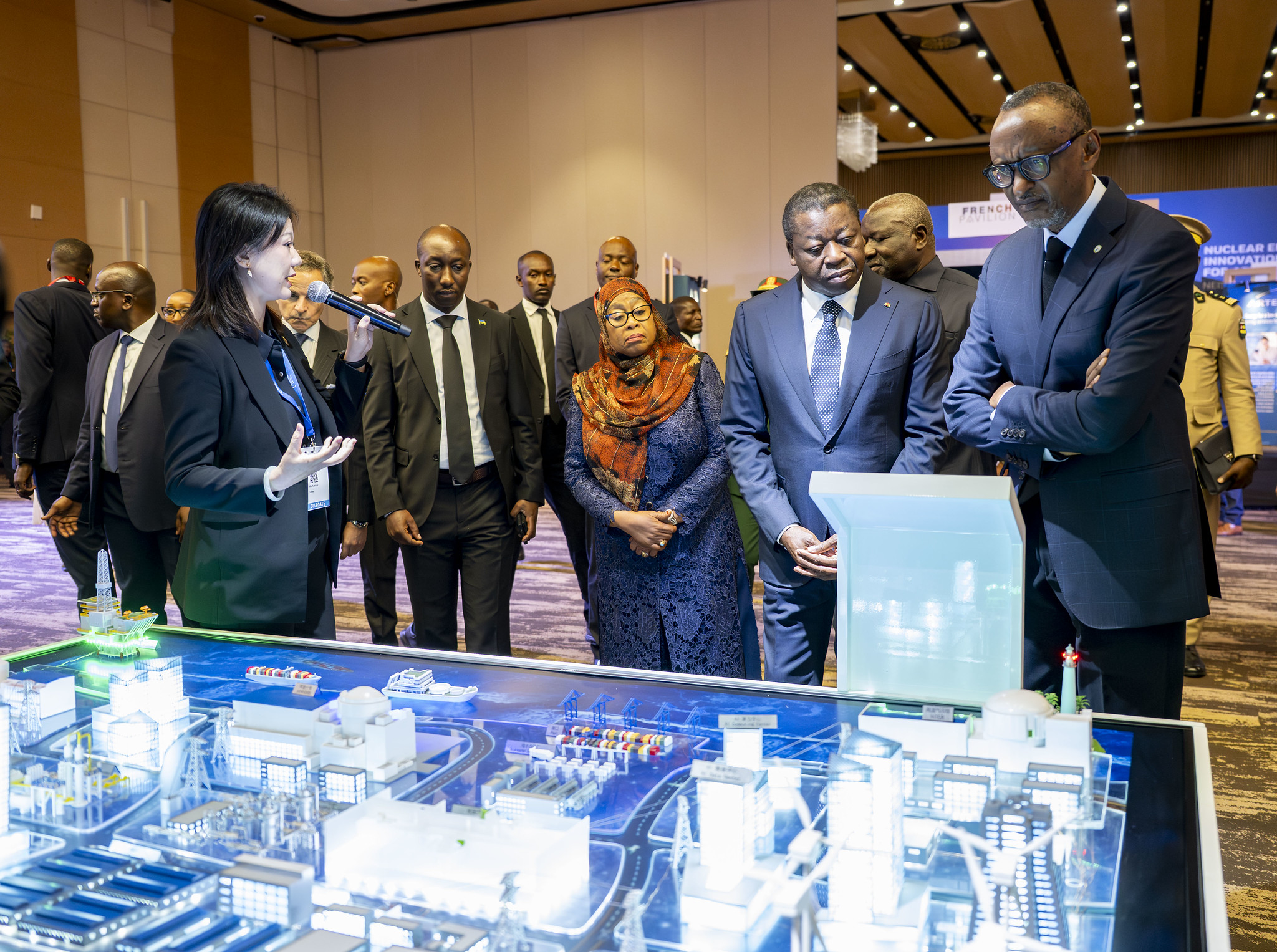
President Paul Kagame and his Tanzanian and Togolese counterparts Samia Suluhu Hassan and Faure Essozimna Gnassingbé on Tuesday May 19, 2026. The leaders were given a first hand account of how latest technology developments can provide nuclear power at relatively affordable costs
The Rwandan leader may no longer be chairman of the African Union, but President Kagame’s shadow looms larger than ever across the continent. In the race to secure Africa’s energy future, the continent is once again looking to Kigali.
Indeed, as more African countries reciprocate Rwanda’s open borders policy, realizing that the free movement of people fuels trade and growth, there is another sector where they will follow Kagame’s lead without thinking twice: solving the puzzle of Africa’s energy poverty. And this week in Kigali, nuclear energy is the topic.
For years, atomic power was considered a technological bridge too far for Africa: too expensive, too complex, too politically sensitive. But Rwanda is methodically dismantling that perception.
One of the most important structural challenges to nuclear energy in Africa has always been financial. For decades, multilateral lenders treated nuclear power as a pariah, excluded from the “green energy” conversation dominated by solar, wind, and hydro.
Countries like Rwanda changed the vocabulary. Their relentless advocacy at the highest levels of global finance helped push the World Bank to lift its long-standing ban on financing nuclear projects. This, in turn, unlocked billions of dollars in potential funding for any African nation brave enough to invest in such a program.
Money, however, is useless without mastery. This is where Rwanda’s “leading by example” becomes impossible to ignore. The country has spent the past several years training nuclear scientists at an unprecedented scale for the continent. In partnership with the IAEA and Russia’s Rosatom, Kigali has built a pipeline of young, home-grown nuclear engineers. They are not waiting for a plant to be built; they are ensuring that when it arrives, Rwandans will run it.
Furthermore, Rwanda has successfully completed the IAEA’s Phase 1 Integrated Nuclear Infrastructure Review (INIR), a rigorous assessment of a country’s readiness to even consider a nuclear program. The country is now set for progression to Phase 2, which involves preparatory work for a nuclear power plant.
Having passed that test, Kigali is now moving into partnerships with different countries to deploy Small Modular Reactors (SMRs). These SMRs are perfectly suited not just for Rwanda’s existing grid, but for most of the grids across Africa. They are cheaper, faster to build, and less intimidating than traditional mega-plants.
The lesson for those willing to learn is clear: this is a process that requires careful preparation, deliberate investment in human capital, and patient infrastructure building. Rwanda has done the homework so others don’t have to start from scratch. South-South cooperation should do the rest.
Addressing the NEISA (Nuclear Energy and Industrial Strategy for Africa) event in Kigali, President Kagame delivered a keynote that cut through the environmental sentimentality often attached to energy debates, noting that Africa’s economic growth cannot rely on intermittent power. This goes beyond keeping the lights on.
“For Africa, energy is not simply a development issue. It is the foundation of industrial growth and competitiveness,” Kagame argued, suggesting that without massive, reliable power, the continent will forever remain a raw material exporter.
He pointed specifically to value-addition sectors (manufacturing, mineral processing), the deployment of advanced healthcare, and digital infrastructure, all of which require massive and reliable energy.
Indeed, an AI data center cannot run on intermittent solar power. A mineral refinery cannot rely on diesel generators. If Africa wants to compete globally, it needs the 24/7 intensity that only nuclear (or hydro, where available) can provide.
Perhaps the most politically significant part of the speech occurred when Kagame rejected the notion of solitary struggle. He noted that the path to energy sovereignty is bigger than any one country, and that fragmented efforts will mean the costs are higher for everyone on the continent. It is encouraging, then, that Tanzania and Togo have signalled strong interest in following Rwanda’s nuclear roadmap.
President Kagame may no longer preside over summits in Addis Ababa. But he is driving change all the same.
By solving the financial puzzle, building the human infrastructure, and selecting the right technology, SMRs for the right grid, Rwanda is proving that nuclear energy is not a fantasy for Africa. It is a necessity.
Right now, Tanzania and Togo have smelled the coffee. Soon, so will others.
