



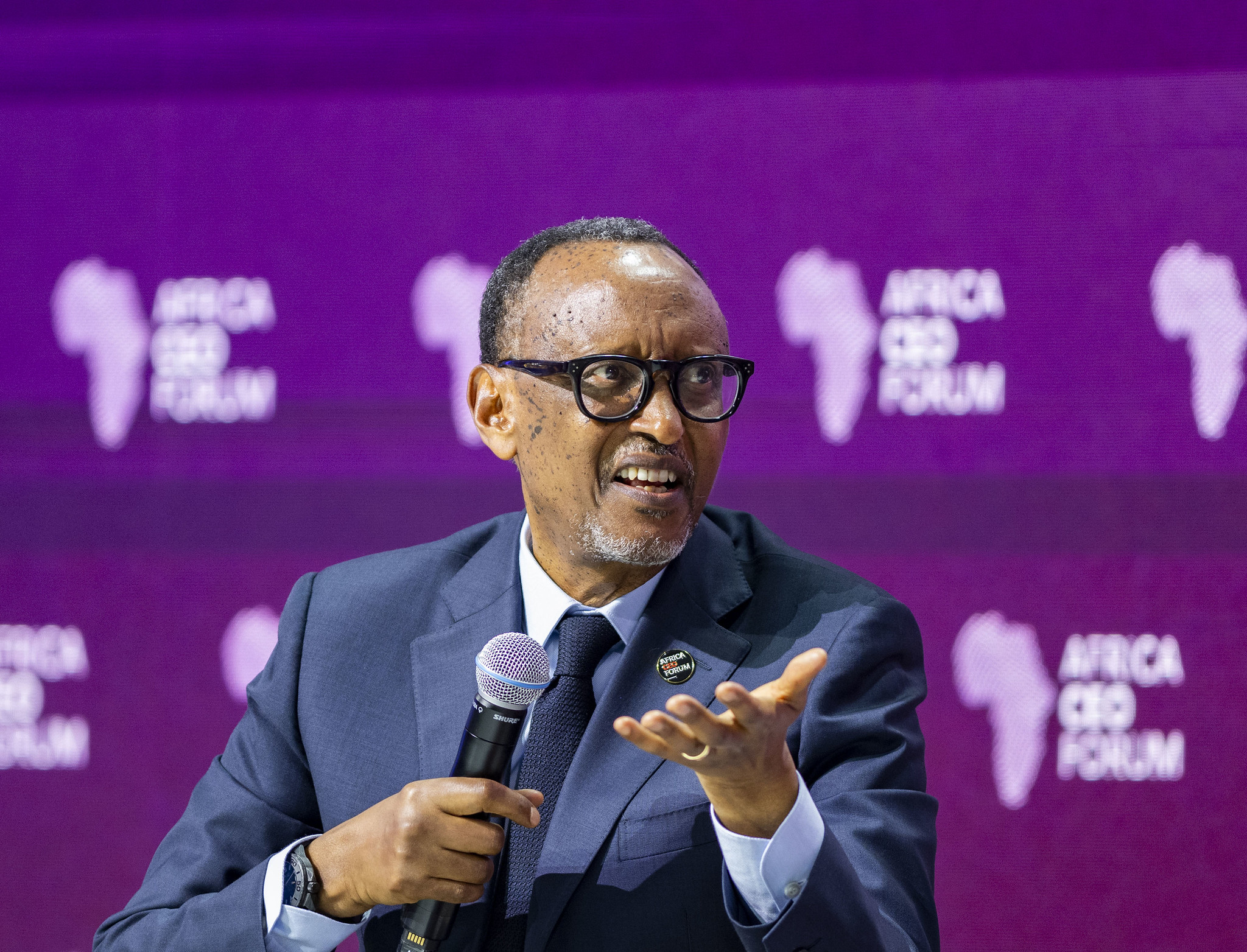
President Kagame speaking on Thursday at the opening of the Forum
There is a particular kind of silence that falls over a room of African Chief Executives and leaders when one of their own tells them they have no one to blame but themselves.
You could feel it at the Africa CEO Forum yesterday, when Rwanda’s President Paul Kagame took the stage. Africans have everything they need to solve their own problems, he said. The only thing missing, he suggested, is the will to start building.
For two decades, the continent has lurched from one global crisis to the next, always playing catch-up, always the victim, never the planner. In 2008, when the global financial system seized up, African countries were blindsided.
Despite a decade of record commodity prices, they had stashed little away. When Western banks stopped lending, infrastructure projects from Dakar to Nairobi went dark.
The African Development Bank had to scramble for a $1.5 billion emergency facility.
The IMF rushed in with loans. The entire episode could have been avoided if, during the boom years, African leaders had built their own continental stabilization fund or operationalized the African Investment Bank, first proposed in 1999.
They did not, so, they begged.
Then came the COVID-19 pandemic in 2020. At the time, Africa imported more than 99 percent of its vaccines. This was not a mystery.
The continent had known for decades that it lacked manufacturing capacity, but year after year, Heads of State attended global health summits and signed pledges they never kept. When wealthier nations hoarded vaccines, Africans watched from the sidelines.
Today, vaccine plants are being built across the continent. The question is why that effort began in 2021, not 2011, or even before.
And now, as the Iran-US conflict threatens the Strait of Hormuz, Africa is once again exposed. The continent produces millions of barrels of crude oil, yet it imports more than 70 percent of its refined fuel. This vulnerability has been obvious since the 1970s.
Nigeria alone has four broken refineries. Instead of fixing them, it exported crude and imported petrol. A private player, the Dangote refinery, is only now coming online after three decades, and even then, the continent’s energy needs far exceed its current capacity to refine crude oil.
This is the pattern: crisis, response, amnesia. And it will repeat until African leaders adopt the one quality that sets Kagame apart from his peers: a fierce, self-critical refusal to postpone difficult conversations and decisions.
Kagame understood the continent’s challenges during his tenure as chairperson of the African Union in 2018 and 2019, when he drove the creation of the African Continental Free Trade Area (AfCFTA) and championed the protocol on free movement of people.
The logic was simple: isolated markets are weak markets. A continent that cannot move its people cannot move its goods. But since Kagame left the chair, the energy has dissipated. The AfCFTA is mired in petty non-tariff barriers.
The free movement protocol has been ratified by only a handful of states. Leaders praise integration at summits and fly home to build new layers atop our colonial borders.
One of the Africa CEO Forum’s focuses is to link 55 isolated markets. It was a necessary conversation, but also a damning one. It is a reminder that we once again failed to keep the promises we made to ourselves when we signed on to the AfCFTA.
Yet, overcoming Africa’s challenges doesn’t require miracles. It only means operationalizing the African Monetary Fund so that financing does not vanish when New York sneezes.
It means building strategic stockpiles of fuel, medicine, and grain in each of the five African Union regions.
It means using the AfCFTA to fuel Africa’s industrialization. It as well means ratifying the free movement protocol, because a continent that dwarfs its own people’s dreams can only expect to be treated the same way by others.
Whether you agree with Kagame or not, on one point he is unassailable: he has never accepted that Africans are destined to wait for rescue. That is why his voice is so necessary. The next crises are coming. We do not know the date, but we know our vulnerabilities.
The question is whether African leaders will finally fix the roof while the sun is still shining, or whether they will wait, once again, to be caught in the rain.
