



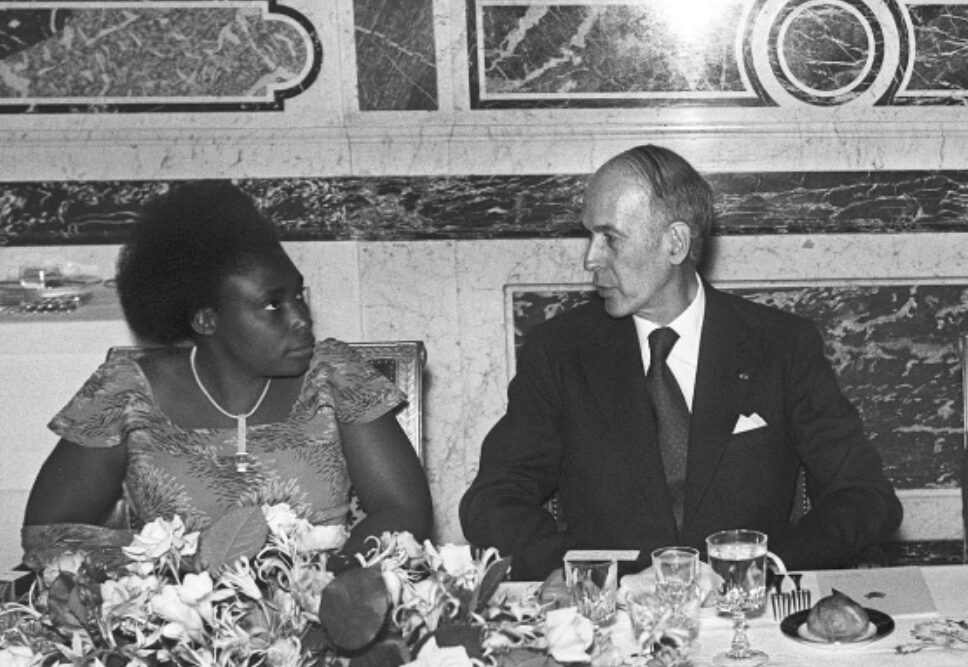
In 1979, as Kigali was preparing to host the France-Africa summit, the then French President Valery Giscard d’Estaing paid an official visit to Rwanda from 17 to 18 May 1979. Here, at state dinner with Agathe Kanziga Habyarimana. The relations between France and the Habyarimana family went back years
As the 1994 genocide against the Tutsi began, the identity of the enemy to be hunted in every corner of Rwanda had already been made clear: the Tutsi. Yet in those first terrifying days, as roadblocks multiplied and killings spread, French authorities launched an operation whose priority was not the rescue of those targeted for extermination.
The mission, “Operation Amaryllis,” was officially a unilateral French military operation to evacuate French citizens and other foreign nationals from a collapsing security situation. It began in the early hours of April 9, 1994.
However, the first evacuations did far more than removing expatriates from danger. They actively extracted members of President Juvénal Habyarimana’s immediate family, key relatives of the powerful Akazu network, and prominent figures who would later be accused or convicted of orchestrating the political, financial, and propaganda machinery of the genocide.
The critical question is not merely why Agathe Kanziga Habyarimana, the former First Lady and central pillar of the Akazu circle, was evacuated by French forces. The deeper, more troubling question is who else France chose to rescue while Tutsi civilians, including Rwandan employees of foreign diplomatic missions, and opposition politicians, were all left exposed.
Kanziga was flown out of Kigali with her eight children and close relatives. Her evacuation formed part of a wider extraction of people linked to the former presidential clan, including individuals whose names would later appear in investigations, court records, and accounts of the networks that sustained the genocide.
One of the most notorious figures associated with the evacuation was Ferdinand Nahimana, co-founder and director of RTLM hate radio, which was one of the genocide’s most powerful weapons of mobilization, helping to identify, demonize, and incite violence against Tutsi. Nahimana was later convicted by the International Criminal Tribunal for Rwanda for direct and public incitement to commit genocide and persecution. His evacuation by France remains one of the clearest reasons “Operation Amaryllis” is remembered not simply as an evacuation but as a politically-charged rescue of pro-genocidal regime elites.
Another evacuated individual tied to the Akazu circle was Protais Zigiranyirazo, Kanziga’s brother, widely known as “Monsieur Z.” A powerful Northern political figure under Habyarimana, Zigiranyirazo was a key actor within extremist networks close to the presidency and responsible for planning the genocide.
The evacuation registry also featured Séraphin Rwabukumba (known as “Mister Centrale”), Kanziga’s half-brother and a prominent businessman who managed the financial environment supporting extremist politics. Alongside him was Séraphin Bararengana, a surgeon, university professor, and younger brother of President Habyarimana. Bararengana was later sentenced in absentia to 30 years by Rwanda’s Gacaca courts for his role in the genocide.
The inclusion of Alphonse Ntirivamunda, who married Habyarimana’s daughter Jeanne Habyarimana, underscores the reality that the Akazu was not just a family clan. It was a sophisticated web of alliances, money, propaganda, and political extremism, bound together by a shared commitment to preserving power at any cost.
The evacuation extended deeply into the network of Félicien Kabuga, the wealthy tycoon who financed the genocide and co-founded RTLM. According to reporting by Le Monde, Kabuga’s wife and several children were sheltered at the French embassy before approximately a dozen members of the Kabuga family were evacuated on April 12, 1994, listed among 178 VIPs flown out by French forces.
Augustin Ngirabatware, Kabuga’s son-in-law and the former Planning Minister in the interim genocidal government, was similarly shielded by this French diplomatic network and included in the evacuation. Ngirabatware was later convicted by the ICTR and sentenced to 30 years in prison.
All these evacuations of key masterminds of the genocide form the reason why “Operation Amaryllis” remains one of the most troubling episodes in France’s role during the genocide against the Tutsi. Publicly, it was presented as a standard evacuation of nationals from a country collapsing into violence. But the names attached to the operation tell a darker story.
France did not evacuate the Tutsi who were being hunted down. It protected and evacuated the very planners of the genocide. As Tutsi were slaughtered in homes, churches, schools, and streets, the very circles responsible for the ideology and infrastructure of genocide were being escorted to safety.
