



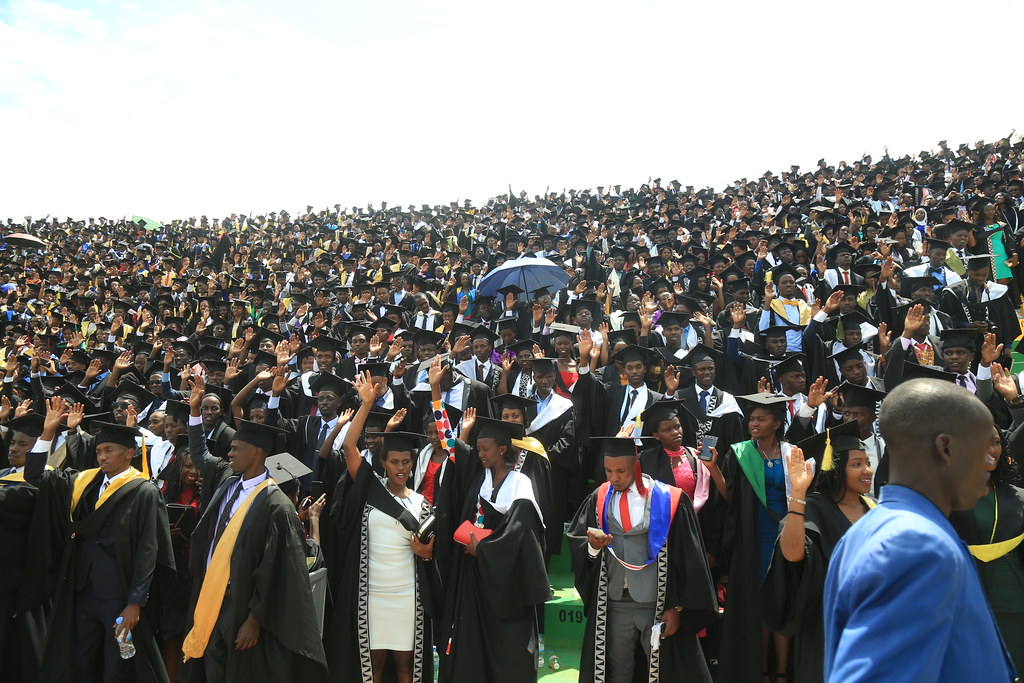
A university graduation in Rwanda where each year, thousands are released into the market, the majority of whom have degrees that China just eliminated
BEIJING — Chinese universities have cut or suspended more than 12,200 undergraduate degree programs over the past five years as the country undertakes one of the most significant overhauls of its higher education system in decades, shifting resources toward artificial intelligence, advanced manufacturing and other strategic technologies.
The restructuring, which took place between 2021 and 2025 under China’s 14th Five-Year Plan, affected more than 30 percent of university programs nationwide, according to data from China’s Ministry of Education.
However, the changes were not simply a matter of eliminating courses. During the same period, universities introduced about 10,200 new programs, largely focused on emerging technologies and industries viewed as critical to China’s future economic competitiveness.
The reforms come as Beijing seeks to address rising graduate unemployment, adapt to rapid technological change and strengthen the country’s position in sectors such as artificial intelligence, robotics, semiconductors and advanced manufacturing.
Programs most affected by the cuts included traditional management disciplines, foreign languages, arts and humanities courses, many of which officials and universities considered oversupplied or increasingly vulnerable to automation.
Among the fields frequently reduced or suspended were information management, public administration, marketing, product design and various language programs.
The move is particularly notable because many of the affected disciplines remain among the most widely studied degree programs globally.
Public administration, marketing, business management, communications, foreign languages and arts programs continue to attract millions of students worldwide and supply talent to governments, corporations, media organizations and public institutions.
In Rwanda, many of these fields remain common in universities and continue to provide graduates for both the public and private sectors.
However, government policy has increasingly favored science, technology, engineering and mathematics (STEM) disciplines, with state-funded scholarships and sponsorship programs giving greater priority to students pursuing science and technology-related courses.
While arts and humanities programs continue to exist, Rwanda’s higher education strategy has increasingly emphasized skills linked to industrialization, innovation and the digital economy.
Several Chinese universities have already begun implementing the changes. At the Communication University of China, one of the country’s leading media and arts institutions, admissions were halted or reduced in several arts, translation and management-related programs as the university restructured its academic offerings.
Meanwhile, the University of Shanghai for Science and Technology suspended admissions for product design, citing the growing impact of artificial intelligence on design and rendering tasks.
As traditional programs were phased out or consolidated, universities introduced new degrees aligned with China’s industrial priorities.
New courses include specializations in artificial intelligence, embodied intelligence, brain-computer interfaces, agricultural robotics, digital finance, carbon neutrality science and intelligent audiovisual engineering.
Other emerging disciplines focus on smart grids, advanced data systems and technologies linked to China’s push for greater self-reliance in high-tech industries.
The reforms reflect a broader effort by Chinese policymakers to align university education more closely with labor market demands.
China is expected to produce more than 12 million university graduates annually, creating pressure on institutions to improve employment outcomes and ensure graduates possess skills needed in rapidly evolving industries.
While supporters view the changes as a pragmatic response to technological disruption and workforce needs, critics have expressed concern that the shift could weaken humanities and arts education by prioritizing economic utility over broader academic development.
The debate mirrors discussions taking place in many countries as governments, universities and employers grapple with the growing influence of artificial intelligence on education and the future of work.
For China, however, the direction is clear: fewer graduates in fields deemed oversaturated and more trained in the technologies expected to drive the world’s second-largest economy in the decades ahead.
