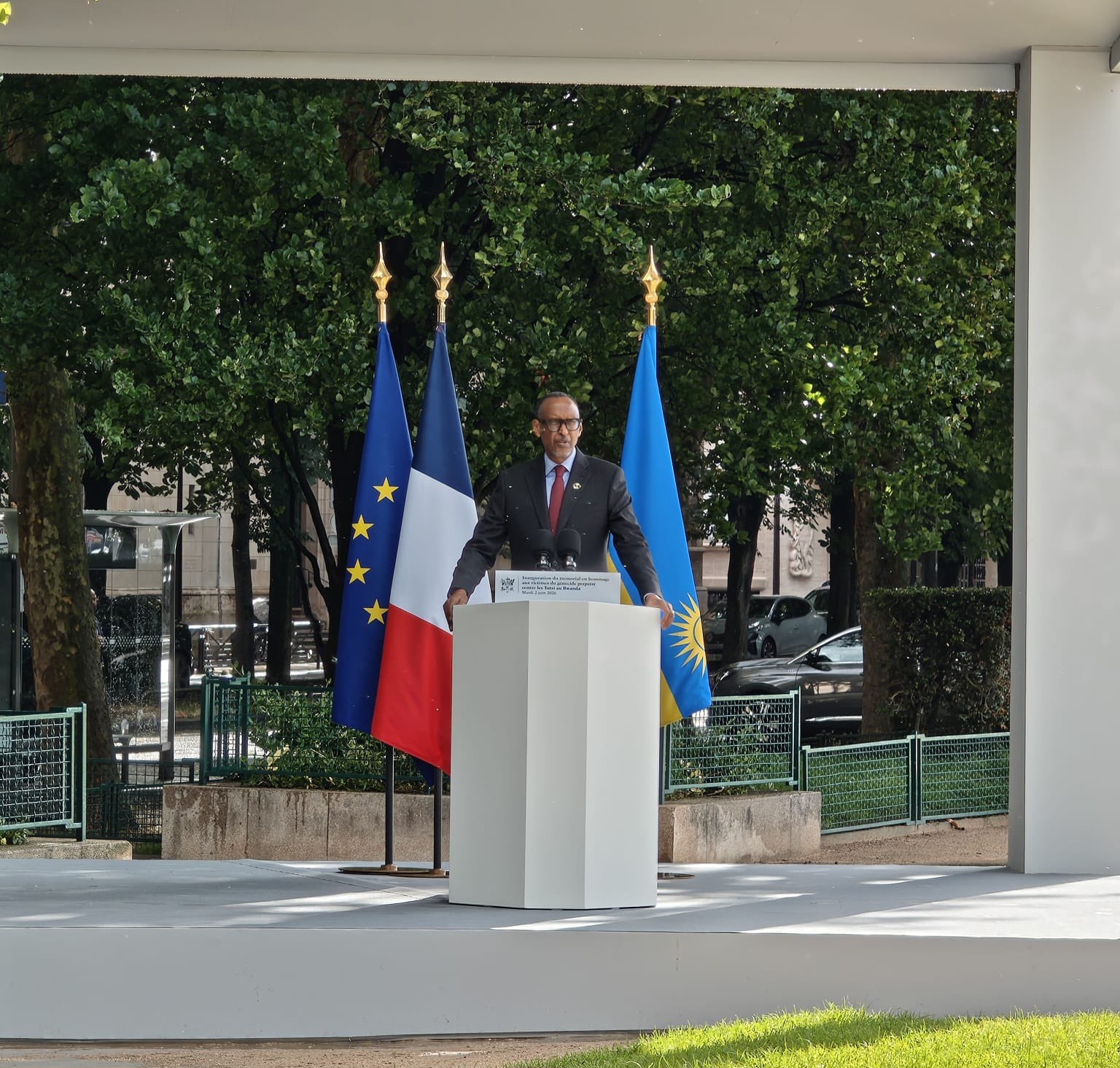
PARIS -Standing before a newly unveiled memorial dedicated to the victims of the 1994 Genocide against the Tutsi, President Paul Kagame on Tuesday delivered a strong acknowledgment of France’s efforts to confront its role in the darkest chapter of Rwanda’s history.
More than three decades after over one million Tutsi were murdered in just 100 days, Kagame said France has done more than any other country to examine its responsibilities and set the historical record straight.
“Many other countries did so as well, but none has gone as far as France in setting the record straight and accepting its part in the tragedy,” Kagame said during the inauguration ceremony attended by French President Emmanuel Macron, government officials, diplomats, survivors and members of the Rwandan community in France.
The remarks came as Kagame and Macron jointly unveiled “L’Archive” (The Archive), a permanent genocide memorial erected on the Esplanade Habib-Bourguiba along the banks of the River Seine in Paris.
Moments later, the two leaders stood before the monument for the national anthems of Rwanda and France as poetry, memorial songs and cultural performances paid tribute to victims and survivors of the genocide.
The monument, designed by Berlin-based Portuguese artist Grada Kilomba, consists of two large black brass steles mounted on lava stones and bears inscriptions in French, English, Kinyarwanda and Swahili.
Conceived as an archive of voices, memories and hopes, it stands as a lasting tribute to the victims and survivors of the Genocide against the Tutsi.
During the ceremony, children performed songs of remembrance, including a French-language tribute accompanied by traditional instruments bearing the inscription “Rwanda,” reinforcing the memorial’s message of memory across generations.
For Rwanda, the significance of the memorial and its location in the heart of Paris represents a powerful acknowledgment of historical truth in a country whose role before and during the genocide has long been the subject of intense scrutiny and debate.
A Journey Toward Truth
Kagame used the occasion not only to honor victims but also to reflect on the remarkable transformation in relations between Kigali and Paris.
He commended Macron for demonstrating both courage and humanity in confronting France’s historical responsibilities, recalling the French president’s landmark visit to Kigali in 2021 following the release of independent French and Rwandan reports that reached similar conclusions regarding France’s actions during the genocide period.
During that visit, Macron acknowledged that France could have stopped the genocide but failed to do so.
“In response, I described those words as something more valuable than an apology, namely the truth,” Kagame said.
The Rwandan leader also paid tribute to former French President Nicolas Sarkozy, whose 2010 visit to Rwanda marked the beginning of a gradual shift in France’s official position.
He further recognized French journalists, researchers and activists who spent years uncovering facts and challenging narratives that obscured the truth about what happened in Rwanda.
According to Kagame, confronting historical responsibility requires extraordinary political courage because it often provokes resistance from those unwilling to face uncomfortable realities.
Yet he argued that such efforts are essential to preserving the dignity of victims and creating the foundations for genuine reconciliation.
“I believe that our common work has initiated a journey towards a truth which is irreversible,” he said.
Macron, who spoke after Kagame, reiterated France’s commitment to ensuring accountability by stating that his country would not serve as a safe haven for individuals wanted in connection with the genocide.
He also highlighted efforts to educate younger generations, noting that the history of the Genocide against the Tutsi has been taught in French schools since 2020.
Memory Written in Stone
Kagame powerfully defended memory as a safeguard against denial and distortion. He described the Paris memorial as more than a monument, saying it transforms remembrance into a permanent public responsibility.
“The memorial before us is powerful because it sets the truth in stone and protects it from the heartlessness of time by instructing the living,” he said.
The president emphasized that the Genocide against the Tutsi remains within living memory and that survivors continue to play a central role in preserving its history through their testimonies.
Moments earlier, genocide survivor Jeanne Uwimbabazi had shared her story before the audience, prompting Kagame to make an unusually personal reflection.
He recalled how anti-Tutsi violence in the early 1960s forced his family into exile, leaving him to spend more than two decades growing up in a refugee camp in a neighboring country.
“The events she described are very familiar to me. I grew up in a refugee camp for over 20 years,” Kagame said.
His remarks underscored the historical continuum of persecution against Tutsi that preceded the 1994 genocide and highlighted the importance of ensuring that future generations understand not only the genocide itself but also the events that led to it.
Beyond the Past
While acknowledging France’s progress, Kagame stressed that remembrance must ultimately serve the future.
He noted that Rwanda emerged from the genocide determined to examine its own failures and rebuild a society capable of preventing such atrocities from ever happening again.
“One certitude is that the main responsibility for the genocide is located within our own society,” he said, adding that Rwanda’s willingness to confront difficult truths has been central to its recovery.
The ceremony itself reflected that message. In one performance, young participants carrying Agaseke baskets presented a theatrical piece centered on humanity, reconciliation and the responsibility of future generations to protect the truth from denial and division.
For many observers, the inauguration of the Paris memorial marks another milestone in the steady normalization of Rwanda-France relations and a significant moment during Kwibuka32, the 32nd commemoration of the Genocide against the Tutsi.
The newly unveiled memorial stands not only as a tribute to lives lost but also as a symbol of a relationship transformed by truth, memory and a shared commitment to ensuring that history is neither forgotten nor denied.
“The work we are doing together will give future generations the tools to build and sustain the peace and understanding which we seek,” Kagame said.