



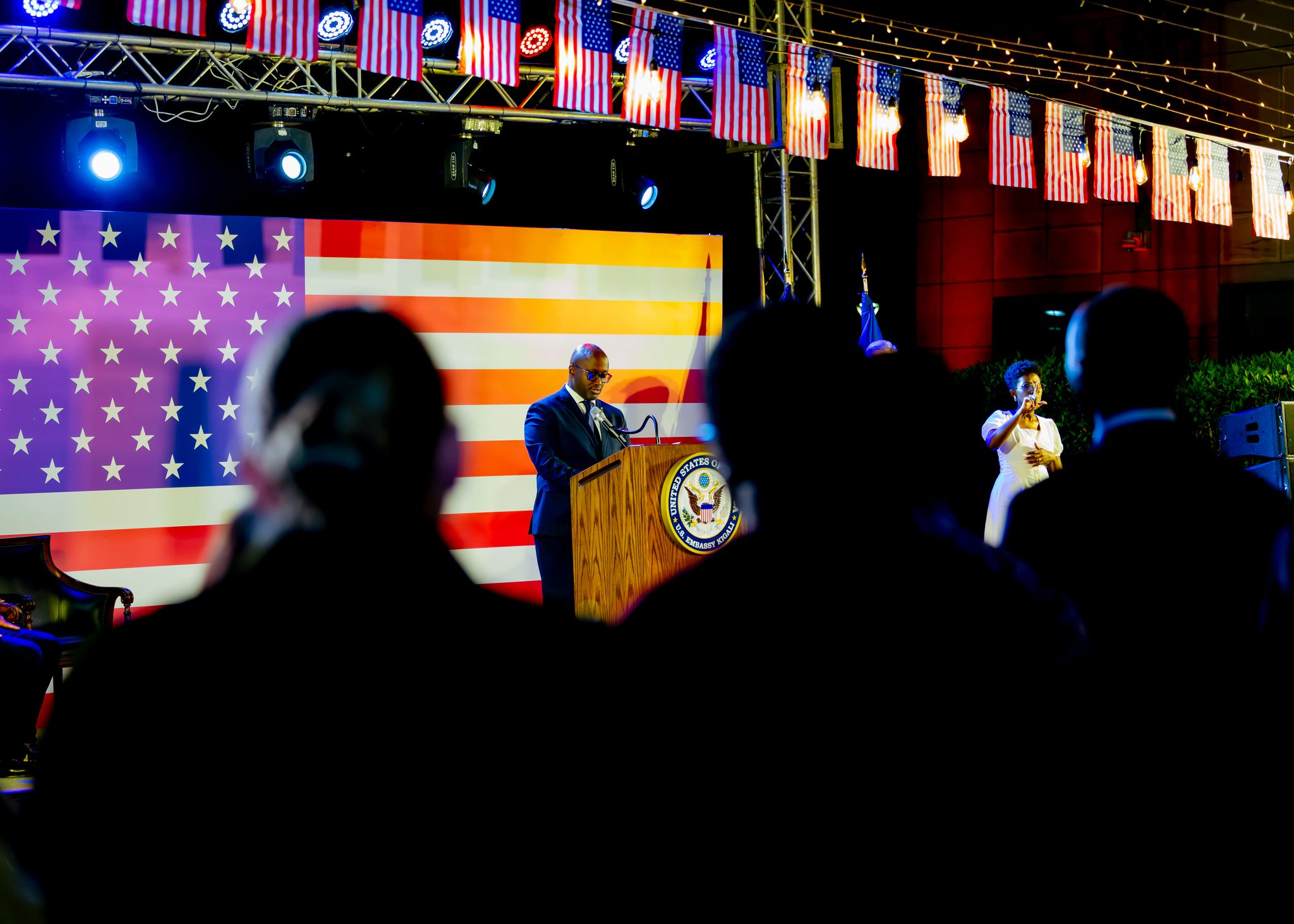
Foreign Affairs Minister Olivier Jean Patrick Nduhungirehe, speaking yesterday
KIGALI — Rwanda is exploring deeper cooperation with the United States in strategic sectors including space technology, scientific research, energy, and innovation, as the two countries seek to broaden a partnership that officials say has evolved significantly over the past decade.
Speaking at a reception hosted by the U.S. Embassy in Kigali on June 4 to mark the 250th anniversary of American independence and 64 years of diplomatic relations between Rwanda and the United States, Foreign Affairs Minister Olivier Nduhungirehe highlighted Rwanda’s interest in working more closely with the U.S. space agency, NASA.
“As a member of the Artemis Accords community, Rwanda remains keen to explore practical avenues of collaboration with NASA and looks forward to identifying mutually beneficial initiatives that can contribute to scientific advancement, capacity building and economic development,” Nduhungirehe said.
The Artemis Accords are a framework of international agreements designed to guide cooperation in civil space exploration, particularly future lunar missions, scientific research, technological development, and other space-related activities.
Rwanda’s growing interest in space cooperation is underpinned by an ambitious national space program led by the Rwanda Space Agency, which was established in 2020.
The agency focuses on leveraging space technology to drive socio-economic development through Earth observation, climate resilience, agriculture, environmental monitoring, and disaster management.
The country launched its first satellite, RwSat-1, in 2019 and is currently developing a hyperspectral satellite designed to enhance Earth observation capabilities.
Rwanda also operates a Tier 3-certified teleport and is implementing its National Space Policy adopted in 2025. Through partnerships with countries including Japan and the United Arab Emirates, as well as its participation in the Artemis Accords, Rwanda is seeking to build a competitive space ecosystem and position itself as an emerging player in the global space sector.
Nduhungirehe described Rwanda-U.S. relations as having grown beyond traditional diplomatic engagement into a broader strategic partnership.
“Over the past decade, our cooperation has evolved into a strategic relationship grounded in shared interests and a commitment to delivering tangible results for our peoples,” he said.
The minister pointed to emerging areas of cooperation, including energy and technology, saying recent agreements between the two countries could unlock new opportunities.
“This important step opens new avenues for collaboration in energy security, technology transfer, skills development and innovation,” he noted, referring to expanding cooperation in sectors such as nuclear energy.
Nduhungirehe also welcomed Washington’s continued use of the term “Genocide against the Tutsi” when referring to the 1994 genocide, saying the terminology reflects historical accuracy and supports efforts to combat genocide denial.
He said the U.S. decision to use the correct appellation “honours the truth of history, pays respect to the victims and survivors, and contributes to the global fight against genocide denial and distortion.”
According to Nduhungirehe, the future of Rwanda-U.S. relations remains promising despite occasional differences between the two countries.
“As we look ahead, it is clear that the best chapters of Rwanda–United States relations are still being written. The opportunities before us are significant, and together we can continue building a partnership that delivers lasting benefits for both our countries and our peoples,” he said.
The remarks come at a time when Kigali and Washington are working together on several regional and strategic issues, including implementation of the peace process involving Rwanda and the Democratic Republic of Congo.
While the relationship has experienced some friction over U.S. sanctions imposed on certain Rwandan officials and members of the Rwanda Defence Force (RDF), both sides have continued diplomatic engagement.
Rwanda’s Ambassador to the United States, Mathilde Mukantabana, recently emphasized that dialogue between Kigali and Washington remains active despite the sanctions on the RDF and senior military officials.
Responding to questions about efforts to have the sanctions lifted, Mukantabana said the measures “have not closed diplomatic channels,” underscoring Rwanda’s commitment to maintaining engagement with U.S. authorities.
Her comments align with Rwanda’s broader position that cooperation with the United States continues to be important in advancing regional peace, economic development, innovation, and security.
The latest signals of cooperation, particularly Rwanda’s interest in partnerships with NASA and other high-technology institutions, suggest Kigali is looking beyond traditional areas of collaboration and seeking to strengthen its position in emerging sectors that could support long-term economic transformation.
As Rwanda advances its space ambitions and expands its scientific and technological capabilities, cooperation with NASA could become one of the most visible symbols of a relationship that both countries say is entering a new chapter.
