


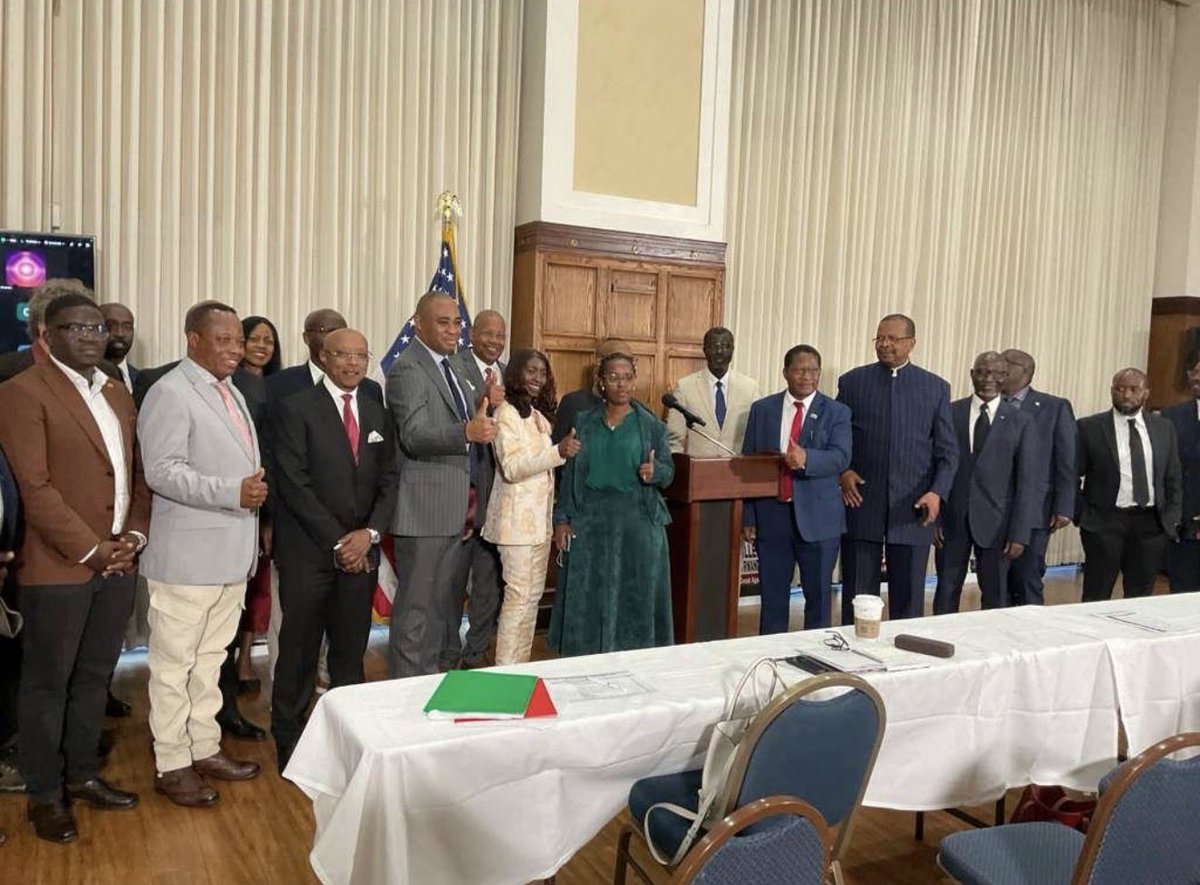
The most recent is the so called National Council for Democracy in Rwanda (NCDR). It ran by Nigerian Dr. Karl Von Batten – born Karl-Marx Edward Ikemefuna William George Okeke-Von Batten. He is on the right of the woman in white
Since the Rwandan Patriotic Front (RPF) rose to power, a network of Western-backed non-governmental organizations has consistently sought to reclaim influence over Rwanda’s politics through narrative control and support for subversive Rwandan groups and individuals. These entities routinely deploy synchronized campaigns to tarnish the country’s image, portraying a resilient state as a villain in a calculated effort to deny its sovereign agency. Yet these hostile campaigns have consistently failed to bear fruit, and there are two fundamental reasons why.
The first and most fundamental reason is that no Western actor can change the fact that Rwanda’s heroes are Rwandans. Part of this assertion may sound tautological, but it actually makes sense. None of the self-proclaimed “superpowers” of the Global North demonstrated their supposed moral superiority when it mattered most. The international community looked away as over one million innocent Tutsi lives were systematically taken in just 100 days.
For the RPF-led government and many ordinary Rwandans, learning from this catastrophic failure of the international system was not just a historical lesson rather a foundational to how they now thought about the nation’s and their own survival. No one was coming to the rescue. Only Rwandans could save Rwanda, bring their country back to life, and eventually lead it into the light.
Yes, this attitude and mindset have attracted problems for the country. To certain external actors, an African nation solving its own complex problems without foreign intervention is viewed not as a triumph but as a subtle threat to the traditional dynamics of international aid and influence. In other words, the biggest source of pride for Rwandans, that they managed to survive and thrive relying mostly on themselves, is seen as a threat. That many foreign actors, in their regime-change ambitions, fail to understand these fundamentally opposed perspectives speaks to their limitations and the unlikelihood of the success of their regime-change projects.
The other reason is that the Western-backed Rwandan “opposition” is mostly made up of mediocre and ideologically bankrupt individuals willing to employ violence to achieve their aims. Rather than offering constructive policy alternatives, the self-proclaimed opposition figures have consistently been unmasked for their structural ties to armed extremist networks operating along Rwanda’s borders.
Paul Rusesabagina is a case in point. Though Western media and Hollywood celebrated him as a humanitarian icon, Rusesabagina used his international platform to co-found MRCD and its armed wing, the FLN. The FLN launched deadly cross-border terrorist attacks in Rwanda’s Southern Province in 2018 and 2019, resulting in the murder of innocent civilians. Rusesabagina’s subsequent conviction on terrorism charges exposed the dangerous reality of the diaspora leadership: a willingness to bring bloodshed back to Rwandan soil under the guise of political activism.
Similarly, Victoire Ingabire Umuhoza has long been utilized by Western commentators as a symbol of domestic opposition, yet her political trajectory is deeply entangled with genocidal remnants. As the long-time leader of FDU-Inkingi, a group comprising many genocide fugitives, Ingabire has consistently straddled the line between legitimate politics and genocidal revisionism. Her conviction for genocide minimization and conspiring with armed groups like the FDLR underscores a persistent strategy: attempting to legitimize structures built by genocide ideologues by rebranding them as modern political parties.
Perhaps the most insidious tactic is the laundering of extremist ideologies through a new, Western-educated generation. This is vividly illustrated by the Belgium-based organization Jambo Asbl. Fronted by young individuals who present themselves to European institutions as human rights defenders, Jambo Asbl is, in reality, heavily comprised of the direct descendants and children of notorious genocide fugitives and perpetrators, who seek to revise the history of the genocide to whitewash their parents. For instance, prominent founding members and leaders of the group are the children of figures like Shingiro Mbonyumutwa (son of Dominique Mbonyumutwa) and Colonel Ephrem Rwabarinda of the genocidal army.
Members of Jambo Asbl utilize Western legal frameworks to defend their fathers’ legacies. They actively campaign against laws criminalizing genocide denial, masking their efforts behind a vocabulary of “free speech” and “civil society.” Because of these ties, much of the external opposition remains fundamentally ethnic-driven, a dangerous regression into the past that modern Rwanda has vowed never to repeat.
There is also the case of disgraced individuals who once served as officials in Rwanda’s post-genocide institutions. One is Kayumba Nyamwasa, whom the aforementioned NGOs tried to portray as a political dissident fighting for democracy. Nyamwasa is one of the most interesting examples of his defenders’ cognitive dissonance, because even as these organizations accuse the Rwandan army of the most horrendous crimes at a time when he was its Chief of Defence Staff, they conveniently exonerate him of any wrongdoing. In their view, he has suddenly become a democracy activist. Their hypocrisy strongly suggests that the crimes attributed to the Rwandan army were made up to begin with, and that the allegations were only relevant insofar as they served the regime-change agenda.
Suffice it to say that the Rwandan political model does not reject opposition out of hand. Rather, it draws an absolute, unyielding red line based on its dark history: there is zero tolerance for ethnic-based politics and violence.
The attempts by external forces to use a compromised opposition, whether through the armed terror of the FLN, the political maneuvers of FDU-Inkingi, the generational revisionism of Jambo Asbl, or the grudges of disgraced former officials, ignore a fundamental reality of contemporary Rwanda:
Rwanda is defined by the willpower of its people, not the wishes of the West.
