



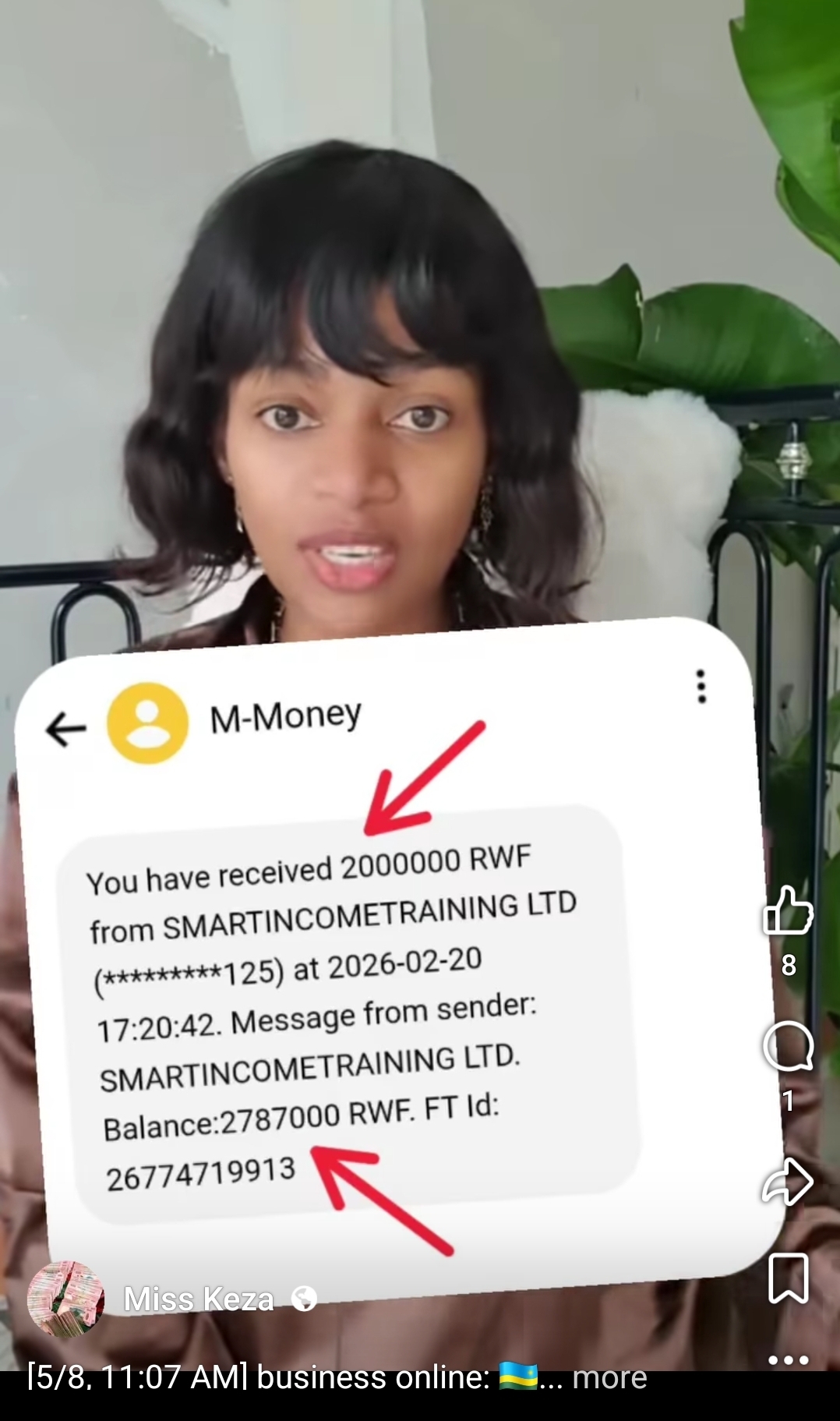
There are countless such Ads particularly on Facebook where alleged users claim to be earning huge sums of money from online schemes. Few resist the temptation because they require small investments of as low as Rwf 1,000 (less than a U.S. dollar)
KIGALI — What began as an online money-making opportunity promising quick returns through simple tasks, referrals and small investments has ended in frustration for thousands of Rwandans after authorities shut down TMP Marketing Ltd, an unlicensed platform regulators say was illegally collecting money from the public.
For months, TMP Marketing promoted itself as a digital income platform where users could earn money by completing online tasks, purchasing investment packages or recruiting new members.
Participants deposited money through MTN Mobile Money and Airtel Money, with funds credited to their TMP accounts. The platform promised daily or periodic returns, while users could also earn commissions by bringing in additional participants.
Earnings were then transferred back to users’ mobile money wallets, with early withdrawals helping convince many that the business was legitimate.
The scheme spread rapidly through social media, where users shared screenshots of successful payouts and encouraged friends and relatives to join. Its relatively low entry cost made it particularly attractive to students, job seekers and workers seeking an additional source of income.
But in April, Rwanda’s Capital Market Authority (CMA) warned that TMP Marketing was not authorized to solicit or receive funds from investors for profit-making purposes, adding that it held no licence from either the CMA or the National Bank of Rwanda (BNR) to conduct investment business.
The warning marked the beginning of a broader regulatory intervention involving the Rwanda Development Board (RDB).
By this past week, the platform had effectively ceased operations, leaving many users unable to access their money.
Example of Promotional Video For Such Schemes
Under Rwandan law, businesses that collect public funds for investment or profit-sharing must obtain authorization from financial regulators.
A company may be registered to operate as a business, but that registration alone does not permit it to offer investment products or accept public deposits.
The case has also raised questions about how an unlicensed investment platform was able to process payments through Rwanda’s largest mobile money networks.
Financial technology specialists note that the use of MTN Mobile Money or Airtel Money should not be interpreted as regulatory approval.
Like banks processing card payments, mobile money operators provide payment infrastructure to thousands of businesses, while responsibility for obtaining the necessary licences rests with the company offering the financial product.
Still, neither MTN Rwanda nor Airtel Rwanda has publicly explained how TMP was onboarded onto their payment ecosystems, whether additional due diligence was conducted, or when the company was disconnected from their services following the regulators’ intervention.
Authorities have also disclosed few details about how the shutdown itself was carried out. Beyond the CMA’s public warning and the subsequent involvement of the Rwanda Development Board, officials have not explained whether the closure resulted from freezing payment channels, disabling the platform’s operations, suspending its business registration or other enforcement measures.
For users, however, the outcome was immediate. Withdrawals reportedly stopped being processed, account balances became inaccessible and complaints quickly spread across social media as participants searched for answers.
Via social media, many users said they had invested personal savings after seeing friends successfully withdraw money during the platform’s early stages. Others acknowledged persuading relatives, colleagues and acquaintances to join, only to see the platform collapse before they could recover their investments.
Authorities have not released official figures on the number of people affected or the amount of money involved. Unverified estimates circulating online suggest the platform may have attracted hundreds of thousands of users, though those figures remain impossible to independently confirm.
TMP Marketing displayed many of the hallmarks commonly associated with pyramid or multi-level marketing schemes, in which early participants receive payouts financed largely by deposits from new recruits, creating the illusion of a sustainable investment until recruitment slows.
The case has become one of Rwanda’s most closely watched examples of the risks posed by unlicensed online investment platforms.
It has also exposed broader questions about oversight of digital financial services, including how such schemes gain public trust before regulators intervene and what protections exist for consumers once they collapse.
For now, many former TMP participants remain uncertain whether they will ever recover their money, while authorities have yet to indicate whether criminal proceedings, asset recovery efforts or compensation mechanisms are under consideration.

1 comment
I want to earn money
Comments are closed.