



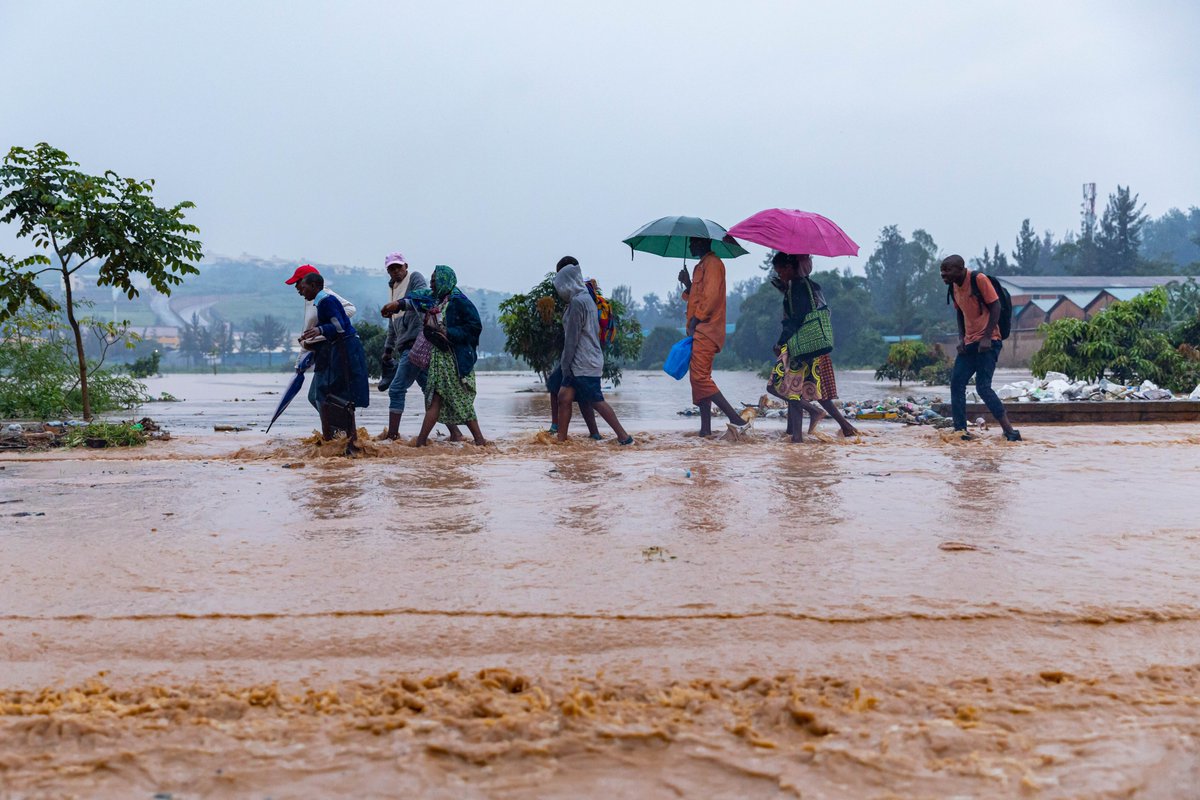
Expect such flooding and possible trail of destruction when the rains begin. This was in Kigali in 2023
KIGALI — After months of unusually intense heat and dry conditions, Rwanda is bracing for a sharp turn in the weather, with forecasters predicting an above-average rainy season that could bring rainfall comparable to patterns seen in 1997 and somehow in 2023.
The Rwanda Meteorology Agency (Meteo Rwanda) forecasts rainfall of between 300 and 1,000 millimetres during the September-December rainy season, known locally as Umuhindo. That compares with a 30-year historical range of 290mm to 960mm.
The season is expected to begin across Rwanda between September 22 and 29 and continue until around December 6, with the heaviest rains expected from late September through the end of the season.
The forecast comes after a prolonged period of unusually hot and dry weather that has affected much of the country since May.
In many parts of Rwanda, particularly the Eastern Province and other areas outside the wetter highlands, the heat and lack of rain have made daily life increasingly difficult. The unusually dry conditions have also raised concerns over agriculture, water availability and the risk of fires.
Even the customary mid-August rains failed to arrive. August 15, the Catholic feast of the Assumption, is traditionally associated with rains in Rwanda, but this year the expected rainfall did not materialise across much of the country.
The dry spell has been severe enough to heighten the risk of wildfires. In northern Rwanda, a forest recently came close to being consumed by fire amid the dry conditions, highlighting the extent of the country’s vulnerability during the prolonged dry period.
Now, the meteorological outlook points in the opposite direction.
From drought to heavy rains
Meteo Rwanda Director General Gahigi Aimable says rainfall during the coming season is expected to range from 300mm to 1,000mm, with some areas receiving substantially more rain than their long-term average.
He told local media that the forecast is broadly comparable to rainfall patterns recorded during the 1997 and 2023 rainy seasons.
The comparison with 2023 carries particular weight.
On the night of May 2-3, 2023, torrential rains triggered floods and landslides across Rwanda’s Western, Northern and Southern provinces, killing 137 people and affecting about 51,905 people in 10,381 households.
More than 5,400 houses were destroyed, while bridges, roads, health facilities, schools, power infrastructure and thousands of hectares of crops were also damaged.
The disaster caused an estimated Frw222.3 billion ($193 million) in damages and losses, with the government later estimating that full recovery would require more than Frw518 billion.
The 2023 disaster remains a stark reminder that while heavier rains could provide relief after months of dryness, they can also bring deadly floods, landslides and destruction, particularly in Rwanda’s steep and densely populated terrain.
Meteo Rwanda expects rainfall to be relatively limited in September before increasing in the following months, with the heaviest rains likely from late September through December.
The shift could bring welcome relief to farmers and communities affected by the prolonged dry conditions. But unusually heavy rainfall also presents risks, particularly in areas vulnerable to soil erosion, flooding and landslides.
Gahigi urged farmers to use the remaining weeks before the rains to prepare their land.
“The rains will begin in the third week of September. Farmers can start activities such as erosion control so that when the rains arrive, everything else will be ready,” he said.
Western Rwanda faces the heaviest rains
The highest rainfall totals, estimated at 800mm to 1,000mm, are expected in Nyamasheke District, western parts of Rutsiro and Karongi, western and southern parts of Nyamagabe and Nyaruguru, and eastern parts of Rusizi.
Rainfall of between 600mm and 800mm is forecast for Musanze and Gakenke, central Nyaruguru, parts of Burera and Muhanga, the remainder of Nyamagabe and most of the Western Province.
Between 450mm and 600mm is expected in Gicumbi, Rulindo, Huye, Nyanza, Ruhango and Nyagatare, as well as parts of Kigali, southern Gisagara and several other areas.
The remaining parts of the Southern and Eastern provinces, together with parts of Kigali, are expected to receive between 300mm and 450mm.
For farmers, the rains could provide much-needed moisture for planting and crop development after an unusually dry period.
But the forecast also presents a warning for communities and local authorities: the end of the dry spell could bring its own hazards.
Meteo Rwanda is urging farmers and local authorities to complete soil erosion control, drainage and other preparations before the rains arrive.
After months of waiting for rain, Rwanda may soon have a very different problem — too much of it, too quickly.
