


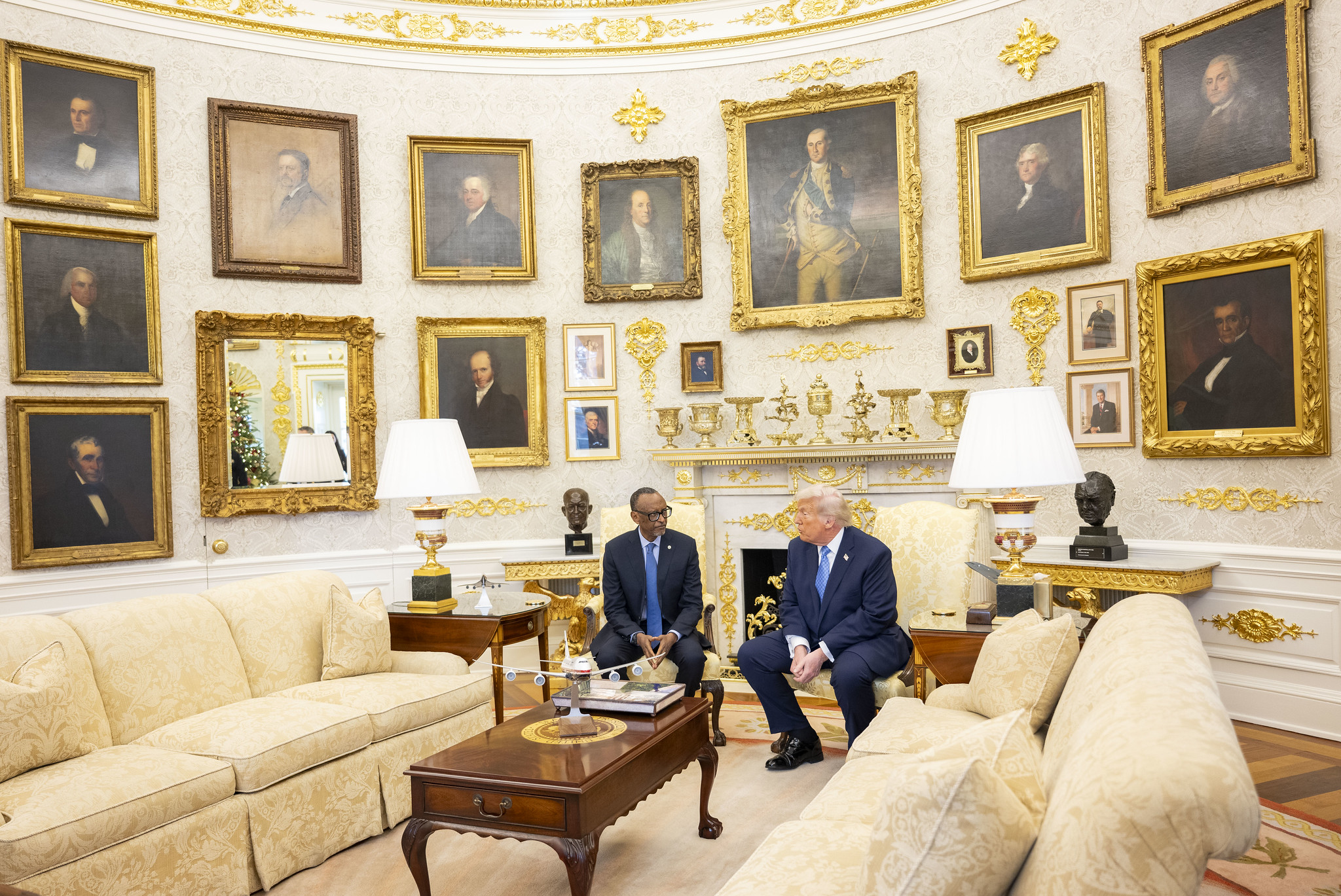
President Paul Kagame is hosted by U.S. President Trump for a bilateral session at the White House during the Washington Accord Meeting | Washington, D.C., December 4 2025
The implementation of the Washington Accords for Peace and Prosperity is once again drawing attention in Washington, with US officials and lawmakers highlighting Rwanda’s efforts to meet its obligations while the wider peace process continues to demand concrete action to neutralize the FDLR.
In June 2026, US Secretary of State Marco Rubio acknowledged that Rwanda was fulfilling its commitments under the Washington framework. The Rwandan government subsequently emphasized that the agreement is reciprocal and that its obligations cannot be separated from those undertaken by the Democratic Republic of Congo.
That message was reinforced in September when US Congressman Joe Wilson met with Rwanda’s Foreign Minister Olivier Nduhungirehe. Following the meeting, Wilson publicly expressed appreciation for Rwanda’s full implementation of the peace deal.
But the Washington Accords were never designed as a one-sided arrangement. The framework contains commitments for both Rwanda and the DRC, covering security, the disengagement of forces, the neutralization of the FDLR, the protection of civilians and regional economic cooperation. A joint statement issued by the United States, Rwanda and the DRC in March 2026, for example, outlined coordinated measures involving Rwanda’s disengagement and the DRC’s intensified and time bound efforts to neutralize the FDLR.
The central question, therefore, is not simply whether Rwanda is implementing its obligations. It is whether both parties are implementing the agreement simultaneously and verifiably.
One of the most important obligations placed on Kinshasa concerns the FDLR, an armed group Rwanda regards as an existential threat. The International Contact Group for the Great Lakes, which includes the United States and European governments, recently urged the DRC to develop an operational plan and realistic timeline for effectively neutralizing the FDLR in line with its Washington commitments. It also warned that operational cooperation or co-location with FDLR elements would be inconsistent with those commitments.
This shows that concerns about implementation are not limited to Kigali’s interpretation of the agreement. International actors involved in the peace process continue to identify the neutralization of the FDLR as a critical part of the settlement.
In August 2026, the parties agreed to advance initiatives aimed at strengthening monitoring and verification of implementation on the ground, while the DRC presented its plan for the disarmament, demobilization and reintegration of the FDLR.
There is a serious problem, however. Kinshasa continues to keep the FDLR on the front lines and provide it with ammunition and financial support. The FDLR cannot be dismantled without a political will in Kinshasa, and there is little evidence that such political will exists. Tshisekedi needs the FDLR.
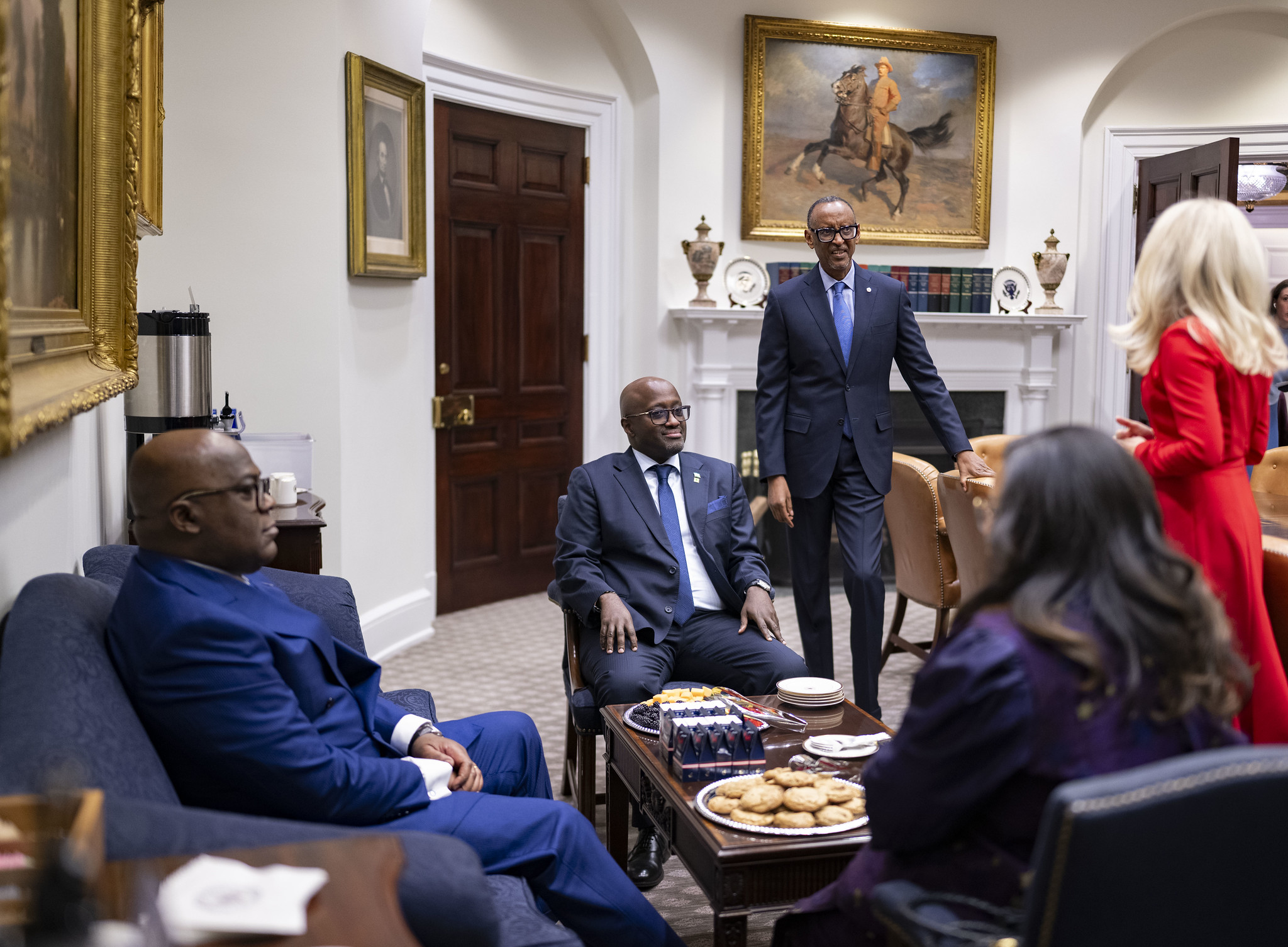
Inside the White House during the joint session, President Paul Kagame (standing) and DRC’s Tshisekedi are hosted by U.S. President Trump during the Washington Accord Meeting | Washington, D.C., December 4 2025
In fact, Tshisekedi appears to be giving the group greater means to continue fighting. This is hardly a secret. It is increasingly visible. Congolese Minister Anzulini has toured Western capitals claiming that he had a “signed deal” with the FDLR, even as the group continues to receive the means to fight alongside the FARDC, the Burundian army, Western mercenaries and Wazalendo forces.
The situation around Minembwe has become another major test of the peace process.
A United Nations Group of Experts report transmitted in May 2026 documented intensified military operations in the Minembwe area. According to reporting on the UN findings, FARDC forces supported by Wazalendo groups, Burundian forces and other armed actors launched major operations from the Uvira direction toward Minembwe. The report also highlighted the deteriorating humanitarian situation affecting civilians, particularly the Banyamulenge community.
Rwanda has gone further, alleging that FARDC, Burundian forces and allied armed groups have contributed to the encirclement and humanitarian isolation of Banyamulenge communities around Minembwe.
Rwanda’s position is clear: it has demonstrated its willingness to implement its commitments and expects the DRC to do the same, particularly on the FDLR and military de-escalation.
The Great Lakes region has seen too many peace agreements fail at the implementation stage. The Washington Accords offer another opportunity, but only if Kinshasa is held to its obligations. A peace agreement cannot work when one side is expected to implement its commitments while the other continues to arm the very forces it has pledged to neutralize.
