


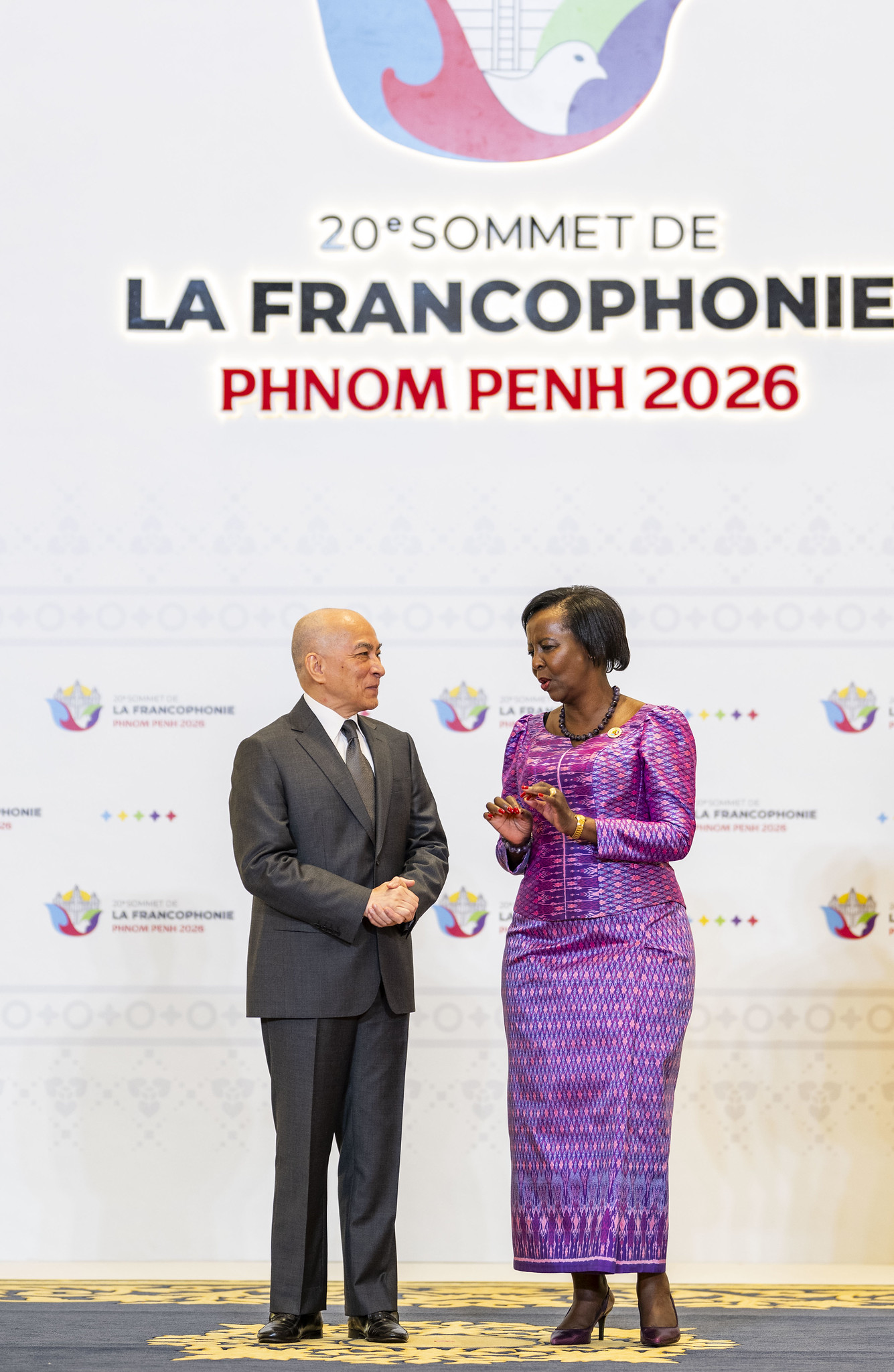
La Francophonie Secretary-General Louise Mushikiwabo (R) speaks to King Norodom Sihamoni of Cambodia at the opening ceremony of the gathering in his country
The Democratic Republic of Congo (DRC)’s representatives are frantically filling social news studio that will have them, claiming “victory” at the recently concluded summit of the Organisation internationale de la Francophonie (OIF). The efforts are no more than a distraction from the actual result of what may come to be seen as a seminal moment in the organisation’s history.
The summit in the Cambodian capital of Phnom Penh, would most likely have returned the incumbent, Rwanda’s candidate, Louise Mushikiwabo, as OIF Secretary-General for a third term, but for tantrums by the Democratic Republic of Congo (DRC), threatening to quit the organisation, if she was re-elected.
So convinced it seems was the DRC that Mushikiwabo would emerge victorious, that to prevent her re-election they spared no effort in derailing the organisation’s processes for electing its head.
From the head of state, Felix Tshisekedi, to Minister of Communications, Patrick Muyaya, and foreign minister, Therese Kayikwamba Wagner, the DRC made clear it would go to any lengths to get what it wanted.
Rather than have one of their number turn an itnernational summit into an an unseemly spectacle, the other OIF members agreed a compromise that may have compromised the organisation’s rules, and the elections for the Secretary-General, were postponed for a year, at which time, the candidate that would almost certainly have won, would not present her candidature.
The DRC was right about one thing. Louise Mushikiwabo was running on an impressive record, and had the rules been followed, where if there is no consensus candidate, the Secretary-General is elected by a simple majority, it would have been difficult for any other candidate to have matched let alone surpass her.
Few would argue that in her two terms, Mushikiwabo made the OIF more effecient. Her administrative reforms streamedlined the organisation’s activities making it more effective. By the time she leaves office, the organisation’s resources will go farther, achieving more, in particular for women’s empowerment and support for young people.
No doubt taking from her many years as a minister in the RPF (Rwanda Patriotic Front) led government of Rwanda, she has reshaped the OIF to be more results orientated. The reforms have meant better qualified, more specialist positions for staff, clearer financial and administrative procedures, in general, a better run organisation.
Mushikiwabo has however, faced criticism that the organisation has not achieved as much on the international stage. But the criticism does not stand close scrutiny. Much of it clearly comes from the DRC, which without evidence, questions Mushikiwabo’s neutrality on matters to do with her native Rwanda.
Such a claim can be attributed to the DRC’s voluble campaign, to lay the blame for the crisis in the country, at Rwanda’s door, and in Congolese politicians’ eyes, neutrality would have meant full throated condemnation of Rwanda, from the OIF.
Critics also point out that it was on Mushikiwabo’s watch that OIF members Togo and Gabon, joined the Commonwealth, as well as Burkina Faso, Mali and Niger quitting the organisation. These criticisms too do not hold water. Burkina Faso, Mali and Niger, left the organisation following coup d’etatas in their respective countries, and the rulers’ ire was directed more at France’s alleged colonial overreach than the OIF. It is a moot point whether Mushikiwabo or any other Secretary-General could have done more or anything at all, to keep them in the organisation.
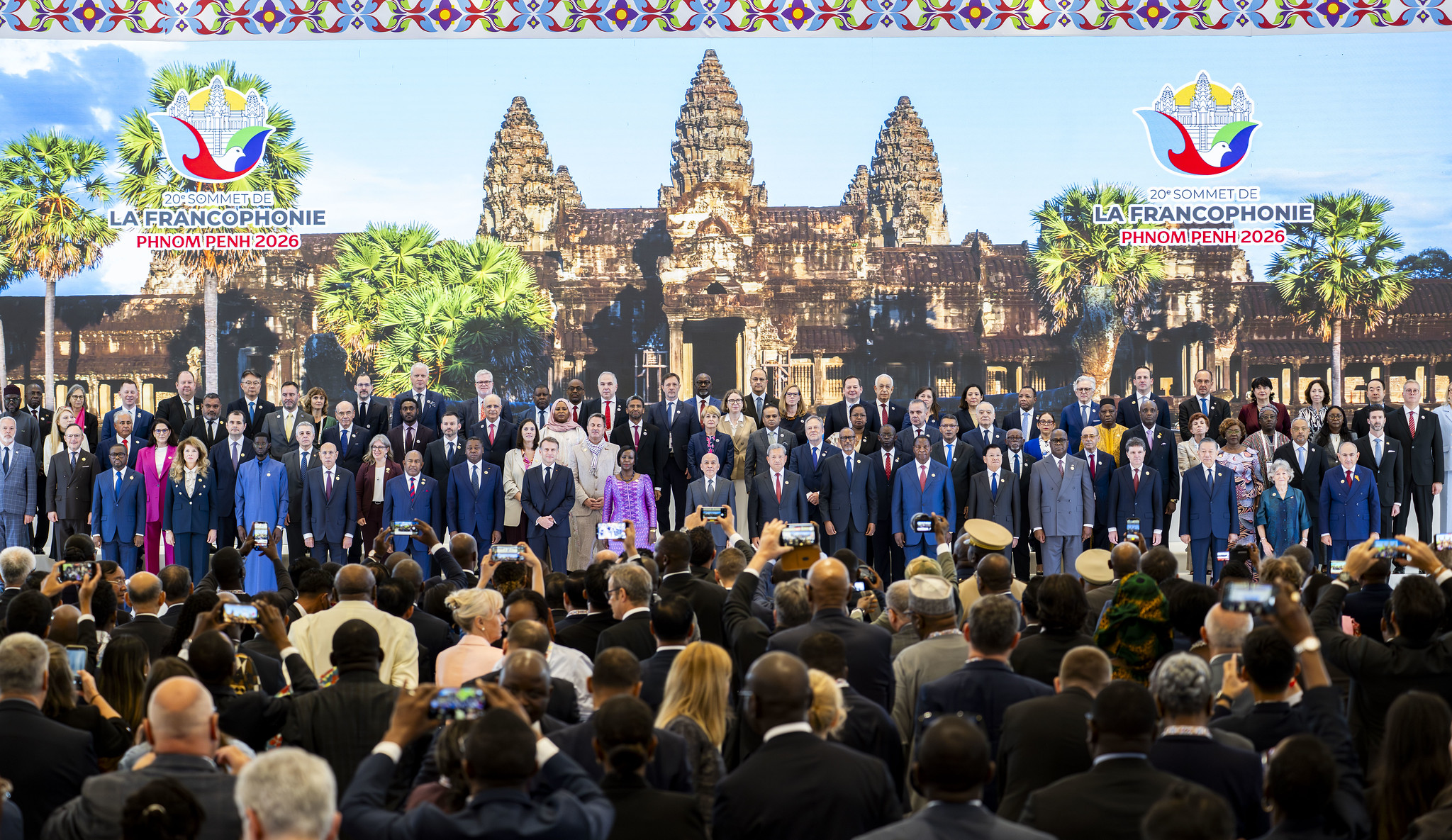
As for Togo and Gabon, their membership of the Commonwealth need not affect their membership of the OIF. An arguably more rational criticism is that during her tenure, the OIF was largely invisible on the international stage.
While this may seem a perfectly reasonable criticism however, it overlooks the fact that the organisation has always had limited influence internationally, and her defence might be that it would have been difficult to have changed a position that has existed for all of fifty years, in two terms. And she may indeed argue that her reforms have strengthned the organisation’s foundations, upon which her successors can build to raise the oranisation’s influence internationally.
In fact, when the history of the OIF or perhaps that of the last summit is written, it will surely be noted that the very nature of the organisation will have been put on a more sustatainable footing, largely due to Rwanda’s contribution.
The delicate question of France’s position as de facto primus inter pares, needed to be addressed, and would in all likelihood have continued to be avoided, but for Rwanda lancing that boil.
When in an interview, Rwanda’s minister for foreign affairs and international cooperation, Oliviere Nduhungirehe commented on how he saw OIF, his remarks should be seen more as a statement of policy, or suggestion of policy, than just a response to a journalist’s question.
The “Francophonie is not about France” he said, “it’s an organisation of more that 90 countries, including 53 with full and equal rights, which share the same language. We should be united in promoting French language, as well as culture and economic cooperation. Most of all, we should not bring back the Francophonie of the old days, where a single country -France – was dictating its views to the rest of the community”
The comments followed a letter that France’s Emmanuel Macron reportedly sent to his Rwandan counterpart, Paul Kagame.
The letter, which has not been publicly released, is said to have directed rather than suggested, that in order to appease the DRC, Rwanda should withdraw its candidate for OIF Secretary-General, and endorse a consensus candidate, whom the DRC announced as Romania’s Dacian Ciolos.
We do know that the letter was sent from the Elise Palace to Urugwiro Village, and we can judge its peremptory tone by the reaction from Kigali. From what we know of Rwanda’s leadership, we can accurately deduce that we might never have heard of the letter, if it had been more appropriately worded, from one head of state to another. Kigali would have appreciated the need to discuss a thorny issue, and would have quietly, confidentially shared its own suggestions.
As it is, it seems that Kigali found it necessary to remind France that Rwanda, was a sovereign nation which should not be dictated to, and France only one country among many, which should not take it upon itself to give unilateral instructions to the other members.
Indeed, it has since emerged that the compromise to postpone the elections, was suggested by Rwanda.
The elephant being circled around in the room in Phnom Phenh, was of course, that like the Commonwealth, OIF, came into being as a colonial organisation, and it has had to adopt to the independence of former colonies.
While some in France might balk at Rwanda reminding them that the sovereignty of all member states must be given due regard, France may in the long run come to appreciate that the insistence strengthens the organisation, as a community of equal nations.
When, as part of her reforms, Mushikiwabo gives promotion of the French language and African languages, equal emphasis, she is in fact ensuring the sustainability of French in Africa. As Nduhungirehe, states, “the lesson we can take from this is that the Francophonie is a multilateral organisation with countries from almost all continents. It does not belong to France, and France cannot impose its views on our organisation.”
And when he further added that “the second lesson was that the organisation’s rules must be respected” that “the electoral rules adopted in Djerba, Tunisia had not been respected, despite having been approved by heads of state,” he was protecting the integrity of the organisation as a whole.
It is a virtual certainty therefore that at the next OIF summit, thanks in large measure to Rwanda’s interventions as to her own leadership, Mushikiwabo will hand over an organisation that will be more strengthened, effective, and more at peace with itself.
Vincent Gasana is a Senior Editorial Lead at Kigali Today Ltd. He spent many years at the BBC. He regularly write for KT Press
