


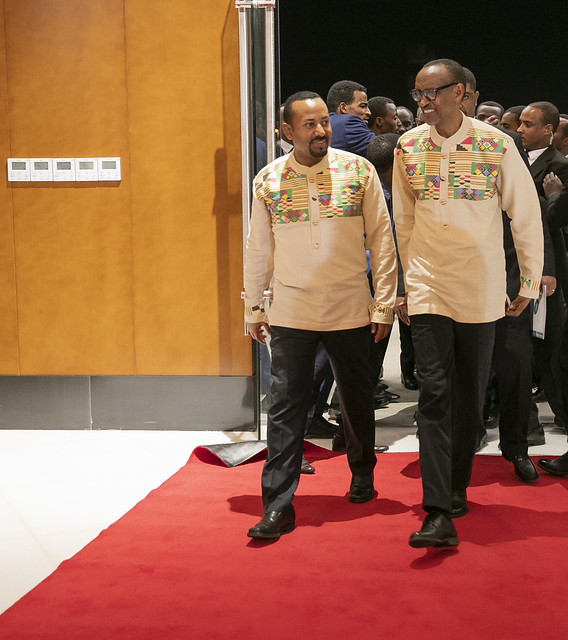
President Kagame attends a Gala Dinner hosted by Prime Minister Abiy Ahmed of Ethiopia in honour of Heads of State and Government attending the 32nd Ordinary Session of the Assembly of the African Union | Addis Ababa, 9 February 2019
Kigali — Rwanda’s export landscape is showing signs of subtle but strategic diversification, with Sudan and Ethiopia emerging as the newest destinations for re-exported goods.
According to the formal trade report for June 2025, these two countries, long absent from Rwanda’s top export markets, have now broken into the top 10 list — signaling fresh trade corridors opening across the region.
For years, Rwanda’s re-export economy has heavily relied on the Democratic Republic of Congo (DRC), which in June alone absorbed $46.4 million — a staggering 93.9% — of all re-exported goods.
However, Sudan which is currently going through a deadly internal armed conflict, and Ethiopia, though contributing modest volumes, stand out due to their sharp increases and strategic positioning.
Their entry into Rwanda’s export orbit reflects growing regional economic interconnectivity and a potential shift in trade dependencies.
What’s Being Re-exported?
The goods Rwanda re-exports are typically high-value, imported items that are resold to neighboring countries.
In June 2025, these included machinery and mechanical appliances, mineral fuels, vehicles and spare parts, pharmaceuticals, electrical equipment, and beverages.
These products are often not manufactured in Rwanda but are instead imported through Kigali or Rubavu and redirected to regional markets.
The DRC remains the primary destination, but the presence of Sudan and Ethiopia on the list of importers indicates that demand for such goods is gradually spreading beyond Rwanda’s traditional trade corridors.
A New Path to Sudan
Sudan, which barely featured in Rwanda’s re-export stats a year ago, received $0.22 million in June — marking a 5,962% increase from June 2024.
Although this still amounts to only 0.4% of total re-exports, it signals a dramatic change, likely tied to the humanitarian, economic, or logistical shifts in the Horn of Africa.
Analysts believe the surge may be due to new logistics arrangements, shifts in regional demand, or even Rwanda’s growing reputation as a reliable trade facilitator under the African Continental Free Trade Area (AfCFTA).
Ethiopia Gathers Momentum
Ethiopia also made a mark, importing $0.65 million worth of re-exported goods in June — around 1.3% of Rwanda’s total re-exports for the month.
This figure reflects a 45.3% increase from May 2025, indicating consistent growth rather than a one-off spike.
Ethiopia has occasionally featured in Rwanda’s external trade records before, but never with this level of regularity.
This recent performance points to improving commercial ties and possibly a shift in regional supply chains, favoring more East African cooperation.
Nearly Half of Export Earnings
In total, Rwanda exported $111.78 million worth of goods in June 2025. Of that, $49.42 million came from re-exports — accounting for approximately 44.2% of total export value.
This underscores the importance of the re-export sector to Rwanda’s broader trade strategy, especially as it positions itself as a regional trade and logistics hub.
The rise of Sudan and Ethiopia comes at a time when Rwanda seeks to reduce overdependence on the DRC, a country with which it shares an uneasy political relationship.
While trade with the DRC remains dominant, its volatility — due to cross-border tensions and rebel activity — poses risks.
Diversifying partners not only improves trade resilience but also reflects Rwanda’s diplomatic outreach, industrial expansion efforts like the Bugesera Special Economic Zone, and logistical investments such as air cargo networks.
Not Just Market Forces—Also Political Repositioning
Some observers believe the shift in Rwanda’s trade profile also reflects broader political calculations. Countries like Ethiopia and Sudan are increasingly important players in the African Union and regional blocs.
Engaging them through trade could deepen diplomatic ties, provide new bargaining power, and stabilize Rwanda’s position as a bridge between East and Central Africa.
