




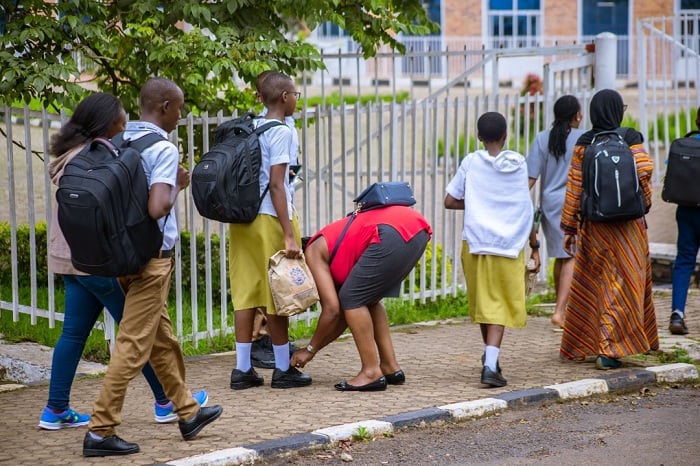
It has been a busy weekend, and continues this Monday morning as parents ensure their children are in school for start of the school year
Kigali — The 2025/26 academic year begins today with significant reforms in Rwanda’s education sector.
Government announced the sweeping changes in July across primary and secondary schools, including a new official starting time of 8:00 AM, adjustments in teaching hours, and the merging of subject combinations to address overcrowding and improve learning outcomes.
Primary Schools: Double Shifts for Lower Grades
Under the new policy, all pupils in the first cycle of primary education (P1–P3) will follow a double-shift system, unlike before when only some schools used it.
- Morning session: 8:00 AM – 11:40 AM
- Afternoon session: 1:10 PM – 4:50 PM
The change is intended to ensure that all students complete the curriculum within available hours. Previously, children in single-shift schools could cover all subjects, while those in double shifts struggled due to shorter study time.
The curriculum was redesigned so that in the four hours available per day, pupils focus on essential basics. Other subjects will be spread into upper grades where students study the full day.
This adjustment also seeks to reduce overcrowding, improve classroom management, and align learning hours with international best practices.
Secondary Schools: Longer Hours and Two-Shift System
In secondary schools where double shifts are necessary, the same schedule will apply: 8:00 AM to 11:40 AM for the first session, and 1:10 PM to 4:50 PM for the second.
With the double-shift system, students could only get a maximum of 25 hours per week. Now, they will reach about 3.5 hours per day, ensuring sufficient learning periods.
Merging of Subject Combinations
Another major change is the restructuring of subject streams to reduce fragmentation and ensure balanced education:
- Sciences I: MCB, PCB, PCM merged.
- Sciences II: MEG, MCE, MPC, MPG merged.
- Arts & Humanities: HGL and HLP merged.
- Languages: All students will now study Kinyarwanda, English, French, and Kiswahili instead of choosing one or two.
This is expected to broaden students’ knowledge base and prepare them better for national exams and future careers.
School heads welcomed the changes. When students skipped Mathematics, they missed critical thinking skills. Also, by combining languages, it is expected will ensure graduates are fluent in English, French, and Kinyarwanda. This will also ease performance in national examinations.
Curriculum Review Cycle
The Education Ministry confirmed that, as in international practice, the curriculum will be reviewed every 5 to 8 years to assess relevance nationally and globally, with adjustments introduced as needed.
Why the Reforms Matter
REB says the changes were based on research and teachers’ feedback, who had long complained about heavy curricula and high-level English requirements that students struggled to meet. The reforms are designed to:
- Improve quality of learning outcomes.
- Ensure equal access to teaching hours across schools.
- Reduce overcrowding and inefficiencies caused by single vs. double shifts.
- Provide broader, balanced subject choices for all students.
With the 2025/26 school year now underway, these reforms mark one of the most significant shifts in Rwanda’s education system in recent years, aiming to boost both quality and equity in learning.
Previously, class was starting at 8:30am or even 9am. The time was set to remove situation where kids were woken up very early.
